第30章政府予算と財政政策
30.2 Taxation30.2 課税
Learning Objectives学習目標
Learning Objectives学習目標
By the end of this section, you will be able to:
英語のヒント
この節を学ぶと、次のことができるようになる。
- Differentiate among a regressive tax, a proportional tax, and a progressive tax
英語のヒント
逆進税、比例税、累進税を区別する - Identify major revenue sources for the U.S. federal budget
英語のヒント
アメリカ連邦予算の主要な財源を明らかにする
There are two main categories of taxes: those that the federal government collects and those that the state and local governments collect. What percentage the government collects and for what it uses that revenue varies greatly. The following sections will briefly explain the taxation system in the United States.
英語のヒント
税には、大きく二つの分類がある。連邦政府が徴収する税と、州・地方政府が徴収する税である。政府がどの程度の割合を徴収し、その歳入を何に使うかは大きく異なる。以下では、アメリカの税制を簡単に説明する。
Taxes are paid by most, but not all, people who work. Even if you are part of the so-called “1099” or “gig” economy, you are considered an independent contractor and must pay taxes on the income you earn in those occupations. Taxes are also paid by consumers whenever they purchase goods and services. Taxes are used for all sorts of spending—from roads, to bridges, to schools (K–12 and public higher education), to police and other public safety functions. Taxes fund vital public services that support our communities.
英語のヒント
働く人の大半は税を払うが、すべての人ではない。いわゆる「1099」経済や「ギグ」経済で働いていても、独立請負人とみなされ、その職業で得る所得に対して納税しなければならない。消費者も、財・サービスを購入するたびに税を払う。税は、道路、橋、学校、つまり幼稚園から第12学年までと公立高等教育、警察、そのほかの公共の安全を守る機能まで、あらゆる支出に使われる。税は、地域社会を支える不可欠な公共サービスの財源となる。
Federal Taxes連邦税
Just as many Americans erroneously think that federal spending has grown considerably, many also believe that taxes have increased substantially. The top line of Figure 30.5 shows total federal taxes as a share of GDP since 1960. Although the line rises and falls, it typically remains within the range of 17% to 20% of GDP, except for 2009–2011, when taxes fell substantially below this level, due to the Great Recession.
英語のヒント
多くのアメリカ人が連邦支出は大幅に増えたと誤って考えるのと同様に、税も大幅に増えたと信じる人が多い。図30.5の最上段の線は、1960年以降の連邦税総額をGDP比で示す。線は上下するが、通常はGDPの17~20%の範囲内にある。例外は、大不況によって税収がこの水準を大きく下回った2009~2011年である。
Federal Taxes, 1960–2020連邦税、1960~2020年
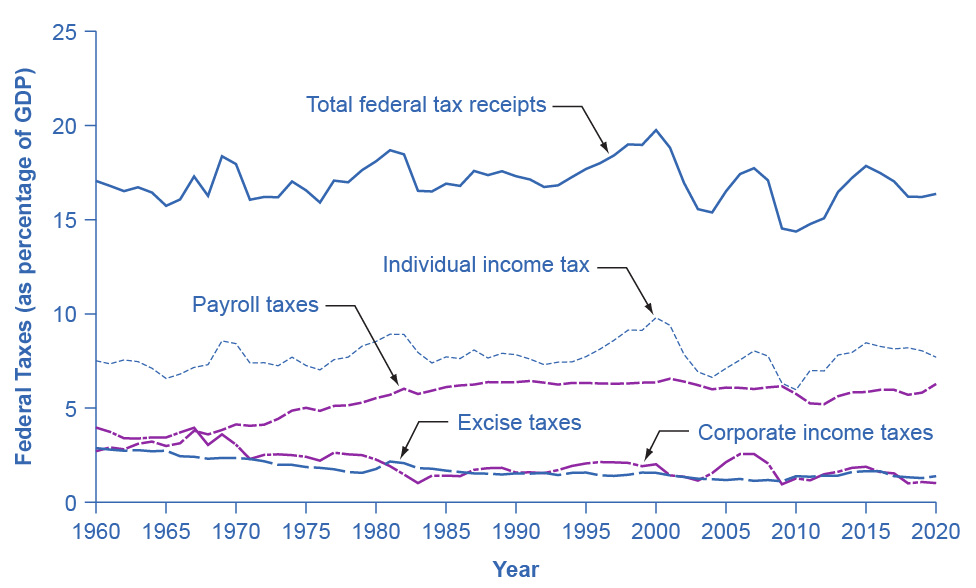

Figure 30.5図 30.5
Federal tax revenues have been about 17–20% of GDP during most periods in recent decades. The primary sources of federal taxes are individual income taxes and the payroll taxes that finance Social Security and Medicare. Corporate income taxes and social insurance taxes provide smaller shares of revenue. (Source: Economic Report of the President, 2021. Table B-47, https://www.govinfo.gov/app/collection/erp/2021)
英語のヒント
近年の数十年間のほとんどの期間、連邦税収はGDPの約17~20%だった。連邦税の主な財源は、個人所得税と、社会保障およびメディケアを賄う給与税である。法人所得税と社会保険税が占める歳入の割合は、より小さい。(出典:『大統領経済報告』2021年、表B-47、https://www.govinfo.gov/app/collection/erp/2021)
Figure 30.5 also shows the taxation patterns for the main categories that the federal government taxes: individual income taxes, corporate income taxes, and social insurance and retirement receipts. When most people think of federal government taxes, the first tax that comes to mind is the individual income tax that is due every year on April 15 (or the first business day after). The personal income tax is the largest single source of federal government revenue, but it still represents less than half of federal tax revenue.
英語のヒント
図30.5はまた、連邦政府が課税する主な分類、すなわち個人所得税、法人所得税、社会保険・退職関連の収入について、課税の傾向を示す。多くの人が連邦政府の税を考えるとき、最初に思い浮かべるのは、毎年4月15日、またはその後最初の営業日が納期限となる個人所得税である。個人所得税は、連邦政府の歳入の中で単独では最大の財源だが、それでも連邦税収の半分未満にとどまる。
The second largest source of federal revenue is the payroll tax (captured in social insurance and retirement receipts), which provides funds for Social Security and Medicare. Payroll taxes have increased steadily over time. Together, the personal income tax and the payroll tax accounted for over 85% of federal tax revenues in 2020. Although personal income tax revenues account for more total revenue than the payroll tax, nearly three-quarters of households pay more in payroll taxes than in income taxes.
英語のヒント
連邦歳入の第二の財源は、社会保険・退職関連の収入に計上される給与税であり、社会保障とメディケアの資金を供給する。給与税は、時間とともに着実に増えてきた。2020年には、個人所得税と給与税を合わせて、連邦税収の85%超を占めた。個人所得税収の総額は給与税収より多いものの、家計のほぼ4分の3は、所得税よりも給与税を多く払っている。
The income tax is a progressive tax, which means that the tax rates increase as a household’s income increases. Taxes also vary with marital status, family size, and other factors. The marginal tax rates (the tax due on all yearly income) for a single taxpayer range from 10% to 35%, depending on income, as the following Clear It Up feature explains.
英語のヒント
所得税は累進税であり、家計の所得が増えるにつれて税率が上がる。税は、婚姻状況、家族の人数、そのほかの要因によっても異なる。独身の納税者の限界税率、つまり年間所得全体に対して支払う税は、所得に応じて10~35%となる。次の「疑問を解く」で説明する。
The key fact here is that the federal income tax is designed so that tax rates increase as income increases, up to a certain level. The payroll taxes that support Social Security and Medicare are designed in a different way. First, the payroll taxes for Social Security are imposed at a rate of 12.4% up to a certain wage limit, set at $137,700 in 2020. Medicare, on the other hand, pays for elderly healthcare, and is fixed at 2.9%, with no upper ceiling.
英語のヒント
ここで重要なのは、連邦所得税は、ある水準までは所得が増えるにつれて税率が上がるよう設計されているという事実である。社会保障とメディケアを支える給与税は、異なる形で設計されている。まず、社会保障の給与税は、一定の賃金上限まで12.4%の税率で課される。その上限は2020年には137,700ドルだった。一方、メディケアは高齢者の医療を賄い、上限なしで2.9%に固定されている。
In both cases, the employer and the employee split the payroll taxes. An employee only sees 6.2% deducted from their paycheck for Social Security, and 1.45% from Medicare. However, as economists are quick to point out, the employer’s half of the taxes are probably passed along to the employees in the form of lower wages, so in reality, the worker pays all of the payroll taxes. If you are a member of the “gig economy” and receive a 1099 tax statement, then you are considered an independent contractor and so you must pay the employee and employer side of the payroll tax.
英語のヒント
どちらの場合も、雇用主と従業員が給与税を折半する。従業員の給与明細に現れる控除は、社会保障について6.2%、メディケアについて1.45%だけである。しかし、経済学者がすぐに指摘するように、雇用主が負担する半分も、おそらく低い賃金という形で従業員へ転嫁される。そのため、実際には労働者が給与税のすべてを払っている。「ギグ経済」で働き、1099税務書類を受け取るなら、独立請負人とみなされるため、給与税の従業員分も雇用主分も支払わなければならない。
We also call the Medicare payroll tax a proportional tax; that is, a flat percentage of all wages earned. The Social Security payroll tax is proportional up to the wage limit, but above that level it becomes a regressive tax, meaning that people with higher incomes pay a smaller share of their income in tax.
英語のヒント
メディケアの給与税は、比例税とも呼ばれる。つまり、稼いだ賃金全体に対して一定の割合を課す税である。社会保障の給与税は賃金上限までは比例的だが、それを超えると逆進税になる。これは、高所得の人ほど、所得に対して税として払う割合が小さくなることを意味する。
The third-largest source of federal tax revenue, as Figure 30.5 shows is the corporate income tax. The common name for corporate income is “profits.” Over time, corporate income tax receipts have declined as a share of GDP, from about 4% in the 1960s to an average of 1% to 2% of GDP in the past 40 years.
英語のヒント
図30.5のように、連邦税収の第三の財源は法人所得税である。法人所得は、一般に「利益」と呼ばれる。法人所得税収のGDP比は、時間とともに低下し、1960年代の約4%から、過去40年間には平均1~2%となった。
The federal government has a few other, smaller sources of revenue. It imposes an excise tax—that is, a tax on a particular good—on gasoline, tobacco, and alcohol. As a share of GDP, the amount the government collects from these taxes has stayed nearly constant over time, from about 2% of GDP in the 1960s to roughly 3% by 2020, according to the nonpartisan Congressional Budget Office. The government also imposes an estate and gift tax on people who pass large amounts of assets to the next generation—either after death or during life in the form of gifts. These estate and gift taxes collected about 0.2% of GDP in 2020. By a quirk of legislation, the government repealed the estate and gift tax in 2010, but reinstated it in 2011. Other federal taxes, which are also relatively small in magnitude, include tariffs the government collects on imported goods and charges for inspections of goods entering the country.
英語のヒント
連邦政府には、ほかにもいくつか小さな財源がある。ガソリン、たばこ、アルコールに、特定の財に課す税である個別消費税を課している。超党派の議会予算局によると、これらの税による政府の徴収額のGDP比は、1960年代の約2%から2020年までの約3%へと、時間を通じてほぼ一定に保たれてきた。政府はまた、死後に、または生前の贈与として、多額の資産を次世代へ移す人々に、遺産税・贈与税を課している。2020年に徴収された遺産税・贈与税はGDPの約0.2%だった。立法上の特殊な経緯から、政府は2010年に遺産税・贈与税を廃止したが、2011年に復活させた。ほかの連邦税も規模は比較的小さく、輸入品に課す関税や、入国する物品の検査手数料などが含まれる。