第30章政府予算と財政政策
Expansionary Fiscal Policy拡張的財政政策
Expansionary fiscal policy increases the level of aggregate demand, through either increases in government spending or reductions in tax rates. Expansionary policy can do this by (1) increasing consumption by raising disposable income through cuts in personal income taxes or payroll taxes; (2) increasing investment spending by raising after-tax profits through cuts in business taxes; and (3) increasing government purchases through increased federal government spending on final goods and services and raising federal grants to state and local governments to increase their expenditures on final goods and services. Contractionary fiscal policy does the reverse: it decreases the level of aggregate demand by decreasing consumption, decreasing investment, and decreasing government spending, either through cuts in government spending or increases in taxes. The aggregate demand/aggregate supply model is useful in judging whether expansionary or contractionary fiscal policy is appropriate.
英語のヒント
拡張的財政政策は、政府支出の増加または税率の引下げによって、総需要の水準を高める。拡張的政策は、次の方法でこれを実現できる。(1)個人所得税や給与税を下げ、可処分所得を増やして消費を増やす。(2)企業への税を下げ、税引後利益を増やして投資支出を増やす。(3)最終財・サービスへの連邦政府支出を増やし、州・地方政府への連邦補助金を増やして、それらの最終財・サービスへの支出を増やすことで、政府購入を増やす。引締め的財政政策は、その逆を行う。政府支出の削減や増税によって、消費、投資、政府支出を減らし、総需要の水準を下げる。総需要・総供給モデルは、拡張的財政政策と引締め的財政政策のどちらが適切かを判断するのに役立つ。
Consider first the situation in Figure 30.11, which is similar to the U.S. economy during the 2007-2009 recession. The intersection of aggregate demand (AD0) and aggregate supply (SRAS0) is occurring below the level of potential GDP as the LRAS curve indicates. At the equilibrium (E0), a recession occurs and unemployment rises. In this case, expansionary fiscal policy using tax cuts or increases in government spending can shift aggregate demand to AD1, closer to the full-employment level of output. In addition, the price level would rise back to the level P1 associated with potential GDP.
英語のヒント
まず、2007~2009年の景気後退期のアメリカ経済に似た、図30.11の状況を考えよう。総需要(AD0)と総供給(SRAS0)の交点は、LRAS曲線が示す潜在GDP水準より下にある。均衡(E0)では、景気後退が起こり、失業が増える。この場合、減税や政府支出増を使う拡張的財政政策によって、総需要をAD1へ移動させ、完全雇用の生産水準に近づけられる。さらに、物価水準も、潜在GDPに対応するP1へ戻るよう上がるだろう。
Expansionary Fiscal Policy拡張的財政政策
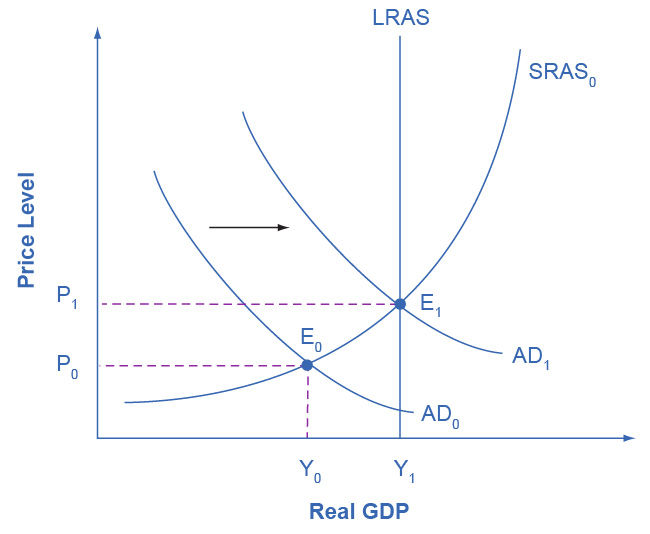

Figure 30.11図 30.11
The original equilibrium (E0) represents a recession, occurring at a quantity of output (Y0) below potential GDP. However, a shift of aggregate demand from AD0 to AD1, enacted through an expansionary fiscal policy, can move the economy to a new equilibrium output of E1 at the level of potential GDP which the LRAS curve shows. Since the economy was originally producing below potential GDP, any inflationary increase in the price level from P0 to P1 that results should be relatively small.
英語のヒント
もとの均衡(E0)は景気後退を表し、生産量(Y0)は潜在GDPを下回る。しかし、拡張的財政政策によって総需要をAD0からAD1へ移動させれば、経済を新しい均衡生産量E1へ移せる。この点は、LRAS曲線が示す潜在GDP水準にある。当初の経済は潜在GDPより下で生産していたので、その結果として物価水準がP0からP1へインフレ的に上がっても、上昇は比較的小さいはずである。
Should the government use tax cuts or spending increases, or a mix of the two, to carry out expansionary fiscal policy? During the 2007-2009 Great Recession, the U.S. economy suffered a 3.1% cumulative loss of GDP. That may not sound like much, but it’s more than one year’s average growth rate of GDP. Over that time frame, the unemployment rate doubled from 5% to 10%. The choice between whether to use tax or spending tools often has a political tinge. As a general statement, conservatives and Republicans prefer to see expansionary fiscal policy carried out by tax cuts, while liberals and Democrats prefer that the government implement expansionary fiscal policy through spending increases. In a bipartisan effort to address the extreme situation, the Obama administration and Congress passed an $830 billion expansionary policy in early 2009 involving both tax cuts and increases in government spending. At the same time, however, the federal stimulus was partially offset when state and local governments, whose budgets were hard hit by the recession, began cutting their spending.
英語のヒント
政府は拡張的財政政策を行うために、減税と支出増のどちらを使うべきだろうか。それとも両方を組み合わせるべきだろうか。2007~2009年の大不況で、アメリカ経済は累積でGDPの3.1%を失った。大きく聞こえないかもしれないが、1年分の平均GDP成長率を超える。この期間に、失業率は5%から10%へ倍増した。税と支出のどちらの手段を使うかという選択には、政治的な色合いがあることが多い。一般に、保守派や共和党は減税による拡張的財政政策を好み、リベラル派や民主党は政府支出増による実施を好む。この極端な状況への超党派の対応として、オバマ政権と議会は2009年初頭、減税と政府支出増の両方を含む8,300億ドルの拡張的政策を成立させた。しかし同時に、景気後退で予算を大きく傷つけられた州・地方政府が支出削減を始め、連邦の刺激策は一部相殺された。
Events were even more severe during the more recent pandemic-induced recession. In a single quarter (Quarter 2 of 2020), GDP fell by over 9%, or at an annualized rate of about 34%. Policymakers were quick to respond with expanded unemployment insurance, aid to state and local governments (so that they didn’t have to cut their spending like they did during the Great Recession), grants and tax breaks for small businesses, and perhaps most significantly, stimulus checks sent to over 100 million households, totaling thousands of dollars each. Since these were mostly spending measures, they were supported more by Democrats than by Republicans, although both groups recognized the severity of the problem and were largely in agreement early on. Especially during the debates over later rounds of the stimulus checks, many discussions were had over the appropriate size and target of the checks. Ultimately, compromises were made and no side got exactly what it wanted.
英語のヒント
より最近のパンデミックによる景気後退では、事態はさらに深刻だった。わずか1四半期、2020年第2四半期に、GDPは9%超、年率換算では約34%も減った。政策担当者は素早く対応し、失業保険の拡充、大不況のときのように支出を削らずに済むようにする州・地方政府への援助、小企業への助成金や税制優遇を実施した。そして、おそらく最も大きかったのは、1億を超える世帯へ、それぞれ合計数千ドルの景気刺激給付を送ったことである。これらは主に支出措置だったため、共和党より民主党の支持が強かった。ただし両者とも問題の深刻さを認識し、初期にはおおむね合意していた。とくに後の給付の回をめぐる議論では、適切な規模と対象について多くの討議が行われた。最終的には妥協が成立し、どちらの側も、望んだものをそのまま得たわけではなかった。
The conflict over which policy tool to use can be frustrating to those who want to categorize economics as “liberal” or “conservative,” or who want to use economic models to argue against their political opponents. However, advocates of smaller government, who seek to reduce taxes and government spending can use the AD AS model, as well as advocates of bigger government, who seek to raise taxes and government spending. Economic studies of specific taxing and spending programs can help inform decisions about whether the government should change taxes or spending, and in what ways. Ultimately, decisions about whether to use tax or spending mechanisms to implement macroeconomic policy is a political decision rather than a purely economic one.
英語のヒント
どの政策手段を使うかをめぐる対立は、経済学を「リベラル」か「保守」かに分類したい人や、経済モデルを使って政治的な相手を論破したい人には、もどかしいかもしれない。しかし、税と政府支出の削減を目指す小さな政府の支持者も、税と政府支出の増加を目指す大きな政府の支持者も、AD–ASモデルを使える。特定の課税制度や支出事業の経済学的研究は、政府が税や支出を変えるべきか、どのように変えるべきかを判断する材料となる。結局、マクロ経済政策を実施するために税と支出のどちらの仕組みを使うかは、純粋に経済的な決定というより、政治的な決定なのである。