第30章政府予算と財政政策
Contractionary Fiscal Policy引締め的財政政策
Fiscal policy can also contribute to pushing aggregate demand beyond potential GDP in a way that leads to inflation. As Figure 30.12 shows, a very large budget deficit pushes up aggregate demand, so that the intersection of aggregate demand (AD0) and aggregate supply (SRAS0) occurs at equilibrium E0, which is an output level above potential GDP. Economists sometimes call this an “overheating economy” where demand is so high that there is upward pressure on wages and prices, causing inflation. In this situation, contractionary fiscal policy involving federal spending cuts or tax increases can help to reduce the upward pressure on the price level by shifting aggregate demand to the left, to AD1, and causing the new equilibrium E1 to be at potential GDP, where aggregate demand intersects the LRAS curve.
英語のヒント
財政政策は、総需要を潜在GDPより先へ押し上げ、インフレにつなげる要因にもなりうる。図30.12のように、非常に大きな財政赤字は総需要を押し上げ、総需要(AD0)と総供給(SRAS0)の交点を、潜在GDPを上回る生産水準の均衡E0にする。経済学者はこれを、ときに「過熱した経済」と呼ぶ。需要が非常に高く、賃金と物価に上昇圧力がかかり、インフレが起きる状態である。この状況では、連邦支出の削減や増税を伴う引締め的財政政策が、総需要をAD1へ左に移動させ、総需要がLRAS曲線と交わる潜在GDPの位置に、新しい均衡E1を生じさせる。それによって、物価水準への上昇圧力を弱められる。
A Contractionary Fiscal Policy引締め的財政政策
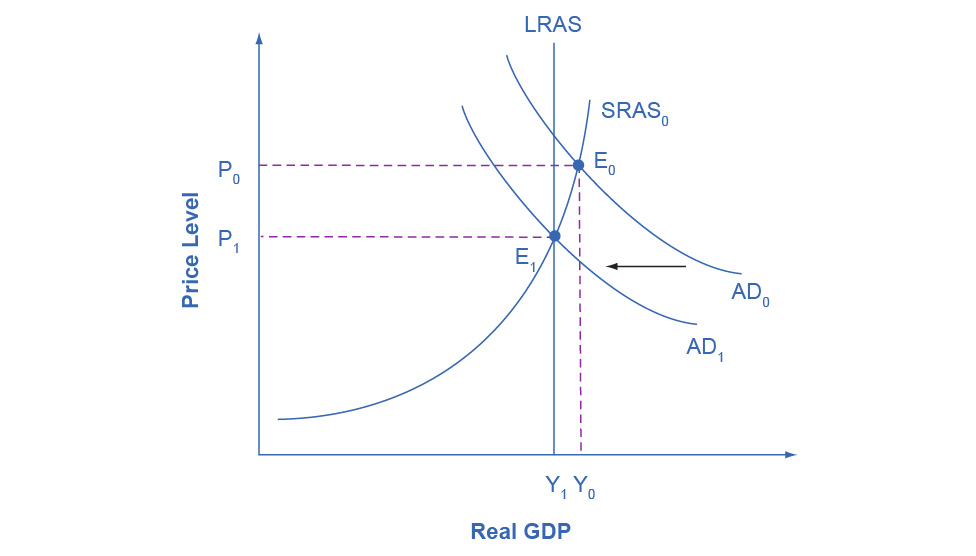

Figure 30.12図 30.12
The economy starts at the equilibrium quantity of output Y0, which is above potential GDP. The extremely high level of aggregate demand will generate inflationary increases in the price level. A contractionary fiscal policy can shift aggregate demand down from AD0 to AD1, leading to a new equilibrium output E1, which occurs at potential GDP, where AD1 intersects the LRAS curve.
英語のヒント
経済は、潜在GDPを上回る均衡生産量Y0から始まる。極端に高い総需要水準は、物価水準のインフレ的上昇を生む。引締め的財政政策は、総需要をAD0からAD1へ下げ、新しい均衡生産量E1をもたらせる。この点は、AD1がLRAS曲線と交わる潜在GDPの位置にある。
Again, the AD–AS model does not dictate how the government should carry out this contractionary fiscal policy. Some may prefer spending cuts; others may prefer tax increases; still others may say that it depends on the specific situation. The model only argues that, in this situation, the government needs to reduce aggregate demand.
英語のヒント
ここでも、AD–ASモデルは、政府がこの引締め的財政政策をどう実施すべきかを命じるものではない。支出削減を好む人も、増税を好む人も、具体的な状況によるという人もいるだろう。モデルが述べるのは、この状況では政府が総需要を減らす必要がある、ということだけである。
Key Concepts and Summary重要概念とまとめ
Expansionary fiscal policy increases the level of aggregate demand, either through increases in government spending or through reductions in taxes. Expansionary fiscal policy is most appropriate when an economy is in recession and producing below its potential GDP. Contractionary fiscal policy decreases the level of aggregate demand, either through cuts in government spending or increases in taxes. Contractionary fiscal policy is most appropriate when an economy is producing above its potential GDP.
英語のヒント
拡張的財政政策は、政府支出増または減税によって、総需要の水準を高める。経済が景気後退にあり、潜在GDPを下回って生産しているとき、拡張的財政政策は最も適している。引締め的財政政策は、政府支出削減または増税によって、総需要の水準を下げる。経済が潜在GDPを上回って生産しているとき、引締め的財政政策は最も適している。
Self-Check Questions理解度確認問題
Exercises 29–30練習問題 29–30
Exercise 29問題 29
What is the main reason for employing contractionary fiscal policy in a time of strong economic growth?
英語のヒント
強い経済成長の時期に、引締め的財政政策を使う主な理由は何か。
Solution解き方
To keep prices from rising too much or too rapidly.
英語のヒント
物価が上がりすぎることや、速すぎるペースで上がることを防ぐため。
Exercise 30問題 30
What is the main reason for employing expansionary fiscal policy during a recession?
英語のヒント
景気後退期に、拡張的財政政策を使う主な理由は何か。
Solution解き方
To increase employment.
英語のヒント
雇用を増やすため。
Review Questions復習問題
Exercises 31–32練習問題 31–32
Exercise 31問題 31
What is the difference between expansionary fiscal policy and contractionary fiscal policy?
英語のヒント
拡張的財政政策と引締め的財政政策の違いは何か。
Exercise 32問題 32
Under what general macroeconomic circumstances might a government use expansionary fiscal policy? When might it use contractionary fiscal policy?
英語のヒント
一般に、どのようなマクロ経済状況で、政府は拡張的財政政策を使うだろうか。どのようなときに、引締め的財政政策を使うだろうか。
Critical Thinking Questions考察問題
Exercises 33–34練習問題 33–34
Exercise 33問題 33
How will cuts in state budget spending affect federal expansionary policy?
英語のヒント
州予算の支出削減は、連邦の拡張的政策にどう影響するか。
Exercise 34問題 34
Is expansionary fiscal policy more attractive to politicians who believe in larger government or to politicians who believe in smaller government? Explain your answer.
英語のヒント
拡張的財政政策は、大きな政府を支持する政治家と、小さな政府を支持する政治家のどちらに、より魅力的か。理由を説明せよ。
Problems問題
Exercises 35練習問題 35
Exercise 35問題 35
Specify whether expansionary or contractionary fiscal policy would seem to be most appropriate in response to each of the situations below and sketch a diagram using aggregate demand and aggregate supply curves to illustrate your answer:
英語のヒント
以下の各状況に対して、拡張的財政政策と引締め的財政政策のどちらが最も適切と思われるかを示し、総需要曲線と総供給曲線を使った図を描いて、答えを説明せよ。
- A recession.
英語のヒント
景気後退。 - A stock market collapse that hurts consumer and business confidence.
英語のヒント
消費者と企業の信頼感を損なう株式市場の崩壊。 - Extremely rapid growth of exports.
英語のヒント
輸出の極端に急速な増加。 - Rising inflation.
英語のヒント
インフレの上昇。 - A rise in the natural rate of unemployment.
英語のヒント
自然失業率の上昇。 - A rise in oil prices.
英語のヒント
石油価格の上昇。
References参考文献
Alesina, Alberto, and Francesco Giavazzi. Fiscal Policy after the Financial Crisis (National Bureau of Economic Research Conference Report). Chicago: University Of Chicago Press, 2013.
英語のヒント
アレシナ、アルベルト、フランチェスコ・ジャヴァッツィ。『金融危機後の財政政策』(全米経済研究所会議報告)。シカゴ:シカゴ大学出版局、2013年。
Martin, Fernando M. “Fiscal Policy in the Great Recession and Lessons from the Past.” Federal Reserve Bank of St. Louis: Economic Synopses. no. 1 (2012). http://research.stlouisfed.org/publications/es/12/ES_2012-01-06.pdf.
英語のヒント
マーティン、フェルナンド・M。「大不況の財政政策と過去の教訓」。セントルイス連邦準備銀行:Economic Synopses、第1号(2012年)。http://research.stlouisfed.org/publications/es/12/ES_2012-01-06.pdf。
Bivens, Josh, Andrew Fieldhouse, and Heidi Shierholz. “From Free-fall to Stagnation: Five Years After the Start of the Great Recession, Extraordinary Policy Measures Are Still Needed, But Are Not Forthcoming.” Economic Policy Institute. Last modified February 14, 2013. http://www.epi.org/publication/bp355-five-years-after-start-of-great-recession/.
英語のヒント
ビヴンズ、ジョシュ、アンドリュー・フィールドハウス、ハイディ・シアーホルツ。「急落から停滞へ:大不況開始から5年、特別な政策措置はなお必要だが、実施の見込みはない」。Economic Policy Institute。最終更新2013年2月14日。http://www.epi.org/publication/bp355-five-years-after-start-of-great-recession/。
Lucking, Brian, and Dan Wilson. Federal Reserve Bank of San Francisco, “FRBSF Economic Letter—U.S. Fiscal Policy: Headwind or Tailwind?” Last modified July 2, 2012. http://www.frbsf.org/economic-research/publications/economic-letter/2012/july/us-fiscal-policy/.
英語のヒント
ラッキング、ブライアン、ダン・ウィルソン。サンフランシスコ連邦準備銀行。「FRBSF Economic Letter――アメリカの財政政策:向かい風か、追い風か」。最終更新2012年7月2日。http://www.frbsf.org/economic-research/publications/economic-letter/2012/july/us-fiscal-policy/。
Greenstone, Michael, and Adam Looney. Brookings. “The Role of Fiscal Stimulus in the Ongoing Recovery.” Last modified July 6, 2012. http://www.brookings.edu/blogs/jobs/posts/2012/07/06-jobs-greenstone-looney.
英語のヒント
グリーンストーン、マイケル、アダム・ルーニー。Brookings。「進行中の回復における財政刺激の役割」。最終更新2012年7月6日。http://www.brookings.edu/blogs/jobs/posts/2012/07/06-jobs-greenstone-looney。
contractionary fiscal policy
引締め的財政政策
fiscal policy that decreases the level of aggregate demand, either through cuts in government spending or increases in taxes
英語のヒント
政府支出削減または増税によって、総需要の水準を下げる財政政策
expansionary fiscal policy
拡張的財政政策
fiscal policy that increases the level of aggregate demand, either through increases in government spending or cuts in taxes
英語のヒント
政府支出増または減税によって、総需要の水準を高める財政政策