第30章政府予算と財政政策
30.4 Using Fiscal Policy to Fight Recession, Unemployment, and Inflation30.4 財政政策を用いて景気後退、失業、インフレと闘う
Learning Objectives学習目標
Learning Objectives学習目標
By the end of this section, you will be able to:
英語のヒント
この節を学ぶと、次のことができるようになる。
- Explain how expansionary fiscal policy can shift aggregate demand and influence the economy
英語のヒント
拡張的財政政策が総需要を移動させ、経済にどう影響しうるかを説明する - Explain how contractionary fiscal policy can shift aggregate demand and influence the economy
英語のヒント
引締め的財政政策が総需要を移動させ、経済にどう影響しうるかを説明する
Fiscal policy is the use of government spending and tax policy to influence the path of the economy over time. Graphically, we see that fiscal policy, whether through changes in spending or taxes, shifts the aggregate demand outward in the case of expansionary fiscal policy and inward in the case of contractionary fiscal policy. We know from the chapter on economic growth that over time the quantity and quality of our resources grow as the population and thus the labor force get larger, as businesses invest in new capital, and as technology improves. The result of this is regular shifts to the right of the aggregate supply curves, as Figure 30.10 illustrates.
英語のヒント
財政政策とは、政府支出と税制を用いて、時間を通じた経済の進路に影響を与えることである。グラフで見ると、財政政策は支出の変更を通じても、税の変更を通じても、拡張的財政政策なら総需要を外側へ、引締め的財政政策なら内側へ移動させる。経済成長の章で学んだように、人口とそれに伴う労働力の増加、企業による新しい資本への投資、技術の改善につれて、時間とともに資源の量と質は高まる。その結果、図30.10のように、総供給曲線は定期的に右へ移動する。
The original equilibrium occurs at E0, the intersection of aggregate demand curve AD0 and aggregate supply curve SRAS0, at an output level of 200 and a price level of 90. One year later, aggregate supply has shifted to the right to SRAS1 in the process of long-term economic growth, and aggregate demand has also shifted to the right to AD1, keeping the economy operating at the new level of potential GDP. The new equilibrium (E1) is an output level of 206 and a price level of 92. One more year later, aggregate supply has again shifted to the right, now to SRAS2, and aggregate demand shifts right as well to AD2. Now the equilibrium is E2, with an output level of 212 and a price level of 94. In short, the figure shows an economy that is growing steadily year to year, producing at its potential GDP each year, with only small inflationary increases in the price level.
英語のヒント
もとの均衡は、総需要曲線AD0と総供給曲線SRAS0が交わるE0にあり、生産水準は200、物価水準は90である。1年後、長期的な経済成長の過程で総供給はSRAS1へ右に移動し、総需要もAD1へ右に移動して、経済は新しい潜在GDPの水準で稼働し続ける。新しい均衡(E1)では、生産水準は206、物価水準は92となる。さらに1年後、総供給は再び右へ、今度はSRAS2へ移動し、総需要もAD2へ右に移動する。均衡はE2となり、生産水準は212、物価水準は94となる。つまり、この図は、毎年着実に成長し、毎年潜在GDPで生産し、物価水準のインフレ的上昇は小さいだけの経済を示す。
A Healthy, Growing Economy健全に成長する経済
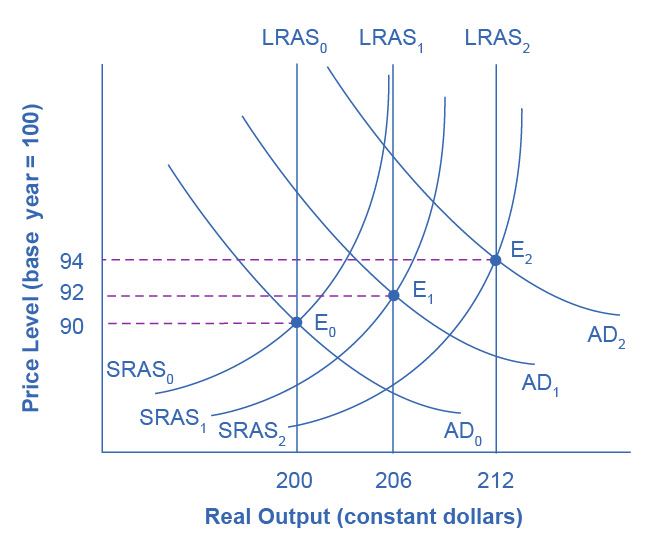

Figure 30.10図 30.10
In this well-functioning economy, each year aggregate supply and aggregate demand shift to the right so that the economy proceeds from equilibrium E0 to E1 to E2. Each year, the economy produces at potential GDP with only a small inflationary increase in the price level. However, if aggregate demand does not smoothly shift to the right and match increases in aggregate supply, growth with deflation can develop.
英語のヒント
このよく機能する経済では、毎年、総供給と総需要が右へ移動し、経済は均衡E0からE1、E2へ進む。毎年、経済は潜在GDPで生産し、物価水準のインフレ的上昇は小さい。しかし、総需要が滑らかに右へ移動して総供給の増加に追いつかなければ、デフレを伴う成長が起こりうる。
Aggregate demand and aggregate supply do not always move neatly together. Think about what causes shifts in aggregate demand over time. As aggregate supply increases, incomes tend to go up. This tends to increase consumer and investment spending, shifting the aggregate demand curve to the right, but in any given period it may not shift the same amount as aggregate supply. What happens to government spending and taxes? Government spends to pay for the ordinary business of government- items such as national defense, social security, and healthcare, as Figure 30.10 shows. Tax revenues, in part, pay for these expenditures. The result may be an increase in aggregate demand more than or less than the increase in aggregate supply. Aggregate demand may fail to increase along with aggregate supply, or aggregate demand may even shift left, for a number of possible reasons: households become hesitant about consuming; firms decide against investing as much; or perhaps the demand from other countries for exports diminishes.
英語のヒント
総需要と総供給は、常に足並みをそろえて動くわけではない。時間とともに総需要を移動させる原因を考えよう。総供給が増えると、所得は上がる傾向がある。これは消費支出と投資支出を増やし、総需要曲線を右に移動させる傾向を持つが、どの期間でも、総供給と同じだけ移動するとは限らない。政府支出と税はどうなるだろうか。図30.10のように、政府は国防、社会保障、医療など、通常の政府業務の費用を支出する。税収は、これらの支出の一部を賄う。その結果、総需要の増加が総供給の増加を上回る場合も、下回る場合もある。家計が消費をためらう、企業がそれほど投資しないと決める、あるいは他国からの輸出品需要が減るなど、さまざまな理由で、総需要が総供給とともに増えないこともあれば、左に移動することさえある。
For example, investment by private firms in physical capital in the U.S. economy boomed during the late 1990s, rising from 14.1% of GDP in 1993 to 17.2% in 2000, before falling back to 15.2% by 2002. Conversely, if shifts in aggregate demand run ahead of increases in aggregate supply, inflationary increases in the price level will result. Business cycles of recession and recovery are the consequence of shifts in aggregate supply and aggregate demand. As these occur, the government may choose to use fiscal policy to address the difference.
英語のヒント
たとえば、アメリカ経済では1990年代後半、民間企業の実物資本への投資が急増し、1993年のGDPの14.1%から2000年の17.2%へ上がった後、2002年までに15.2%へ戻った。逆に、総需要の移動が総供給の増加に先行すると、物価水準のインフレ的上昇が起こる。景気後退と回復からなる景気循環は、総供給と総需要の移動の結果である。こうしたことが起きると、政府はその差に対処するため、財政政策を使うことを選ぶかもしれない。
Monetary Policy and Bank Regulation shows us that a central bank can use its powers over the banking system to engage in countercyclical—or “against the business cycle”—actions. If recession threatens, the central bank uses an expansionary monetary policy to increase the money supply, increase the quantity of loans, reduce interest rates, and shift aggregate demand to the right. If inflation threatens, the central bank uses contractionary monetary policy to reduce the money supply, reduce the quantity of loans, raise interest rates, and shift aggregate demand to the left. Fiscal policy is another macroeconomic policy tool for adjusting aggregate demand by using either government spending or taxation policy.
英語のヒント
「金融政策と銀行規制」では、中央銀行が銀行制度に対する権限を使い、反循環的、つまり「景気循環に逆らう」行動を取れることを見た。景気後退のおそれがあると、中央銀行は拡張的金融政策を用い、貨幣供給を増やし、貸出量を増やし、金利を下げ、総需要を右に移動させる。インフレのおそれがあると、中央銀行は引締め的金融政策を用い、貨幣供給を減らし、貸出量を減らし、金利を上げ、総需要を左に移動させる。財政政策は、政府支出または課税政策によって総需要を調整する、もう一つのマクロ経済政策手段である。