第27章動物の多様性への導入
27.3 Animal Phylogeny27.3 動物の系統
Learning Objectives学習目標
By the end of this section, you will be able to do the following:
この節を学ぶと、次のことができるようになる。
- Interpret the metazoan phylogenetic tree後生動物の系統樹を読み解く。
- Describe the types of data that scientists use to construct and revise animal phylogeny動物の系統を構築・修正するために使うデータの種類を述べる。
- List some of the relationships within the modern phylogenetic tree that have been discovered as a result of modern molecular data現代の分子データによって明らかになった、現在の系統樹内の関係をいくつか挙げる。
Biologists strive to understand the evolutionary history and relationships of members of the animal kingdom, and all of life, for that matter. The study of phylogeny (the branching sequence of evolution) aims to determine the evolutionary relationships between phyla. Currently, most biologists divide the animal kingdom into 35 to 40 phyla. Scientists develop phylogenetic trees, which serve as hypotheses about which species have evolved from which ancestors.
英語のヒント
生物学者は、動物界の生物の進化史と類縁関係、さらには生命全体の進化史と関係を理解しようと努めている。系統、すなわち進化の分岐順序の研究は、門どうしの進化的関係を明らかにすることを目指す。現在、多くの生物学者は動物界を35〜40の門に分ける。科学者のつくる系統樹は、どの種がどの祖先から進化したかについての仮説となる。
Recall that until recently, only morphological characteristics and the fossil record were used to determine phylogenetic relationships among animals. Scientific understanding of the distinctions and hierarchies between anatomical characteristics provided much of this knowledge. Used alone, however, this information can be misleading. Morphological characteristics (such as skin color, body shape, etc.) may evolve multiple times, and independently, through evolutionary history. Analogous characteristics may appear similar between animals, but their underlying evolution may be very different. With the advancement of molecular technologies, modern phylogenetics is now informed by genetic and molecular analyses, in addition to traditional morphological and fossil data. With a growing understanding of genetics, the animal evolutionary tree has changed substantially and continues to change as new DNA and RNA analyses are performed on additional animal species.
英語のヒント
最近まで、動物の系統関係を決めるために使われていたのは、形態の特徴と化石記録だけだった。解剖学的特徴の違いや階層関係についての科学的理解が、その知識の多くを支えていた。ただし、それだけを使うと誤ることがある。皮膚の色や体形などの形態は、進化史上で独立に何度も進化しうる。相似の特徴は見た目が似ていても、進化の過程は大きく異なる場合がある。分子技術の進歩により、現在の系統学は従来の形態・化石データに加え、遺伝学的・分子解析も取り入れている。遺伝学への理解が深まるにつれて動物の系統樹は大きく変わり、さらに多くの種でDNAとRNAが解析されるたび、変化し続けている。
Constructing an Animal Phylogenetic Tree動物の系統樹を構築する
The current understanding of evolutionary relationships among animal, or Metazoa, phyla begins with the distinction between animals with true differentiated tissues, called Eumetazoa, and animal phyla that do not have true differentiated tissues, such as the sponges (Porifera) and the Placozoa (Figure 27.6). Similarities between the feeding cells of sponges (choanocytes) and choanoflagellate protists (Figure 27.12) have been used to suggest that Metazoa evolved from a common ancestral organism that resembled the modern colonial choanoflagellates.
英語のヒント
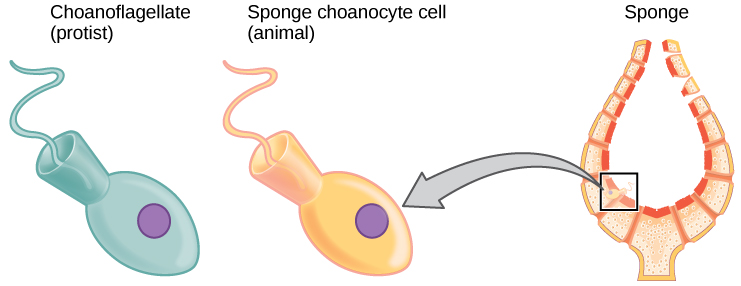

Figure 27.12図 27.12
Choanoflagellates and choanocytes. Cells of the protist choanoflagellate clade closely resemble sponge choanocyte cells. Beating of choanocyte flagella draws water through the sponge so that nutrients can be extracted and waste removed.
襟鞭毛虫と襟細胞。襟鞭毛虫という原生生物群の細胞は、カイメンの襟細胞によく似る。襟細胞の鞭毛運動は水をカイメン内に引き込み、栄養分の取り出しと老廃物の除去を可能にする。
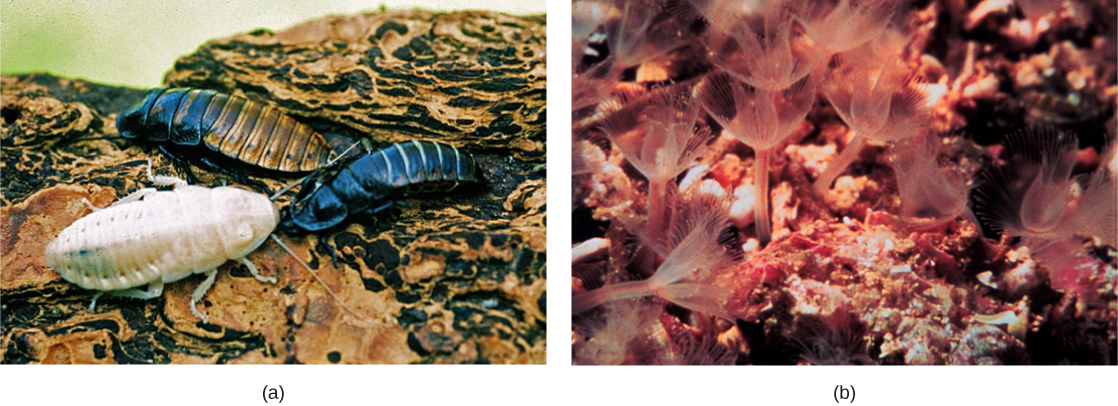
Eumetazoa are subdivided into radially symmetrical animals and bilaterally symmetrical animals, and are thus classified into the clades Bilateria and Radiata, respectively. As mentioned earlier, the cnidarians and ctenophores are animal phyla with true radial, biradial, or rotational symmetry. All other Eumetazoa are members of the Bilateria clade. The bilaterally symmetrical animals are further divided into deuterostomes (including chordates and echinoderms) and two distinct clades of protostomes (including ecdysozoans and lophotrochozoans) (Figure 27.13a,b). Ecdysozoa includes nematodes and arthropods; they are so named for a commonly found characteristic among the group: the physiological process of exoskeletal molting followed by the “stripping” of the outer cuticular layer, called ecdysis. Lophotrochozoa is named for two structural features, each common to certain phyla within the clade. Some lophotrochozoan phyla are characterized by a larval stage called trochophore larvae, and other phyla are characterized by the presence of a feeding structure called a lophophore (thus, the shorter term, “lopho-trocho-zoa”).
英語のヒント
真正後生動物は、放射相称の動物と左右相称の動物に細分され、それぞれ左右相称動物と放射相称動物のクレードに分類される。前述のように、刺胞動物と有櫛動物は真の放射相称、二放射相称、または回転対称をもつ門である。それ以外の真正後生動物はすべて左右相称動物に属する。左右相称動物はさらに、脊索動物と棘皮動物を含む新口動物と、旧口動物の異なる二群である脱皮動物と冠輪動物に分かれる(図27.13a、b)。脱皮動物には線形動物と節足動物が含まれる。この名は、外骨格を脱ぎ、その外側のクチクラ層を剥ぎ取る脱皮という、群に共通の生理過程に由来する。冠輪動物の名は、群内の特定の門にそれぞれ共通する、二つの構造的特徴に由来する。一部にはトロコフォアという幼生段階があり、別の門には触手冠という摂食構造がある。この二つを合わせたのが「lopho-trocho-zoa」という短い呼び名である。
OpenStax, Rice University; Biology 2e. (credit a: modification of work by Whitney Cranshaw, Colorado State University, Bugwood.org; credit b: modification of work by NOAA) · CC BY 4.0 · Source出典

Figure 27.13図 27.13
Ecdysozoa. Animals that molt their exoskeletons, such as these (a) Madagascar hissing cockroaches, are in the clade Ecdysozoa. (b) Phoronids are in the clade Lophotrochozoa. The tentacles are part of a feeding structure called a lophophore. (credit a: modification of work by Whitney Cranshaw, Colorado State University, Bugwood.org; credit b: modification of work by NOAA)
脱皮動物。(a)マダガスカルオオゴキブリのように外骨格を脱ぐ動物は、脱皮動物のクレードに属する。(b)ホウキムシは冠輪動物に属し、触手は触手冠という摂食構造の一部である。(出典a:Whitney Cranshaw、Colorado State University、Bugwood.orgの作品を改変、b:NOAAの作品を改変)
Modern Advances in Phylogenetic Understanding Come from Molecular Analyses分子解析による系統理解の進展
The phylogenetic groupings are continually being debated and refined by evolutionary biologists. Each year, new evidence emerges that further alters the relationships described by a phylogenetic tree diagram.
系統分類は、進化生物学者によって絶えず議論され、洗練されている。毎年新たな証拠が現れ、系統樹が示す関係はさらに変わる。
Nucleic acid and protein analyses have greatly modified and refined the modern phylogenetic animal tree. These data come from a variety of molecular sources, such as mitochondrial DNA, nuclear DNA, ribosomal RNA (rRNA), and certain cellular proteins. Many evolutionary relationships in the modern tree have only recently been determined from the molecular evidence. For example, a previously classified group of animals called lophophorates, which included brachiopods and bryozoans, were long-thought to be primitive deuterostomes. Extensive molecular analysis using rRNA data found these animals are actually protostomes, more closely related to annelids and mollusks. This discovery allowed for the distinction of the protostome clade Lophotrochozoa. Molecular data have also shed light on some differences within the lophotrochozoan group, and the placement of the Platyhelminthes is particularly problematic. Some scientists believe that the phyla Platyhelminthes and Rotifera should actually belong to their own clade of protostomes termed Platyzoa.
英語のヒント
核酸とタンパク質の解析は、現在の動物系統樹を大きく修正し、精密にしてきた。データ源にはミトコンドリアDNA、核DNA、リボソームRNA(rRNA)、特定の細胞タンパク質などがある。現在の系統樹の多くの関係は、分子の証拠から近年になって初めて決まった。例えば、以前は触手冠動物としてまとめられた腕足動物やコケムシは、長く原始的な新口動物と考えられていた。rRNAデータを使った広範な分子解析で、実は環形動物や軟体動物により近い旧口動物であるとわかった。これにより、旧口動物の冠輪動物クレードが区別された。分子データは冠輪動物内の違いにも光を当てている。とくに扁形動物の位置づけは難しい。扁形動物門と輪形動物門は、平形動物(Platyzoa)という独自の旧口動物クレードに属すべきだと考える科学者もいる。
Molecular research similar to the discoveries that brought about the distinction of the lophotrochozoan clade has also revealed a dramatic rearrangement of the relationships between mollusks, annelids, arthropods, and nematodes, and as a result, a new ecdysozoan clade was formed. Due to morphological similarities in their segmented body types, annelids and arthropods were once thought to be closely related. However, molecular evidence has revealed that arthropods are actually more closely related to nematodes, now comprising the ecdysozoan clade, and annelids are more closely related to mollusks, brachiopods, and other phyla in the lophotrochozoan clade. These two clades now make up the protostomes.
冠輪動物クレードの区別につながったのと同様の分子研究は、軟体動物、環形動物、節足動物、線形動物の関係も大きく組み替え、新たに脱皮動物クレードが形成された。以前は体節構造の形態的類似から、環形動物と節足動物が近縁と考えられた。しかし分子の証拠は、節足動物がむしろ線形動物に近く、ともに脱皮動物を構成することを示した。環形動物は、冠輪動物の軟体動物、腕足動物などにより近い。現在はこの二クレードが旧口動物を構成する。
Another change to former phylogenetic groupings because of modern molecular analyses includes the emergence of an entirely new phylum of worm called Acoelomorpha. These acoel flatworms were long thought to belong to the phylum Platyhelminthes because of their similar “flatworm” morphology. However, molecular analyses revealed this to be a false relationship and originally suggested that acoels represented living species of some of the earliest divergent bilaterians. More recent research into the acoelomorphs has called this hypothesis into question and suggested that the acoels are more closely related to deuterostomes. The placement of this new phylum remains disputed, but scientists agree that with sufficient molecular data, their true phylogeny will be determined.
英語のヒント
分子解析によるもう一つの変更は、無腸動物(Acoelomorpha)という虫の新しい門の出現である。これらの無腸類は、扁形の体が似るため、長く扁形動物門に属すと考えられていた。しかし分子解析で関係が誤りとわかり、当初は左右相称動物のごく初期に分岐した群の現生種だと示唆された。より最近の研究はその仮説に疑問を示し、無腸類は新口動物により近いとした。この新しい門の位置づけはなお争われているが、十分な分子データがあれば、真の系統が決まるという点で科学者は一致している。
Another example of phylogenetic reorganization involves the identification of the Ctenophora as the basal clade of the animal kingdom. Ctenophora, or comb jellies, were once considered to be a sister group of the Cnidaria, and the sponges (Porifera) were placed as the basal animal group, sister to other animals. The presence of nerve and muscle cells in both the Ctenophores and the Cnidaria and their absence in the Porifera strengthened this view of the relationships among simple animal forms. However, recent molecular analysis has shown that many of the genes that support neural development in other animals are absent from the Ctenophore genome. The muscle cells are restricted to the mouth and tentacles and are derived from cells in the mesoglea. The mitochondrial genome of the Ctenophores is small and lacks many genes found in other animal mitochondrial genomes. These features plus the absence of Hox genes from the Ctenophores have been used to argue that the Ctenophores should be considered basal or as a sister group of the Porifera, and that the evolution of specialized nerve and muscle tissue may have occurred more than once in the history of animal life. Although Ctenophores have been shown as basal to other animals in the phylogeny presented in Chapter 27.2, debate on this issue is likely to continue as Ctenophores are more closely studied.
英語のヒント
系統再編の別の例が、有櫛動物を動物界の基部のクレードとする見方である。有櫛動物、すなわちクシクラゲは、以前は刺胞動物の姉妹群とされ、カイメン(海綿動物)が他の動物の姉妹群として基部に置かれていた。有櫛動物と刺胞動物には神経細胞と筋細胞があり、海綿動物にはないことが、この関係を支持していた。しかし近年の分子解析では、他の動物の神経発生を支える遺伝子の多くが、有櫛動物のゲノムにはないとわかった。筋細胞は口と触手に限られ、中膠の細胞に由来する。ミトコンドリアゲノムは小さく、他の動物のそれにある多くの遺伝子を欠く。これらの特徴とHox遺伝子の欠如は、有櫛動物を基部または海綿動物の姉妹群とし、特殊化した神経・筋組織が動物史上で複数回進化した可能性を支持する論拠となった。27.2節の系統樹では有櫛動物を他の動物より基部に示したが、研究の進展に伴い議論は続くだろう。
Changes to the phylogenetic tree can be difficult to track and understand, and are evidence of the process of science. Data and analytical methods play a significant role in the development of phylogenies. For this reason – because molecular analysis and reanalysis are not complete -- we cannot necessarily dismiss a former phylogenetic tree as inaccurate. A recent reanalysis of molecular evidence by an international group of evolutionary biologists refuted the proposition that comb jellies are the phylogenetically oldest extant metazoan group. The study, which relied on more sophisticated methods of analyzing the original genetic data, reaffirms the traditional view that the sponges were indeed the first phylum to diverge from the common ancestor of metazoans. The ongoing discussion concerning the location of sponges and comb jellies on the animal “family tree” is an example of what drives science forward.
英語のヒント
系統樹の変化は追跡も理解も難しいことがあるが、科学が進む過程の証拠でもある。系統の構築には、データと解析法が大きく関わる。分子解析と再解析が完了していない以上、以前の系統樹を必ずしも不正確だと切り捨てることはできない。進化生物学者の国際グループによる最近の再解析は、クシクラゲが系統的に最も古い現生の後生動物群だという説に反証した。元の遺伝データをより高度な方法で解析し、カイメンが後生動物の共通祖先から最初に分岐した門だという従来の見方を再確認した。動物の「家系図」におけるカイメンとクシクラゲの位置をめぐる継続的な議論は、科学を前へ進めるものの一例である。