第27章動物の多様性への導入
27.1 Features of the Animal Kingdom27.1 動物界の特徴
Learning Objectives学習目標
By the end of this section, you will be able to do the following:
この節を学ぶと、次のことができるようになる。
- List the features that distinguish the kingdom Animalia from other kingdoms動物界を他の界と区別する特徴を挙げる。
- Explain the processes of animal reproduction and embryonic development動物の生殖と胚発生の過程を説明する。
- Describe the roles that Hox genes play in development発生におけるHox遺伝子の役割を述べる。
Two different groups within the Domain Eukaryota have produced complex multicellular organisms: The plants arose within the Archaeplastida, whereas the animals (and their close relatives, the fungi) arose within the Opisthokonta. However, plants and animals not only have different life styles, they also have different cellular histories as eukaryotes. The opisthokonts share the possession of a single posterior flagellum in flagellated cells, e.g., sperm cells.
英語のヒント
真核生物ドメインの二つの異なる群から、複雑な多細胞生物が生まれた。植物はアーケプラスチダから、動物と近縁の菌類はオピストコンタから生じた。植物と動物は生活様式だけでなく、真核生物としての細胞の歴史も異なる。オピストコンタに共通するのは、精子などの鞭毛をもつ細胞で、後方に一本の鞭毛があるという特徴である。
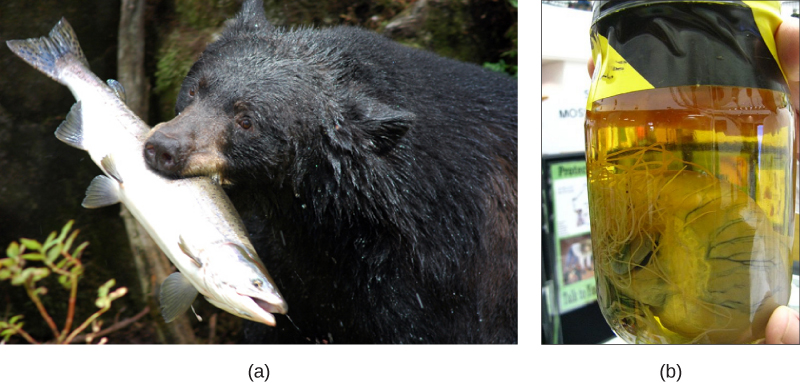
Most animals also share other features that distinguish them from organisms in other kingdoms. All animals require a source of food and are therefore heterotrophic, ingesting other living or dead organisms. This feature distinguishes them from autotrophic organisms, such as most plants, which synthesize their own nutrients through photosynthesis. As heterotrophs, animals may be carnivores, herbivores, omnivores, or parasites (Figure 27.2a,b). As with plants, almost all animals have a complex tissue structure with differentiated and specialized tissues. The necessity to collect food has made most animals motile, at least during certain life stages. The typical life cycle in animals is diplontic (like you, the diploid state is multicellular, whereas the haploid state is gametic, such as sperm or egg). We should note that the alternation of generations characteristic of the land plants is typically not found in animals. In animals whose life histories include several to multiple body forms (e.g., insect larvae or the medusae of some Cnidarians), all body forms are diploid. Animal embryos pass through a series of developmental stages that establish a determined and fixed body plan. The body plan refers to the morphology of an animal, determined by developmental cues.
英語のヒント
大部分の動物には、他の界の生物と区別する別の共通点もある。すべての動物は食物の供給源を必要とし、生きた生物や死んだ生物を取り込む従属栄養生物である。光合成で自ら栄養分を合成する大部分の植物など、独立栄養生物とはこの点で異なる。動物は従属栄養生物として、肉食、草食、雑食、寄生などの生活をする(図27.2a、b)。植物と同様に、ほぼすべての動物は、分化・特殊化した組織からなる複雑な組織構造をもつ。食物を集める必要があるため、大部分の動物は少なくとも生活史のある時期には運動性をもつ。典型的な動物の生活環は複相型である。ヒトと同じく、二倍体の状態が多細胞であり、半数体の状態は精子や卵などの配偶子に限られる。陸上植物に特徴的な世代交代は、普通は動物にはみられない。昆虫の幼虫や一部の刺胞動物のクラゲ型など、生活史に複数の体形が含まれる動物でも、そのすべては二倍体である。動物の胚は一連の発生段階を経て、定まった体制を確立する。体制とは、発生を導く情報によって決まる動物の形態をいう。
OpenStax, Rice University; Biology 2e. (credit a: modification of work by USDA Forest Service; credit b: modification of work by Clyde Robinson) · CC BY 4.0 · Source出典

Figure 27.2図 27.2
Heterotrophy. All animals are heterotrophs and thus derive energy from a variety of food sources. The (a) black bear is an omnivore, eating both plants and animals. The (b) heartworm Dirofilaria immitis is a parasite that derives energy from its hosts. It spends its larval stage in mosquitoes and its adult stage infesting the heart of dogs and other mammals, as shown here. (credit a: modification of work by USDA Forest Service; credit b: modification of work by Clyde Robinson)
従属栄養。すべての動物は従属栄養生物であり、多様な食物源からエネルギーを得る。(a)アメリカクロクマは動植物の両方を食べる雑食動物。(b)イヌ糸状虫Dirofilaria immitisは、宿主からエネルギーを得る寄生虫である。幼虫期を蚊の体内で過ごし、成虫は図のように犬などの哺乳類の心臓に寄生する。(出典a:USDA Forest Serviceの作品を改変、b:Clyde Robinsonの作品を改変)
Complex Tissue Structure複雑な組織構造
Many of the specialized tissues of animals are associated with the requirements and hazards of seeking and processing food. This explains why animals typically have evolved special structures associated with specific methods of food capture and complex digestive systems supported by accessory organs. Sensory structures help animals navigate their environment, detect food sources, and avoid becoming a food source for other animals!. Movement is driven by muscle tissue attached to supportive structures like bone or chitin, and is coordinated by neural communication. Animal cells may also have unique structures for intercellular communication (such as gap junctions). The evolution of nerve tissues and muscle tissues has resulted in animals’ unique ability to rapidly sense and respond to changes in their environment. This allows animals to survive in environments where they must compete with other species to meet their nutritional demands.
英語のヒント
動物の特殊化した組織の多くは、食物を探し、処理するための必要性や危険と関わる。そのため動物には一般に、特定の方法で食物を捕らえる特殊な構造や、付属器官に支えられた複雑な消化器系が進化してきた。感覚構造は、周囲の環境を移動し、食物源を見つけ、自分が他の動物の食物になることを避ける助けになる。運動は、骨やキチンなどの支持構造につく筋組織によって生じ、神経の情報伝達によって調整される。動物細胞には、ギャップ結合など、細胞間で情報を伝える特有の構造もみられる。神経組織と筋組織の進化により、動物は環境の変化を素早く感知して反応する独特の能力を得た。これにより、栄養の需要を満たすために他種と競争しなければならない環境でも、生き残ることができる。
The tissues of animals differ from those of the other major multicellular eukaryotes, plants and fungi, because their cells don't have cell walls. However, cells of animal tissues may be embedded in an extracellular matrix (e.g., mature bone cells reside within a mineralized organic matrix secreted by the cells). In vertebrates, bone tissue is a type of connective tissue that supports the entire body structure. The complex bodies and activities of vertebrates demand such supportive tissues. Epithelial tissues cover and protect both external and internal body surfaces, and may also have secretory functions. Epithelial tissues include the epidermis of the integument, the lining of the digestive tract and trachea, as well as the layers of cells that make up the ducts of the liver and glands of advanced animals, for example. The different types of tissues in true animals are responsible for carrying out specific functions for the organism. This differentiation and specialization of tissues is part of what allows for such incredible animal diversity.
英語のヒント
動物の細胞には細胞壁がないため、その組織は他の主要な多細胞真核生物である植物や菌類の組織と異なる。ただし細胞は細胞外基質に埋め込まれることがある。例えば成熟した骨細胞は、細胞が分泌した有機基質が石灰化したものの中に存在する。脊椎動物の骨組織は、体全体を支える結合組織の一種である。脊椎動物の複雑な体と活動には、このような支持組織が必要となる。上皮組織は体の外側と内側の表面を覆って保護し、分泌機能をもつ場合もある。例えば外皮の表皮、消化管と気管の内張り、発達した動物の肝臓の導管や腺をつくる細胞層などがある。真の動物の各種組織は、個体のために特定の機能を担う。こうした組織の分化と特殊化が、驚くほどの動物の多様性を可能にする要因の一つとなっている。
Just as there are multiple ways to be a eukaryote, there are multiple ways to be a multicellular animal. The animal kingdom is currently divided into five monophyletic clades: Parazoa or Porifera (sponges), Placozoa (tiny parasitic creatures that resemble multicellular amoebae), Cnidaria (jellyfish and their relatives), Ctenophora (the comb jellies), and Bilateria (all other animals). The Placozoa ("flat animal") and Parazoa (“beside animal”) do not have specialized tissues derived from germ layers of the embryo; although they do possess specialized cells that act functionally like tissues. The Placozoa have only four cell types, while the sponges have nearly two dozen. The three other clades do include animals with specialized tissues derived from the germ layers of the embryo. In spite of their superficial similarity to Cnidarian medusae, recent molecular studies indicate that the Ctenophores are only distantly related to the Cnidarians, which together with the Bilateria constitute the Eumetazoa ("true animals"). When we think of animals, we usually think of Eumetazoa, since most animals fall into this category.
英語のヒント
真核生物のあり方が一通りでないように、多細胞動物のあり方も一通りではない。動物界は現在、五つの単系統のクレードに分けられる。側生動物すなわち海綿動物(カイメン)、平板動物(多細胞のアメーバに似た小さな寄生生物)、刺胞動物(クラゲとその仲間)、有櫛動物(クシクラゲ)、左右相称動物(それ以外のすべての動物)である。平板動物(「平たい動物」)と側生動物(「動物のそば」)には、胚の胚葉に由来する特殊化した組織がない。ただし、組織のように機能する特殊化した細胞はある。平板動物の細胞型は四つだけで、カイメンは24種類近くある。他の三つのクレードには、胚葉由来の特殊化した組織をもつ動物が含まれる。有櫛動物は刺胞動物のクラゲと外見が似るものの、近年の分子研究では、両者の類縁関係は遠いと示されている。刺胞動物は左右相称動物とともに真正後生動物(「真の動物」)を構成する。大部分の動物がこの範疇に入るため、私たちが動物と聞いて思い浮かべるのは、通常は真正後生動物である。