第27章動物の多様性への導入
Embryonic Development of the Mouth胚発生における口の形成
Bilaterally symmetrical, tribloblastic eucoelomates can be further divided into two groups based on differences in the origin of the mouth. When the primitive gut forms, the opening that first connects the gut cavity to the outside of the embryo is called the blastopore. Most animals have openings at both ends of the gut: mouth at one end and anus at the other. One of these openings will develop at or near the site of the blastopore. In Protostomes ("mouth first"), the mouth develops at the blastopore (Figure 27.11). In Deuterostomes ("mouth second"), the mouth develops at the other end of the gut (Figure 27.11) and the anus develops at the site of the blastopore. Protostomes include arthropods, mollusks, and annelids. Deuterostomes include more complex animals such as chordates but also some “simple” animals such as echinoderms. Recent evidence has challenged this simple view of the relationship between the location of the blastopore and the formation of the mouth, however, and the theory remains under debate. Nevertheless, these details of mouth and anus formation reflect general differences in the organization of protostome and deuterostome embryos, which are also expressed in other developmental features.
英語のヒント
左右相称の三胚葉性真体腔動物は、口の起源の違いからさらに二群に分けられる。原腸ができるとき、腸の内腔と胚の外を最初につなぐ開口部を原口という。多くの動物には腸の両端に開口部があり、一方が口、他方が肛門となる。このどちらかが原口の位置かその近くに生じる。旧口動物(「口が先」)では原口に口ができる(図27.11)。新口動物(「口が後」)では腸の反対側の端に口ができ(図27.11)、原口の位置には肛門ができる。旧口動物には節足動物、軟体動物、環形動物が含まれる。新口動物には脊索動物のような複雑な動物だけでなく、棘皮動物のような「単純」な動物も含まれる。ただし最近の証拠は、原口の位置と口の形成の関係についてのこの単純な見方に疑問を投げかけており、理論は議論中である。それでも、口と肛門の形成の詳細は、旧口動物と新口動物の胚の構成の一般的な違いを反映する。その違いはほかの発生上の特徴にも現れる。
One of these differences between protostomes and deuterostomes is the method of coelom formation, beginning from the gastrula stage. Since body cavity formation tends to accompany the formation of the mesoderm, the mesoderm of protostomes and deuterostomes forms differently. The coelom of most protostomes is formed through a process called schizocoely. The mesoderm in these organisms is usually the product of specific blastomeres, which migrate into the interior of the embryo and form two clumps of mesodermal tissue. Within each clump, cavities develop and merge to form the hollow opening of the coelom. Deuterostomes differ in that their coelom forms through a process called enterocoely. Here, the mesoderm develops as pouches that are pinched off from the endoderm tissue. These pouches eventually fuse and expand to fill the space between the gut and the body wall, giving rise to the coelom.
英語のヒント
旧口動物と新口動物の違いの一つは、原腸胚期から始まる体腔形成の方法である。体腔形成は中胚葉形成に伴うことが多く、両群では中胚葉のでき方が異なる。大部分の旧口動物の体腔は、裂体腔形成によって生じる。通常は特定の割球が胚の内部へ移動し、中胚葉組織の二つの塊をつくる。それぞれの内部に空洞ができ、融合して体腔になる。新口動物では、腸体腔形成という過程をとる。内胚葉組織からくびれ切れる袋として中胚葉が発達する。やがて袋は融合して広がり、腸と体壁の間を満たして体腔になる。
Another difference in organization of protostome and deuterostome embryos is expressed during cleavage. Protostomes undergo spiral cleavage, meaning that the cells of one pole of the embryo are rotated, and thus misaligned, with respect to the cells of the opposite pole. This is due to the oblique angle of cleavage relative to the two poles of the embryo. Deuterostomes undergo radial cleavage, where the cleavage axes are either parallel or perpendicular to the polar axis, resulting in the parallel (up-and-down) alignment of the cells between the two poles.
英語のヒント
両群の胚の構成のもう一つの違いは卵割に現れる。旧口動物はらせん卵割を行い、胚の一方の極の細胞は、反対の極の細胞に対して回転した、ずれた配置になる。これは両極を結ぶ軸に対して、卵割が斜めの角度で起こるためである。新口動物は放射卵割を行う。卵割軸が極軸に平行または垂直で、両極間の細胞が上下にそろって平行に並ぶ。
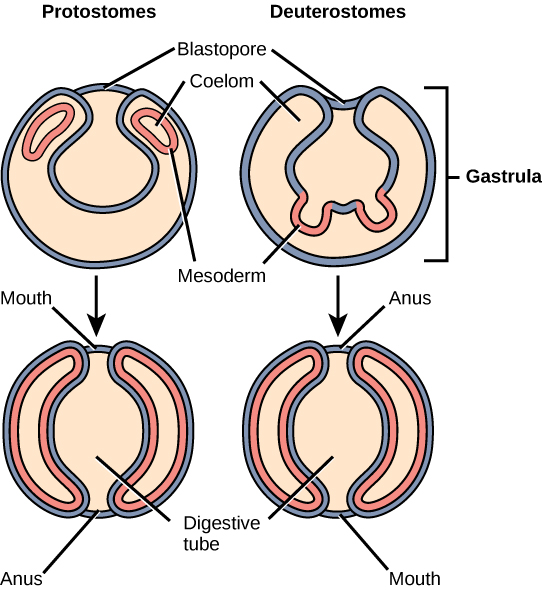

Figure 27.11図 27.11
Protostomes and deuterostomes. Eucoelomates can be divided into two groups based on their early embryonic development. In protostomes, the mouth forms at or near the site of the blastopore and the body cavity forms by splitting the mesodermal mass during the process of schizocoely. In deuterostomes, the mouth forms at a site opposite the blastopore end of the embryo and the mesoderm pinches off to form the coelom during the process of enterocoely.
旧口動物と新口動物。真体腔動物は初期胚発生に基づいて二群に分けられる。旧口動物では原口の位置またはその近くに口ができ、裂体腔形成で中胚葉の塊が裂けて体腔が生じる。新口動物では胚の原口と反対側に口ができ、腸体腔形成で中胚葉がくびれ切れて体腔が生じる。
A second distinction between the types of cleavage in protostomes and deuterostomes relates to the fate of the resultant blastomeres (cells produced by cleavage). In addition to spiral cleavage, protostomes also undergo determinate cleavage. This means that even at this early stage, the developmental fate of each embryonic cell is already determined. A given cell does not have the ability to develop into any cell type other than its original destination. Removal of a blastomere from an embryo with determinate cleavage can result in missing structures, and embryos that fail to develop. In contrast, deuterostomes undergo indeterminate cleavage, in which cells are not yet fully committed at this early stage to develop into specific cell types. Removal of individual blastomeres from these embryos does not result in the loss of embryonic structures. In fact, twins (clones) can be produced as a result from blastomeres that have been separated from the original mass of blastomere cells. Unlike protostomes, however, if some blastomeres are damaged during embryogenesis, adjacent cells are able to compensate for the missing cells, and the embryo is not damaged. These cells are referred to as undetermined cells. This characteristic of deuterostomes is reflected in the existence of familiar embryonic stem cells, which have the ability to develop into any cell type until their fate is programmed at a later developmental stage.
英語のヒント
卵割の第二の違いは、できた割球の運命に関わる。旧口動物は、らせん卵割とともに決定卵割を行う。この早い段階ですでに各細胞の発生運命が決まり、最初に定められたもの以外の細胞型へは発達できない。割球を取り除くと構造が欠け、胚が発生できなくなる場合がある。新口動物は不決定卵割を行い、この早期段階では、特定の細胞型へ発達する運命が完全には決まっていない。個々の割球を取り除いても胚の構造は失われない。実際、元の割球集団から分離した割球から、双子、すなわちクローンが生じることもある。旧口動物とは異なり、胚発生中に一部の割球が損傷しても、隣接する細胞が失われた細胞を補えるので、胚は損なわれない。これらを未決定細胞と呼ぶ。この特徴は、よく知られる胚性幹細胞にも現れる。後の発生段階で運命がプログラムされるまでは、どの細胞型にも発達できる。