第27章動物の多様性への導入
Animal Characterization Based on Features of Embryological Development胚発生の特徴による動物の特徴づけ
Most animal species undergo a separation of tissues into germ layers during embryonic development. Recall that these germ layers are formed during gastrulation, and that each germ layer typically gives rise to specific types of embryonic tissues and organs. Animals develop either two or three embryonic germ layers (Figure 27.9). The animals that display radial, biradial, or rotational symmetry develop two germ layers, an inner layer (endoderm or mesendoderm) and an outer layer (ectoderm). These animals are called diploblasts, and have a nonliving middle layer between the endoderm and ectoderm (although individual cells may be distributed through this middle layer, there is no coherent third layer of tissue). The four clades considered to be diploblastic have different levels of complexity and different developmental pathways, although there is little information about development in Placozoa. More complex animals (usually those with bilateral symmetry) develop three tissue layers: an inner layer (endoderm), an outer layer (ectoderm), and a middle layer (mesoderm). Animals with three tissue layers are called triploblasts.
英語のヒント
大部分の動物種では、胚発生中に組織が胚葉へ分かれる。胚葉は原腸形成中に生じ、通常はそれぞれ特定の胚組織や器官を生む。動物には二つまたは三つの胚葉が発達する(図27.9)。放射相称、二放射相称、回転対称を示す動物は、内側の内胚葉または内中胚葉と、外側の外胚葉という二胚葉をもつ。これらを二胚葉動物と呼ぶ。内胚葉と外胚葉の間には非生物性の中間層がある。中間層に個々の細胞が分布することはあっても、まとまった第三の組織層はない。二胚葉性とされる四つのクレードは複雑さと発生経路が異なるが、平板動物の発生に関する情報は少ない。より複雑な動物、通常は左右相称の動物には、内胚葉、外胚葉、中胚葉という三層が発達する。これらを三胚葉動物と呼ぶ。
Each of the three germ layers is programmed to give rise to specific body tissues and organs, although there are variations on these themes. Generally speaking, the endoderm gives rise to the lining of the digestive tract (including the stomach, intestines, liver, and pancreas), as well as to the lining of the trachea, bronchi, and lungs of the respiratory tract, along with a few other structures. The ectoderm develops into the outer epithelial covering of the body surface, the central nervous system, and a few other structures. The mesoderm is the third germ layer; it forms between the endoderm and ectoderm in triploblasts. This germ layer gives rise to all specialized muscle tissues (including the cardiac tissues and muscles of the intestines), connective tissues such as the skeleton and blood cells, and most other visceral organs such as the kidneys and the spleen. Diploblastic animals may have cell types that serve multiple functions, such as epitheliomuscular cells, which serve as a covering as well as contractile cells.
英語のヒント
三つの胚葉は、それぞれ特定の組織と器官を生じるようプログラムされているが、変異もある。一般に内胚葉は、胃、腸、肝臓、膵臓を含む消化器系の内張りと、気管、気管支、肺の内張りなどを生む。外胚葉は体表の上皮、中枢神経系などになる。第三の胚葉である中胚葉は、三胚葉動物の内胚葉と外胚葉の間にできる。心筋や腸の筋肉などすべての特殊化した筋組織、骨格や血球などの結合組織、腎臓や脾臓など他の内臓の大部分を生じる。二胚葉動物には、体を覆う働きと収縮する働きを兼ねる上皮筋細胞など、複数の機能を担う細胞型がみられる。
Presence or Absence of a Coelom体腔の有無
Further subdivision of animals with three germ layers (triploblasts) results in the separation of animals that may develop an internal body cavity derived from mesoderm, called a coelom, and those that do not. This epithelial cell-lined coelomic cavity, usually filled with fluid, lies between the visceral organs and the body wall. It houses many organs such as the digestive, urinary, and reproductive systems, the heart and lungs, and also contains the major arteries and veins of the circulatory system. In mammals, the body cavity is divided into the thoracic cavity, which houses the heart and lungs, and the abdominal cavity, which houses the digestive organs. In the thoracic cavity further subdivision produces the pleural cavity, which provides space for the lungs to expand during breathing, and the pericardial cavity, which provides room for movements of the heart. The evolution of the coelom is associated with many functional advantages. For example, the coelom provides cushioning and shock absorption for the major organ systems that it encloses. In addition, organs housed within the coelom can grow and move freely, which promotes optimal organ development and placement. The coelom also provides space for the diffusion of gases and nutrients, as well as body flexibility, promoting improved animal motility.
英語のヒント
三胚葉動物はさらに、中胚葉に由来する内部の空間、すなわち体腔をつくる動物と、つくらない動物に分けられる。体腔は上皮細胞で内張りされ、通常は液体で満たされており、内臓と体壁の間にある。消化器系、泌尿器系、生殖器系、心臓、肺など多くの器官と、循環系の主要な動脈・静脈を収める。哺乳類では、心臓と肺を収める胸腔と、消化器官を収める腹腔に分かれる。胸腔はさらに、呼吸時に肺が膨らむ空間となる胸膜腔と、心臓の運動のための空間となる心膜腔に分かれる。体腔の進化には、機能上の利点が多くある。主要な器官系を包み込み、緩衝材となって衝撃を吸収する。内部の器官は自由に成長・運動でき、適切な発達と配置が促される。気体と栄養素が拡散する空間や、体の柔軟性ももたらし、運動性を高める。
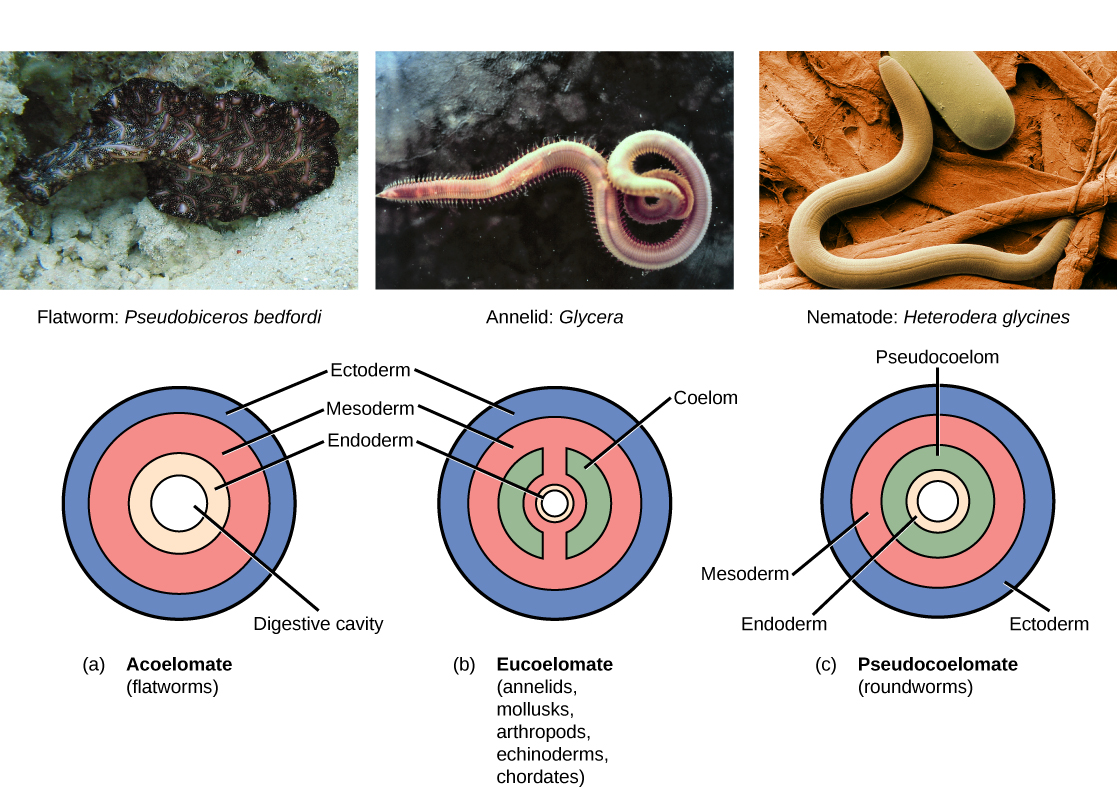
Triploblasts that do not develop a coelom are called acoelomates, and their mesoderm region is completely filled with tissue, although they do still have a gut cavity. Examples of acoelomates include animals in the phylum Platyhelminthes, also known as flatworms. Animals with a true coelom are called eucoelomates (or coelomates) (Figure 27.10). In such cases, a true coelom arises entirely within the mesoderm germ layer and is lined by an epithelial membrane. This membrane also lines the organs within the coelom, connecting and holding them in position while allowing them some freedom of movement. Annelids, mollusks, arthropods, echinoderms, and chordates are all eucoelomates. A third group of triploblasts has a slightly different coelom lined partly by mesoderm and partly by endoderm. Although still functionally a coelom, these are considered “false” coeloms, and so we call these animals pseudocoelomates. The phylum Nematoda (roundworms) is an example of a pseudocoelomate. True coelomates can be further characterized based on other features of their early embryological development.
英語のヒント
体腔をつくらない三胚葉動物を無体腔動物という。腸の内腔はあるものの、中胚葉の領域は組織で完全に満たされている。扁形動物などがその例である。真の体腔をもつ動物を真体腔動物、または体腔動物という(図27.10)。真体腔は全体が中胚葉の内部に生じ、上皮性の膜で内張りされる。この膜は内部の器官も覆い、ある程度の運動の自由を与えつつ、器官をつないで所定の位置に保つ。環形動物、軟体動物、節足動物、棘皮動物、脊索動物はいずれも真体腔動物である。第三の群には、一部を中胚葉、一部を内胚葉で内張りされた、少し異なる体腔がある。機能上は体腔だが「偽」の体腔とされるため、偽体腔動物と呼ぶ。線形動物がその例である。真体腔動物は、初期胚発生のほかの特徴によってさらに特徴づけられる。
OpenStax, Rice University; Biology 2e. (credit a: modification of work by Jan Derk; credit b: modification of work by NOAA; credit c: modification of work by USDA, ARS) · CC BY 4.0 · Source出典

Figure 27.10図 27.10
Body cavities. Triploblasts may be (a) acoelomates, (b) eucoelomates, or (c) pseudocoelomates. Acoelomates have no body cavity. Eucoelomates have a body cavity within the mesoderm, called a coelom, in which both the gut and the body wall are lined with mesoderm. Pseudocoelomates also have a body cavity, but only the body wall is lined with mesoderm. (credit a: modification of work by Jan Derk; credit b: modification of work by NOAA; credit c: modification of work by USDA, ARS)
体腔。三胚葉動物には(a)無体腔動物、(b)真体腔動物、(c)偽体腔動物がある。無体腔動物には体腔がない。真体腔動物では中胚葉内に体腔ができ、腸と体壁の両側を中胚葉が覆う。偽体腔動物にも体腔はあるが、中胚葉が覆うのは体壁側だけである。(出典a:Jan Derk、b:NOAA、c:USDA, ARSの作品を改変)