第27章動物の多様性への導入
27.4 The Evolutionary History of the Animal Kingdom27.4 動物界の進化史
Learning Objectives学習目標
By the end of this section, you will be able to do the following:
この節を学ぶと、次のことができるようになる。
- Describe the features that characterized the earliest animals and approximately when they appeared on earth最初期の動物の特徴と、地球上に現れたおよその時期を述べる。
- Explain the significance of the Cambrian period for animal evolution and the changes in animal diversity that took place during that time動物進化におけるカンブリア紀の重要性と、その間に起こった多様性の変化を説明する。
- Describe some of the unresolved questions surrounding the Cambrian explosionカンブリア爆発をめぐる未解決の問題をいくつか述べる。
- Discuss the implications of mass animal extinctions that have occurred in evolutionary history進化史で起こった動物の大量絶滅がもつ意味を論じる。
Many questions regarding the origins and evolutionary history of the animal kingdom continue to be researched and debated, as new fossil and molecular evidence change prevailing theories. Some of these questions include the following: How long have animals existed on Earth? What were the earliest members of the animal kingdom, and what organism was their common ancestor? While animal diversity increased during the Cambrian period of the Paleozoic era, 530 million years ago, modern fossil evidence suggests that primitive animal species existed much earlier.
英語のヒント
新たな化石や分子の証拠が通説を変えるなか、動物界の起源と進化史をめぐる多くの問題が、今も研究・議論されている。動物は地球上にいつからいるのか。最初の動物は何で、その共通祖先はどのような生物だったのか。5億3000万年前の古生代カンブリア紀に動物の多様性は増したが、現在の化石の証拠は、原始的な動物がはるかに以前から存在したことを示唆する。
Pre-Cambrian Animal Lifeカンブリア紀以前の動物
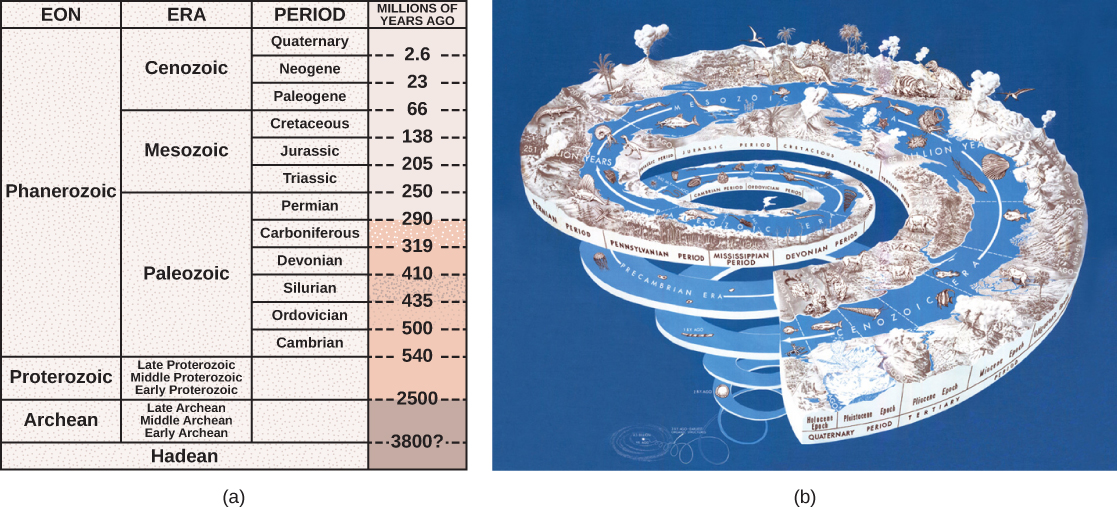
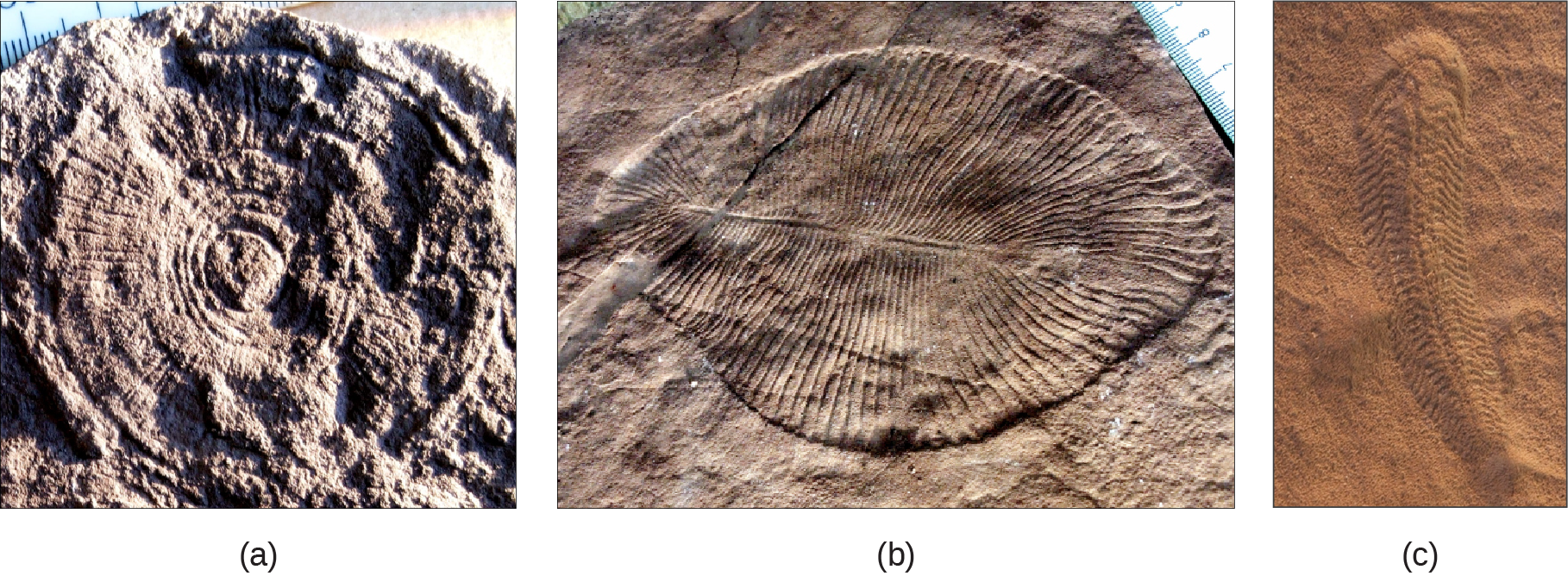
The time before the Cambrian period is known as the Ediacaran Period (from about 635 million years ago to 543 million years ago), the final period of the late Proterozoic Neoproterozoic Era (Figure 27.14). Ediacaran fossils were first found in the Ediacaran hills of Southern Australia. There are no living representatives of these species, which have left impressions that look like those of feathers or coins (Figure 27.15). It is believed that early animal life, termed Ediacaran biota, evolved from protists at this time.
英語のヒント
OpenStax, Rice University; Biology 2e. (credit: modification of work by USGS) · CC BY 4.0 · Source出典
Figure 27.14図 27.14
An evolutionary timeline. (a) Earth’s history is divided into eons, eras, and periods. Note that the Ediacaran period starts in the Proterozoic eon and ends at the start of the Cambrian period of the Phanerozoic eon. (b) Stages on the geological time scale are represented as a spiral. (credit: modification of work by USGS)
進化の年表。(a)地球史は累代、代、紀に分けられる。エディアカラ紀は原生代累代に始まり、顕生代累代のカンブリア紀の開始時に終わる。(b)地質時代区分をらせん状に示す。(出典:USGSの作品を改変)
Most Ediacaran biota were just a few mm or cm long, but some of the feather-like forms could reach lengths of over a meter. Recently there has been increasing scientific evidence suggesting that more varied and complex animal species lived during this time, and likely even before the Ediacaran period.
エディアカラ生物群の多くは数mm〜数cm程度だったが、羽毛状のものには長さ1 mを超えるものもあった。近年、この時代、さらにはエディアカラ紀より前にも、いっそう多様で複雑な動物がいたことを示唆する科学的証拠が増えている。
Fossils believed to represent the oldest animals with hard body parts were recently discovered in South Australia. These sponge-like fossils, named Coronacollina acula, date back as far as 560 million years, and are believed to show the existence of hard body parts and spicules that extended 20–40 cm from the thimble-shaped body (estimated about 5 cm long). Other fossils from the Ediacaran period are shown in Figure 27.15a, b, c.
英語のヒント
硬い体の部分をもつ最古の動物と考えられる化石が、最近オーストラリア南部で発見された。Coronacollina aculaと名づけられたカイメン状の化石は、5億6000万年前までさかのぼる。硬い部分と、長さ約5 cmと推定される指ぬき状の体から20〜40 cm伸びる骨針の存在を示すと考えられる。ほかのエディアカラ紀の化石を図27.15a、b、cに示す。
OpenStax, Rice University; Biology 2e. (credit: modification of work by “Smith609”/Wikimedia Commons) · CC BY 4.0 · Source出典
Figure 27.15図 27.15
Ediacaran fauna. Fossils of (a) Cyclomedusa (up to 20 cm), (b) Dickinsonia (up to 1.4 m), and (c) Spriggina (up to 5 cm) date to the Ediacaran period (543-635 MYA). (credit: modification of work by “Smith609”/Wikimedia Commons)
エディアカラ動物群。(a)Cyclomedusa(最大20 cm)、(b)Dickinsonia(最大1.4 m)、(c)Spriggina(最大5 cm)は、エディアカラ紀(6億3500万〜5億4300万年前)の化石である。(出典:“Smith609”/Wikimedia Commonsの作品を改変)
Another recent fossil discovery may represent the earliest animal species ever found. While the validity of this claim is still under investigation, these primitive fossils appear to be small, one-centimeter long, sponge-like creatures, irregularly shaped and with internal tubes or canals. These ancient fossils from South Australia date back 650 million years, actually placing the putative animal before the great ice age that marked the transition between the Cryogenian period and the Ediacaran period. Until this discovery, most scientists believed that there was no animal life prior to the Ediacaran period. Many scientists now believe that animals may in fact have evolved during the Cryogenian period.
英語のヒント
別の最近の化石発見は、これまでで最古の動物を示す可能性がある。主張の妥当性は検討中だが、不規則な形で、内部に管や水路をもつ、長さ1 cmほどのカイメン状生物に見える。オーストラリア南部のこの化石は6億5000万年前にさかのぼり、動物と推定される生物を、クライオジェニアン紀からエディアカラ紀への移行を特徴づけた大氷期より前に位置づける。以前は多くの科学者が、エディアカラ紀以前に動物はいなかったと考えていた。現在は、クライオジェニアン紀に進化した可能性があると考える科学者が多い。
The Cambrian Explosion of Animal Life動物のカンブリア爆発
If the fossils of the Ediacaran and Cryogenian periods are enigmatic, those of the following Cambrian period are far less so, and include body forms similar to those living today. The Cambrian period, occurring between approximately 542–488 million years ago, marks the most rapid evolution of new animal phyla and animal diversity in Earth’s history. The rapid diversification of animals that appeared during this period, including most of the animal phyla in existence today, is often referred to as the Cambrian explosion (Figure 27.16). Animals resembling echinoderms, mollusks, worms, arthropods, and chordates arose during this period. What may have been a top predator of this period was an arthropod-like creature named Anomalocaris, over a meter long, with compound eyes and spiky tentacles. Obviously, all these Cambrian animals already exhibited complex structures, so their ancestors must have existed much earlier.
英語のヒント
エディアカラ紀とクライオジェニアン紀の化石が謎めいているのに対し、次のカンブリア紀の化石ははるかにわかりやすく、現生動物に似た体形も含む。約5億4200万〜4億8800万年前のカンブリア紀には、地球史上で最も急速に新たな動物門が進化し、動物が多様化した。現存する動物門の大部分を含むこの急速な多様化は、カンブリア爆発と呼ばれる(図27.16)。この時期に、棘皮動物、軟体動物、蠕虫、節足動物、脊索動物に似た動物が現れた。頂点捕食者だった可能性があるのは、体長1 mを超え、複眼ととげのある触手をもつ、節足動物状のアノマロカリスである。これらの動物は明らかにすでに複雑な構造をもっていたので、その祖先ははるかに前から存在したはずである。
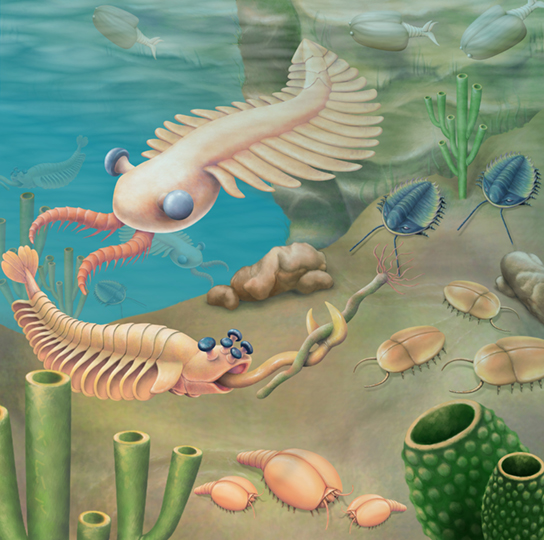
Figure 27.16図 27.16
Fauna of the Burgess Shale. An artist’s rendition depicts some organisms from the Cambrian period. Anomalocaris is seen in the upper left quadrant of the picture.
バージェス頁岩の動物群。カンブリア紀の生物を描いた復元画。左上にはアノマロカリスがいる。
One of the most dominant species during the Cambrian period was the trilobite, an arthropod that was among the first animals to exhibit a sense of vision (Figure 27.17a,b,c,d). Trilobites were somewhat similar to modern horseshoe crabs. Thousands of different species have been identified in fossil sediments of the Cambrian period; not a single species survives today.
英語のヒント
カンブリア紀にとくに優勢だった動物の一つが三葉虫である。節足動物で、視覚を備えた最初期の動物の一つだった(図27.17a、b、c、d)。現生のカブトガニにいくらか似る。カンブリア紀の堆積物から数千種が確認されているが、現在まで生き残った種は一つもない。
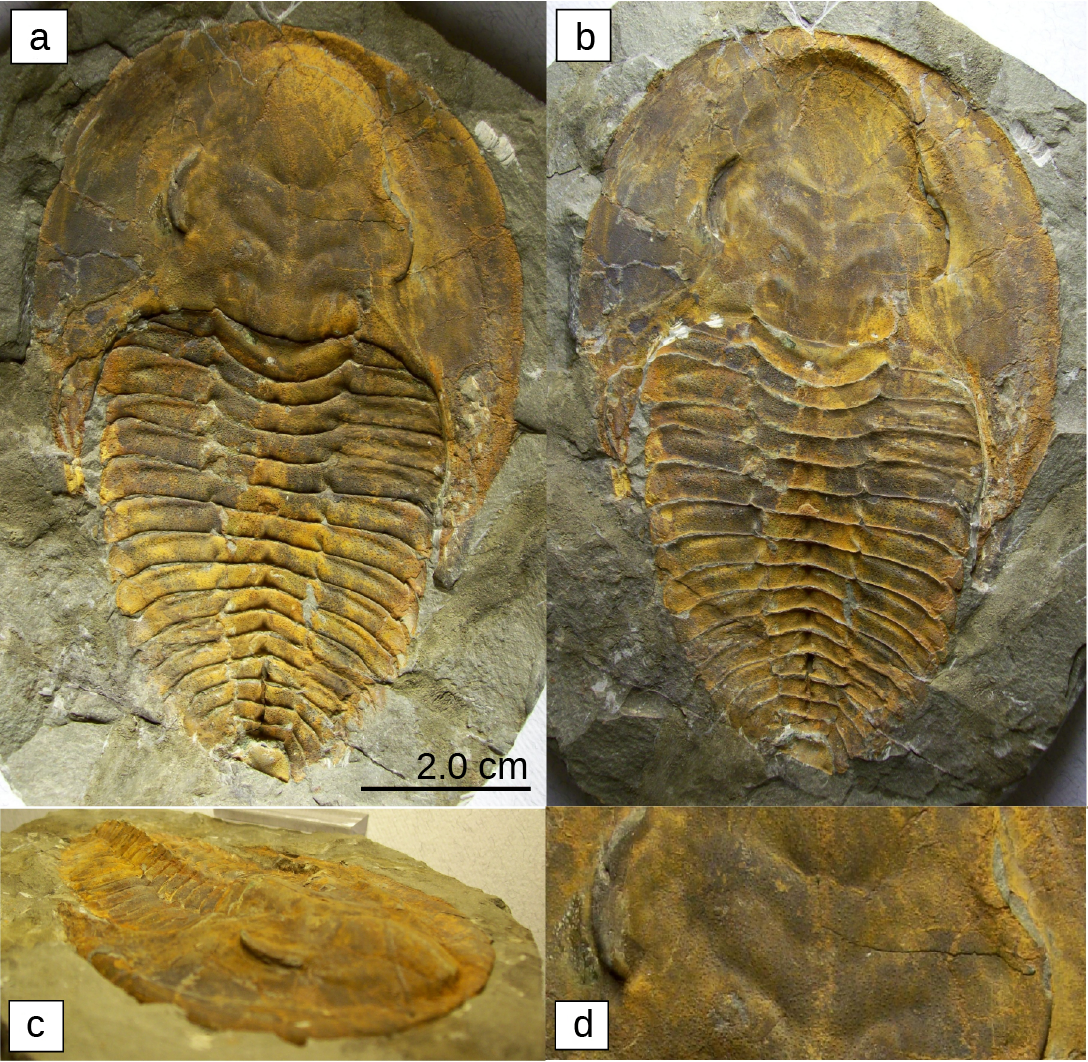
Figure 27.17図 27.17
Trilobites. These fossils (a–d) belong to trilobites, extinct arthropods that appeared in the early Cambrian period, 525 million years ago, and disappeared from the fossil record during a mass extinction at the end of the Permian period, about 250 million years ago.
三葉虫。化石(a〜d)は、カンブリア紀初期の5億2500万年前に現れ、約2億5000万年前のペルム紀末の大量絶滅で化石記録から消えた、絶滅した節足動物である。
The cause of the Cambrian explosion is still debated, and in fact, it may be that a number of interacting causes ushered in this incredible explosion of animal diversity. For this reason, there are a number of hypotheses that attempt to answer this question. Environmental changes may have created a more suitable environment for animal life. Examples of these changes include rising atmospheric oxygen levels (Figure 27.18) and large increases in oceanic calcium concentrations that preceded the Cambrian period. Some scientists believe that an expansive, continental shelf with numerous shallow lagoons or pools provided the necessary living space for larger numbers of different types of animals to coexist. There is also support for hypotheses that argue that ecological relationships between species, such as changes in the food web, competition for food and space, and predator-prey relationships, were primed to promote a sudden massive coevolution of species. Yet other hypotheses claim genetic and developmental reasons for the Cambrian explosion. The morphological flexibility and complexity of animal development afforded by the evolution of Hox control genes may have provided the necessary opportunities for increases in possible animal morphologies at the time of the Cambrian period. Hypotheses that attempt to explain why the Cambrian explosion happened must be able to provide valid reasons for the massive animal diversification, as well as explain why it happened when it did. There is evidence that both supports and refutes each of the hypotheses described above, and the answer may very well be a combination of these and other theories.
英語のヒント
カンブリア爆発の原因は今も議論中で、複数の原因が相互作用して、この驚くべき多様化を招いた可能性がある。そのため多くの仮説が提案されている。環境変化が動物により適した条件をつくったのかもしれない。例として、カンブリア紀に先立つ大気中酸素の増加(図27.18)や、海水中カルシウムの大幅な増加がある。浅い潟や水たまりを多数もつ広大な大陸棚が、多くの種類の動物が共存するための空間を供給したと考える科学者もいる。食物網の変化、食物と空間をめぐる競争、捕食者と被食者の関係など、生態学的な関係が大規模で急激な共進化を促す態勢にあったという仮説にも支持がある。別の仮説は、遺伝と発生に原因を求める。Hox制御遺伝子の進化がもたらした形態の柔軟性と発生の複雑さが、カンブリア紀に可能な動物の形態を増やす機会を与えたのかもしれない。どの仮説も、大規模な多様化を説明すると同時に、なぜその時期に起きたかを説明できなければならない。上記の各仮説には支持と反証の双方の証拠があり、答えはこれらとほかの説の組合せかもしれない。
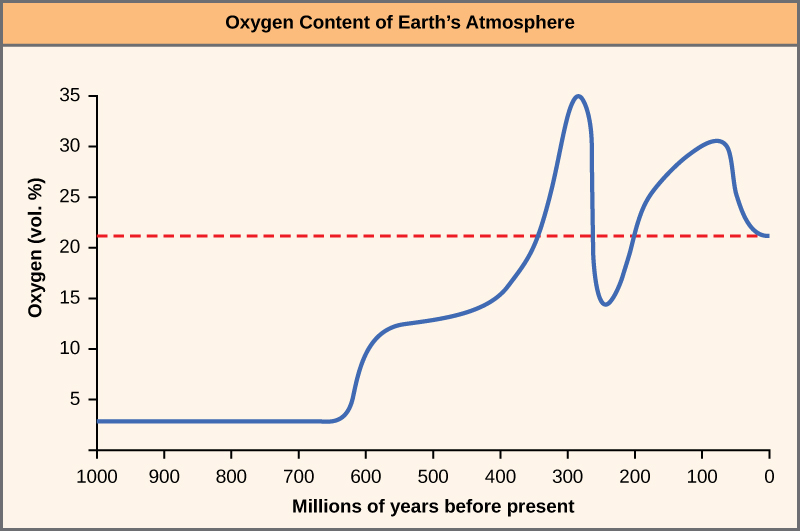


Figure 27.18図 27.18
Atmospheric oxygen over time. The oxygen concentration in Earth’s atmosphere rose sharply around 300 million years ago.
大気中酸素の変化。酸素濃度は約3億年前に急上昇した。
However, unresolved questions about the animal diversification that took place during the Cambrian period remain. For example, we do not understand how the evolution of so many species occurred in such a short period of time. Was there really an “explosion” of life at this particular time? Some scientists question the validity of this idea, because there is increasing evidence to suggest that more animal life existed prior to the Cambrian period and that other similar species’ so-called explosions (or radiations) occurred later in history as well. Furthermore, the vast diversification of animal species that appears to have begun during the Cambrian period continued well into the following Ordovician period. Despite some of these arguments, most scientists agree that the Cambrian period marked a time of impressively rapid animal evolution and diversification of body forms that is unmatched for any other time period.
英語のヒント
カンブリア紀の多様化には、なお未解決の問題がある。これほど短期間に、多くの種がどう進化したのかはわかっていない。本当にこの特定の時期に生命の「爆発」があったのだろうか。カンブリア紀以前にもっと多くの動物がいた証拠や、後の時代にも同様の種の「爆発」、すなわち放散があった証拠が増えているため、この考えの妥当性を疑う科学者もいる。さらに、カンブリア紀に始まったように見える大規模な多様化は、次のオルドビス紀まで長く続いた。こうした議論はあるものの、多くの科学者は、カンブリア紀がほかのどの時代にも匹敵しないほど急速な動物進化と体形の多様化の時代だった点で一致している。