第27章動物の多様性への導入
Animal Reproduction and Development動物の生殖と発生
Most animals are diploid organisms, meaning that their body (somatic) cells are diploid and haploid reproductive (gamete) cells are produced through meiosis. Some exceptions exist: for example, in bees, wasps, and ants, the male is haploid because it develops from unfertilized eggs. Most animals undergo sexual reproduction. However, a few groups, such as cnidarians, flatworms, and roundworms, may also undergo asexual reproduction, in which offspring originate from part of the parental body.
英語のヒント
大部分の動物は二倍体生物であり、体をつくる体細胞は二倍体で、半数体の生殖細胞である配偶子を減数分裂によってつくる。例外もあり、ミツバチ、ハチ、アリでは、雄は未受精卵から発生するため半数体である。大部分の動物は有性生殖を行う。刺胞動物、扁形動物、線形動物などの一部の群は、親の体の一部から子が生じる無性生殖も行う。
Processes of Animal Reproduction and Embryonic Development動物の生殖と胚発生の過程
During sexual reproduction, the haploid gametes of the male and female individuals of a species combine in a process called fertilization. Typically, both male and female gametes are required: the small, motile male sperm fertilizes the typically much larger, sessile female egg. This process produces a diploid fertilized egg called a zygote.
有性生殖では、同じ種の雄と雌の半数体配偶子が、受精という過程で融合する。普通は雄と雌の両方の配偶子が必要である。小さく運動性のある雄の精子が、通常ははるかに大きく、動かない雌の卵に受精する。その結果、接合子と呼ばれる二倍体の受精卵が生じる。
Some animal species—including sea stars and sea anemones—are capable of asexual reproduction. The most common forms of asexual reproduction for stationary aquatic animals include budding and fragmentation, where part of a parent individual can separate and grow into a new individual. This type of asexual reproduction produces genetically identical offspring, which would appear to be disadvantageous from the perspective of evolutionary adaptability, simply because of the potential buildup of deleterious mutations.
英語のヒント
ヒトデやイソギンチャクなど、無性生殖ができる動物もいる。定着性の水生動物では出芽と分裂がよくみられ、親個体の一部が分かれて新個体に育つ。この型の無性生殖では、遺伝的に同一の子ができる。有害な突然変異が蓄積する可能性だけを考えても、進化的な適応能力の観点からは不利に思える。
In contrast, a form of uniparental reproduction found in some insects and a few vertebrates is called parthenogenesis (or “virgin beginning”). In this case, progeny develop from a gamete, but without fertilization. Because of the nutrients stored in eggs, only females produce parthenogenetic offspring. In some insects, unfertilized eggs develop into new male offspring. This type of sex determination is called haplodiploidy, since females are diploid (with both maternal and paternal chromosomes) and males are haploid (with only maternal chromosomes). A few vertebrates, e.g., some fish, turkeys, rattlesnakes, and whiptail lizards, are also capable of parthenogenesis. In the case of turkeys and rattlesnakes, parthenogenetically reproducing females also produce only male offspring, but not because the males are haploid. In birds and rattlesnakes, the female is the heterogametic (ZW) sex, so the only surviving progeny of post-meiotic parthenogenesis would be ZZ males. In the whiptail lizards, on the other hand, only female progeny are produced by parthenogenesis. These animals may not be identical to their parent, although they have only maternal chromosomes. However, for animals that are limited in their access to mates, uniparental reproduction can ensure genetic propagation.
英語のヒント
これに対し、一部の昆虫と少数の脊椎動物にみられる、一方の親だけによる生殖を単為生殖(「処女からの始まり」)という。配偶子から子が発生するが、受精はしない。卵には栄養が蓄えられているため、単為生殖で子をつくれるのは雌だけである。一部の昆虫では、未受精卵から雄の子が生じる。雌は母方と父方の染色体をもつ二倍体、雄は母方の染色体だけをもつ半数体なので、この性決定を半倍数性という。一部の魚、シチメンチョウ、ガラガラヘビ、ムチオトカゲなど、少数の脊椎動物も単為生殖ができる。シチメンチョウとガラガラヘビでは、単為生殖する雌がつくるのも雄だけであるが、雄が半数体だからではない。鳥類とガラガラヘビでは雌が異型配偶子性(ZW)なので、減数分裂後の単為生殖で生き残れる子はZZの雄だけになる。ムチオトカゲでは逆に、雌の子だけが生じる。これらの動物は母方の染色体しかもたないが、親と同一とは限らない。交配相手に出会う機会が限られる動物にとって、一方の親だけでの生殖は、遺伝子を次代へ伝えることを確実にできる。
In animals, the zygote progresses through a series of developmental stages, during which primary germ layers (ectoderm, endoderm, and mesoderm) are established and reorganize to form an embryo. During this process, animal tissues begin to specialize and organize into organs and organ systems, determining their future morphology and physiology.
英語のヒント
動物では、接合子が一連の発生段階を進む間に、外胚葉、内胚葉、中胚葉という基本的な胚葉が成立し、再編成されて胚を形成する。この過程で組織は特殊化を始め、器官や器官系へと組織化され、将来の形態と生理機能が決まっていく。
Animal development begins with cleavage, a series of mitotic cell divisions, of the zygote (Figure 27.3). Cleavage differs from somatic cell division in that the egg is subdivided by successive cleavages into smaller and smaller cells, with no actual cell growth. The cells resulting from subdivision of the material of the egg in this way are called blastomeres. Three cell divisions transform the single-celled zygote into an eight-celled structure. After further cell division and rearrangement of existing cells, a solid morula is formed, followed by a hollow structure called a blastula. The blastula is hollow only in invertebrates whose eggs have relatively small amounts of yolk. In very yolky eggs of vertebrates, the yolk remains undivided, with most cells forming an embryonic layer on the surface of the yolk (imagine a chicken embryo growing over the egg’s yolk), which serve as food for the developing embryo.
英語のヒント
動物の発生は、接合子が一連の有糸分裂を行う卵割から始まる(図27.3)。卵割では実際の細胞成長を伴わず、連続する分裂によって卵がますます小さい細胞へ分かれる。この点が体細胞分裂とは異なる。こうして卵の物質を分けてできる細胞を割球という。三回の分裂で、一細胞の接合子は八細胞の構造になる。さらに細胞分裂と既存の細胞の再配置が進むと、中が詰まった桑実胚が生じ、その後に胞胚という中空の構造ができる。胞胚が中空なのは、卵黄の比較的少ない卵をもつ無脊椎動物だけである。卵黄が非常に多い脊椎動物の卵では、卵黄は分割されず、大部分の細胞がその表面に胚の層をつくる。卵黄の上で育つニワトリの胚を思い浮かべてほしい。卵黄は発生する胚の食物となる。
Further cell division and cellular rearrangement leads to a process called gastrulation. Gastrulation results in two important events: the formation of the primitive gut (archenteron) or digestive cavity, and the formation of the embryonic germ layers, as we have discussed above. These germ layers are programmed to develop into certain tissue types, organs, and organ systems during a process called organogenesis. Diploblastic organisms have two germ layers, endoderm and ectoderm. Endoderm forms the wall of the digestive tract, and ectoderm covers the surface of the animal. In triploblastic animals, a third layer forms: mesoderm, which differentiates into various structures between the ectoderm and endoderm, including the lining of the body cavity.
英語のヒント
細胞分裂と細胞の再配置がさらに進むと、原腸形成という過程に至る。二つの重要な出来事が起こる。原始的な腸、すなわち原腸という消化腔の形成と、先に述べた胚葉の形成である。胚葉は器官形成という過程で、特定の組織、器官、器官系へ発達するようプログラムされている。二胚葉性の生物は内胚葉と外胚葉をもつ。内胚葉は消化管壁をつくり、外胚葉は体表を覆う。三胚葉性の動物では第三の層である中胚葉が生じ、体腔の内張りを含む、外胚葉と内胚葉の間のさまざまな構造へ分化する。
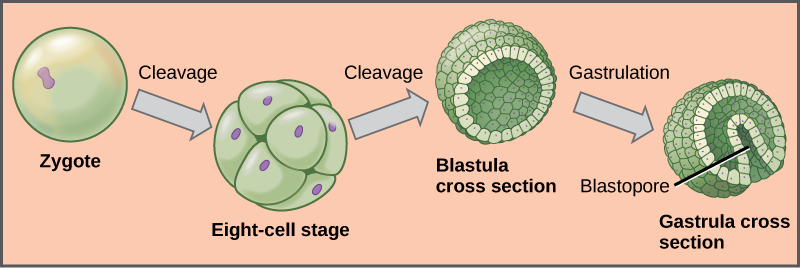
Figure 27.3図 27.3
Development of a simple embryo. During embryonic development, the zygote undergoes a series of mitotic cell divisions, or cleavages, that subdivide the egg into smaller and smaller blastomeres. Note that the 8-cell stage and the blastula are about the same size as the original zygote. In many invertebrates, the blastula consists of a single layer of cells around a hollow space. During a process called gastrulation, the cells from the blastula move inward on one side to form an inner cavity. This inner cavity becomes the primitive gut (archenteron) of the gastrula ("little gut") stage. The opening into this cavity is called the blastopore, and in some invertebrates it is destined to form the mouth.
英語のヒント
単純な胚の発生。胚発生では接合子が卵割という一連の有糸分裂を行い、卵がより小さな割球へ分かれていく。八細胞期と胞胚の大きさは、元の接合子とほぼ同じである。多くの無脊椎動物では、胞胚は中空の空間を囲む一層の細胞からなる。原腸形成では胞胚の片側の細胞が内側へ移動し、内部に腔をつくる。この腔は、原腸胚(「小さな腸」)期の原始的な腸である原腸になる。腔の入り口を原口といい、一部の無脊椎動物では将来の口になる。
Some animals produce larval forms that are different from the adult. In insects with incomplete metamorphosis, such as grasshoppers, the young resemble wingless adults, but gradually produce larger and larger wing buds during successive molts, until finally producing functional wings and sex organs during the last molt. Other animals, such as some insects and echinoderms, undergo complete metamorphosis in which the embryo develops into one or more feeding larval stages that may differ greatly in structure and function from the adult (Figure 27.4). The adult body then develops from one or more regions of larval tissue. For animals with complete metamorphosis, the larva and the adult may have different diets, limiting competition for food between them. Regardless of whether a species undergoes complete or incomplete metamorphosis, the series of developmental stages of the embryo remains largely the same for most members of the animal kingdom.
英語のヒント
成体とは異なる幼生の形をもつ動物もいる。バッタなどの不完全変態をする昆虫では、幼虫は翅のない成虫に似る。脱皮を繰り返す間に翅芽が徐々に大きくなり、最後の脱皮で機能する翅と生殖器官が生じる。一部の昆虫や棘皮動物などは完全変態をする。胚は、成体と構造や機能が大きく異なることもある、一つ以上の摂食する幼生段階へ発達する(図27.4)。その後、幼生組織の一つ以上の領域から成体が生じる。完全変態する動物では幼生と成体の食物が異なる場合があり、両者の食物をめぐる競争が少なくなる。完全変態か不完全変態かにかかわらず、胚がたどる一連の発生段階は、動物界の大部分でほぼ共通している。
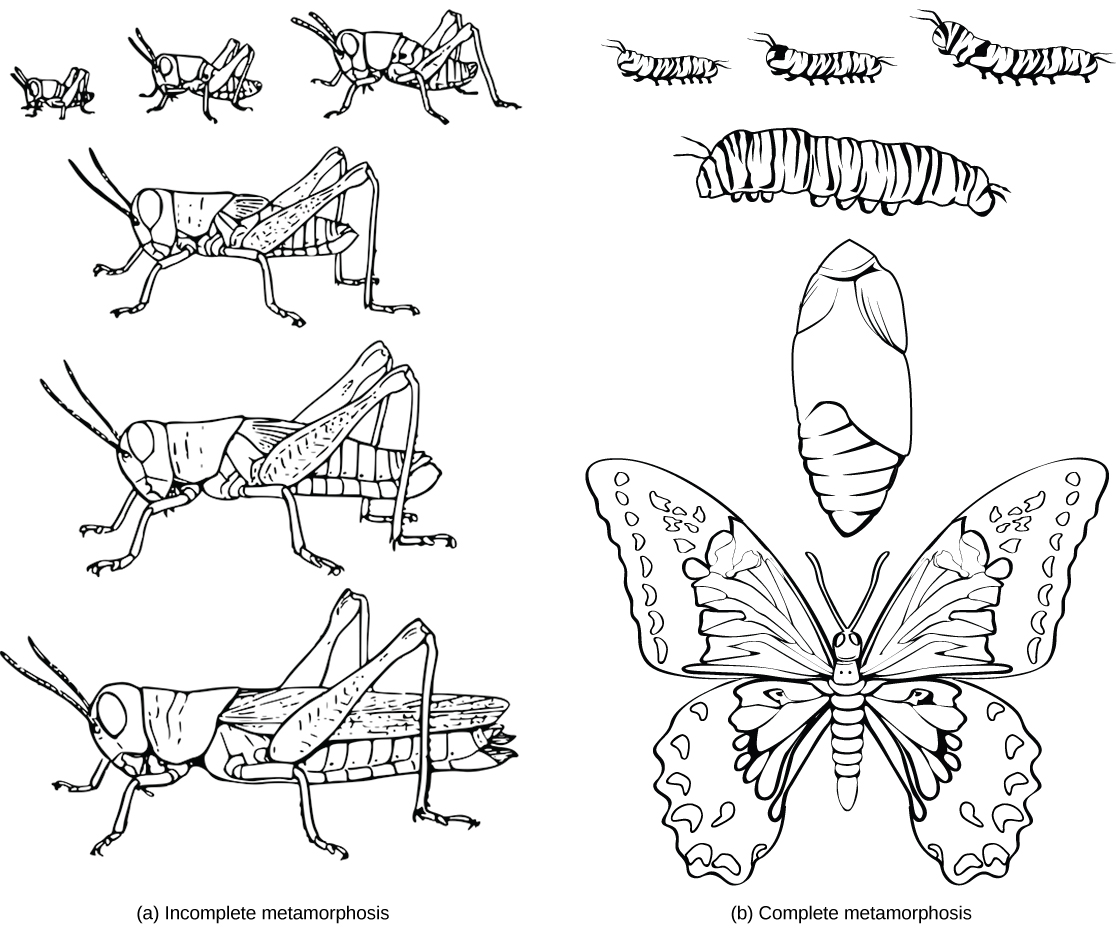


Figure 27.4図 27.4
Insect metamorphosis. (a) The grasshopper undergoes incomplete metamorphosis. (b) The butterfly undergoes complete metamorphosis. (credit: S.E. Snodgrass, USDA)
昆虫の変態。(a)バッタは不完全変態をし、(b)チョウは完全変態をする。(出典:S.E. Snodgrass、USDA)