第27章動物の多様性への導入
Post-Cambrian Evolution and Mass Extinctionsカンブリア紀以後の進化と大量絶滅
The periods that followed the Cambrian during the Paleozoic Era are marked by further animal evolution and the emergence of many new orders, families, and species. As animal phyla continued to diversify, new species adapted to new ecological niches. During the Ordovician period, which followed the Cambrian period, plant life first appeared on land. This change allowed formerly aquatic animal species to invade land, feeding directly on plants or decaying vegetation. Continual changes in temperature and moisture throughout the remainder of the Paleozoic Era due to continental plate movements encouraged the development of new adaptations to terrestrial existence in animals, such as limbed appendages in amphibians and epidermal scales in reptiles.
英語のヒント
古生代のカンブリア紀以後の各紀には、動物のさらなる進化と、多くの新たな目、科、種の出現がみられる。各門が多様化を続けるなか、新種は新しい生態的地位に適応した。カンブリア紀の次のオルドビス紀には、植物が初めて陸上に現れた。これにより、それまで水生だった動物も陸上に進出し、植物や腐敗した植物体を直接食べられるようになった。残りの古生代を通じ、大陸プレートの移動がもたらす温度と湿度の継続的な変化は、陸上生活への新たな適応を促した。両生類の四肢や爬虫類の表皮性の鱗などがその例である。
Changes in the environment often create new niches (diversified living spaces) that invite rapid speciation and increased diversity. On the other hand, cataclysmic events, such as volcanic eruptions and meteor strikes that obliterate life, can result in devastating losses of diversity to some clades, yet provide new opportunities for others to “fill in the gaps” and speciate. Such periods of mass extinction (Figure 27.19) have occurred repeatedly in the evolutionary record of life, erasing some genetic lines while creating room for others to evolve into the empty niches left behind. The end of the Permian period (and the Paleozoic Era) was marked by the largest mass extinction event in Earth’s history, a loss of an estimated 95 percent of the extant species at that time. Some of the dominant phyla in the world’s oceans, such as the trilobites, disappeared completely. On land, the disappearance of some dominant species of Permian reptiles made it possible for a new line of reptiles to emerge, the dinosaurs. The warm and stable climatic conditions of the ensuing Mesozoic Era promoted an explosive diversification of dinosaurs into every conceivable niche in land, air, and water. Plants, too, radiated into new landscapes and empty niches, creating complex communities of producers and consumers, some of which became very large on the abundant food available.
英語のヒント
環境変化は、多様な生活空間という新しいニッチをつくり、急速な種分化と多様性の増加を招くことが多い。他方、火山噴火や隕石衝突のように生命を消し去る激変は、一部のクレードの多様性を大きく失わせる一方で、他の群が「空いた場所を埋める」ように種分化する機会にもなる。このような大量絶滅期(図27.19)は生命の進化史で繰り返され、ある遺伝的系統を消すと同時に、空いたニッチへ別の系統が進化する余地を生んだ。ペルム紀末、すなわち古生代末には、地球史上最大の大量絶滅が起こり、当時の種の推定95%が失われた。三葉虫など、海で優勢だった門の一部は完全に消えた。陸上ではペルム紀の優勢な爬虫類の一部が消え、新しい爬虫類系統である恐竜が現れる余地ができた。続く中生代の温暖で安定した気候は、恐竜が陸・空・水の考えられるあらゆるニッチへ爆発的に多様化するのを促した。植物も新たな景観と空いたニッチへ放散し、生産者と消費者の複雑な群集を形成した。豊富な食物を利用し、非常に大きくなるものもあった。
Another mass extinction event occurred at the end of the Cretaceous period, bringing the Mesozoic Era to an end. Skies darkened and temperatures fell after a large meteor impact and tons of volcanic ash ejected into the atmosphere blocked incoming sunlight. Plants died, herbivores and carnivores starved, and the dinosaurs ceded their dominance of the landscape to the more warm-blooded mammals. In the following Cenozoic Era, mammals radiated into terrestrial and aquatic niches once occupied by dinosaurs, and birds—the warm-blooded direct descendants of one line of the ruling reptiles—became aerial specialists. The appearance and dominance of flowering plants in the Cretaceous Era created new niches for pollinating insects, as well as for birds and mammals. Changes in animal species diversity during the late Cretaceous and early Cenozoic were also promoted by a dramatic shift in Earth’s geography, as tectonic plates slid over the crust into their current positions, leaving some animal groups isolated on islands and continents, or separated by mountain ranges or inland seas from other competitors. Early in the Cenozoic, new ecosystems appeared, with the evolution of grasses and coral reefs, leading to their wide distribution. Late in the Cenozoic, further extinctions followed by speciation occurred during ice ages that covered high latitudes with ice and then retreated, leaving new open spaces for colonization.
英語のヒント
白亜紀末に再び大量絶滅が起こり、中生代が終わった。巨大な隕石の衝突と、大量の火山灰の大気への放出により日光が遮られ、空は暗くなり気温が下がった。植物が枯れ、草食動物も肉食動物も飢え、恐竜は陸上での優勢な地位を、より恒温性の高い哺乳類へ譲った。続く新生代には、哺乳類がかつて恐竜の占めた陸上と水中のニッチへ放散した。かつて支配的だった爬虫類の一系統の直系子孫で、恒温性をもつ鳥類は、空中生活に特殊化した。白亜紀に被子植物が現れて優勢になったことは、送粉昆虫、鳥類、哺乳類の新たなニッチを生んだ。白亜紀後期から新生代初期にかけての動物種の多様性の変化は、地理の劇的な変化にも促された。プレートが地殻上を滑って現在の位置に移り、一部の動物群は島や大陸に孤立したり、山脈や内海で他の競争相手と隔てられたりした。新生代初期にはイネ科植物とサンゴ礁の進化により新たな生態系が現れ、広く分布した。後期には氷期が高緯度を氷で覆い、その後退く間に、さらに絶滅とそれに続く種分化が起こり、新しく開けた空間への定着が可能になった。
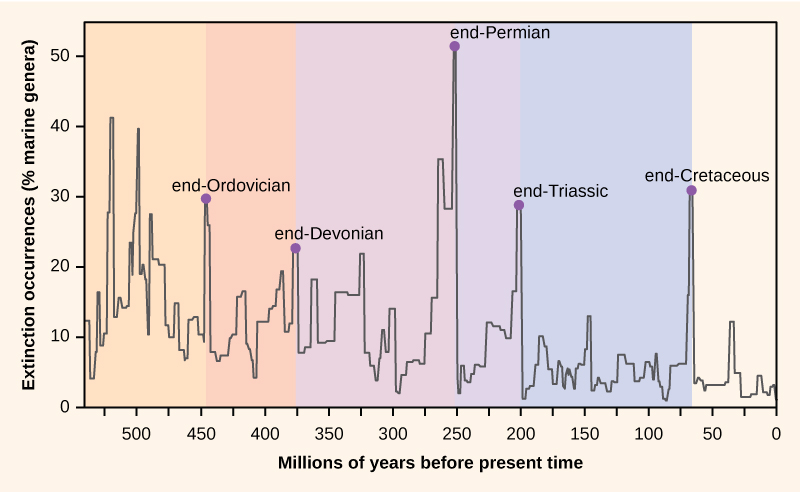

Figure 27.19図 27.19
Extinctions. Mass extinctions have occurred repeatedly over geological time.
絶滅。地質時代を通じ、大量絶滅は繰り返されてきた。