第27章動物の多様性への導入
27.2 Features Used to Classify Animals27.2 動物の分類に使う特徴
Learning Objectives学習目標
By the end of this section, you will be able to do the following:
この節を学ぶと、次のことができるようになる。
- Explain the differences in animal body plans that support basic animal classification動物の基本分類の根拠となる体制の違いを説明する。
- Compare and contrast the embryonic development of protostomes and deuterostomes旧口動物と新口動物の胚発生の共通点と相違点を述べる。
Scientists have developed a classification scheme that categorizes all members of the animal kingdom, although there are exceptions to most “rules” governing animal classification (Figure 27.6). Animals have been traditionally classified according to two characteristics: body plan and developmental pathway. The major feature of the body plan is its symmetry: how the body parts are distributed along the major body axis. Symmetrical animals can be divided into roughly equivalent halves along at least one axis. Developmental characteristics include the number of germ tissue layers formed during development, the origin of the mouth and anus, the presence or absence of an internal body cavity, and other features of embryological development, such as larval types or whether or not periods of growth are interspersed with molting.
英語のヒント
科学者は動物界の全生物を分類する体系をつくってきた。ただし、分類の「規則」の大部分には例外がある(図27.6)。従来は、体制と発生経路という二つの特徴に基づいて分類してきた。体制の主要な特徴は対称性、すなわち体の主要な軸に沿って各部分がどう配置されるかである。対称な動物は、少なくとも一つの軸に沿って、ほぼ等しい二つの半分に分けられる。発生の特徴には、形成される胚葉の数、口と肛門の起源、内部の体腔の有無などがある。そのほか、幼生の型や、成長期の間に脱皮が挟まるかどうかといった特徴も含まれる。
Animal Characterization Based on Body Symmetry体の対称性による動物の特徴づけ
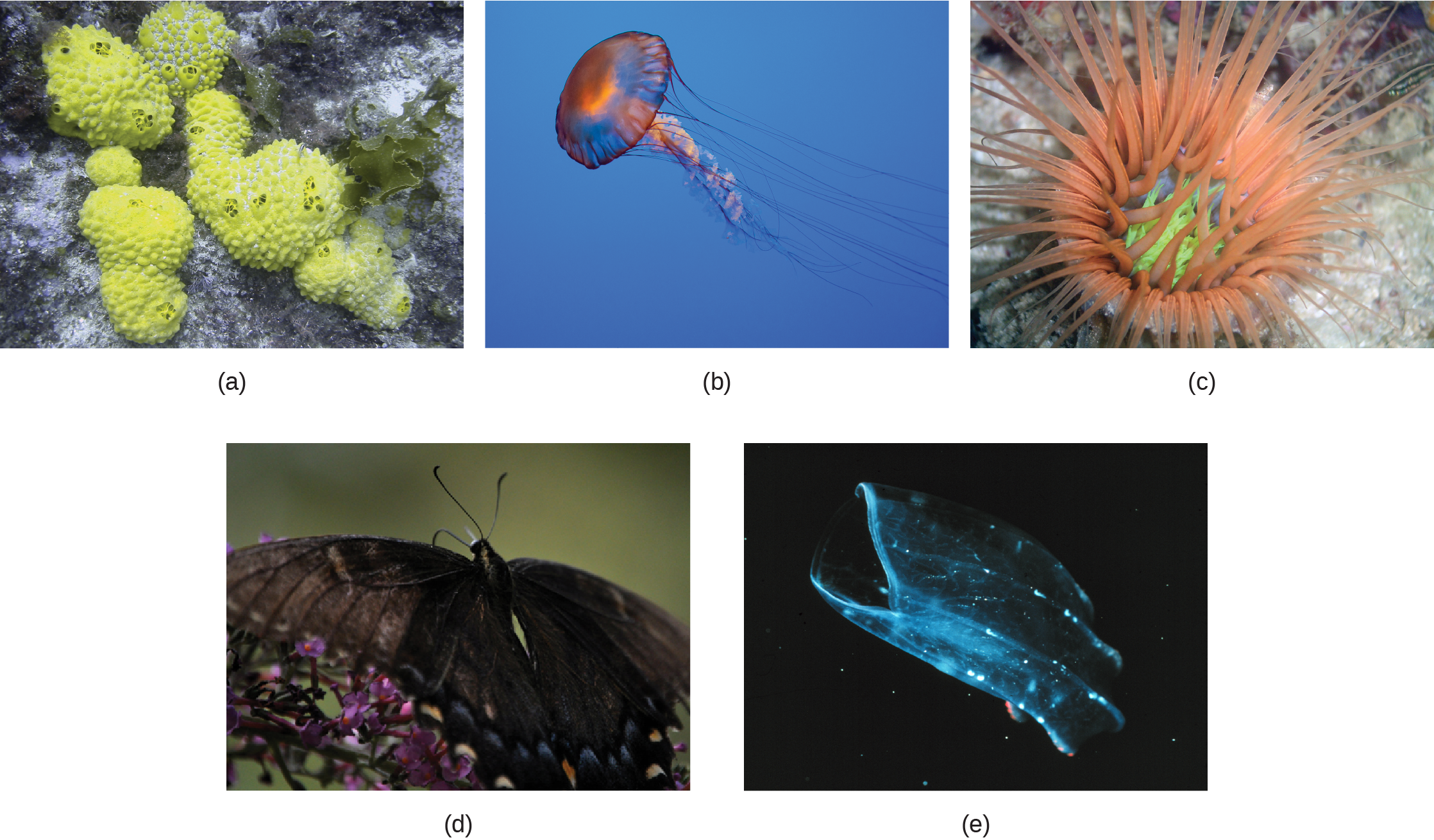
At a very basic level of classification, true animals can be largely divided into three groups based on the type of symmetry of their body plan: radially symmetrical, bilaterally symmetrical, and asymmetrical. Asymmetry is seen in two modern clades, the Parazoa (Figure 27.7a) and Placozoa. (Although we should note that the ancestral fossils of the Parazoa apparently exhibited bilateral symmetry.) One clade, the Cnidaria (Figure 27.7b,c), exhibits radial or biradial symmetry: Ctenophores have rotational symmetry (Figure 27.7e). Bilateral symmetry is seen in the largest of the clades, the Bilateria (Figure 27.7d); however the Echinodermata are bilateral as larvae and metamorphose secondarily into radial adults. All types of symmetry are well suited to meet the unique demands of a particular animal’s lifestyle.
英語のヒント
Radial symmetry is the arrangement of body parts around a central axis, as is seen in a bicycle wheel or pie. It results in animals having top and bottom surfaces but no left and right sides, nor front or back. If a radially symmetrical animal is divided in any direction along the oral/aboral axis (the side with a mouth is “oral side,” and the side without a mouth is the “aboral side”), the two halves will be mirror images. This form of symmetry marks the body plans of many animals in the phyla Cnidaria, including jellyfish and adult sea anemones (Figure 27.7b, c). Radial symmetry equips these sea creatures (which may be sedentary or only capable of slow movement or floating) to experience the environment equally from all directions. Bilaterally symmetrical animals, like butterflies (Figure 27.7d) have only a single plane along which the body can be divided into equivalent halves. The Ctenophora (Figure 27.7e), although they look similar to jellyfish, are considered to have rotational symmetry rather than radial or biradial symmetry because division of the body into two halves along the oral/aboral axis divides them into two copies of the same half, with one copy rotated 180o, rather than two mirror images.
英語のヒント
放射相称とは、自転車の車輪やパイのように、中心軸の周りに体の各部分が並ぶことである。上面と下面はあるが、左右も前後もない。口側・反口側の軸に沿ってどの方向から切っても、二つの半分は鏡像になる。口のある側を口側、ない側を反口側という。クラゲや成体のイソギンチャクなど、多くの刺胞動物の体制に特徴的である(図27.7b、c)。これらの海の動物は定着していたり、ゆっくり動くか漂うだけだったりするが、放射相称によってどの方向の環境にも等しく接することができる。チョウなどの左右相称動物では、等しい半分に分けられる面は一つだけである(図27.7d)。有櫛動物(図27.7e)はクラゲに似るが、放射相称や二放射相称ではなく回転対称とされる。口側・反口側の軸に沿って二分すると、二つは鏡像ではなく、同じ半分を180o回転させた配置になるためである。
OpenStax, Rice University; Biology 2e. (credit a: modification of work by Andrew Turner; credit b: modification of work by Robert Freiburger; credit c: modification of work by Samuel Chow; credit d: modification of work by Cory Zanker; credit e: modification of work by NOAA) · CC BY 4.0 · Source出典
Figure 27.7図 27.7
Symmetry in animals. The (a) sponge is asymmetrical. The (b) jellyfish and (c) anemone are radially symmetrical, the (d) butterfly is bilaterally symmetrical. Rotational symmetry (e) is seen in the ctenophore Beroe, shown swimming open-mouthed. (credit a: modification of work by Andrew Turner; credit b: modification of work by Robert Freiburger; credit c: modification of work by Samuel Chow; credit d: modification of work by Cory Zanker; credit e: modification of work by NOAA)
動物の対称性。(a)カイメンは非対称。(b)クラゲと(c)イソギンチャクは放射相称、(d)チョウは左右相称である。(e)回転対称を示す有櫛動物のウリクラゲBeroeが、口を開けて泳いでいる。(出典a:Andrew Turner、b:Robert Freiburger、c:Samuel Chow、d:Cory Zanker、e:NOAAの作品を改変)
Bilateral symmetry involves the division of the animal through a midsagittal plane, resulting in two superficially mirror images, right and left halves, such as those of a butterfly (Figure 27.7d), crab, or human body. Animals with bilateral symmetry have a “head” and “tail” (anterior vs. posterior), front and back (dorsal vs. ventral), and right and left sides (Figure 27.8). All Eumetazoa except those with secondary radial symmetry are bilaterally symmetrical. The evolution of bilateral symmetry that allowed for the formation of anterior and posterior (head and tail) ends promoted a phenomenon called cephalization, which refers to the collection of an organized nervous system at the animal’s anterior end. In contrast to radial symmetry, which is best suited for stationary or limited-motion lifestyles, bilateral symmetry allows for streamlined and directional motion. In evolutionary terms, this simple form of symmetry promoted active and controlled directional mobility and increased sophistication of resource-seeking and predator-prey relationships.
英語のヒント
左右相称では、動物を正中矢状面で分けると、チョウ(図27.7d)、カニ、ヒトの体のように、外見上は鏡像となる左右の半分が得られる。頭と尾(前方と後方)、前と後ろ(背側と腹側)、右と左がある(図27.8)。二次的な放射相称をもつものを除き、すべての真正後生動物は左右相称である。左右相称の進化によって前端と後端、すなわち頭と尾が形成できるようになり、頭化という現象が促された。これは組織化した神経系が前端に集中することである。定着性や限られた運動に適する放射相称と異なり、左右相称は流線型で方向性のある運動を可能にする。進化の観点では、この単純な対称性が、能動的で制御された方向性のある移動や、資源探索と捕食者・被食者関係の高度化を促した。
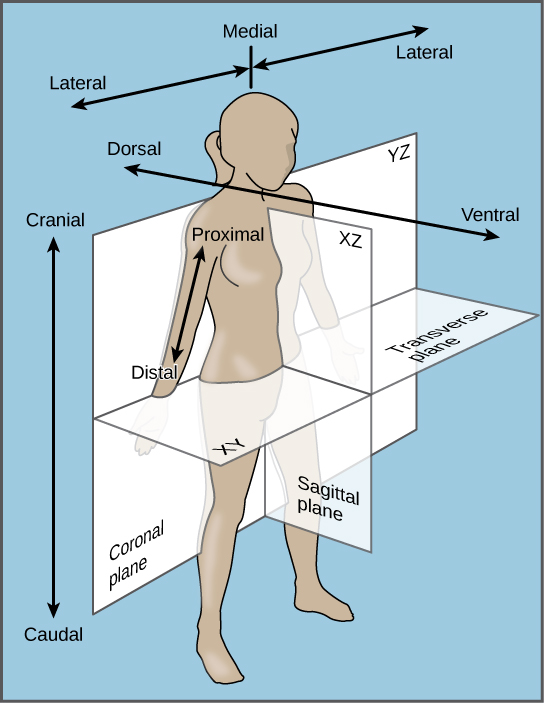


Figure 27.8図 27.8
Bilateral symmetry. The bilaterally symmetrical human body can be divided by several planes.
左右相称。左右相称のヒトの体は、複数の面で区切ることができる。
Animals in the phylum Echinodermata (such as sea stars, sand dollars, and sea urchins) display modified radial symmetry as adults, but as we have noted, their larval stages (such as the bipinnaria) initially exhibit bilateral symmetry until they metamorphose in animals with radial symmetry (this is termed secondary radial symmetry). Echinoderms evolved from bilaterally symmetrical animals; thus, they are classified as bilaterally symmetrical.
ヒトデ、カシパン、ウニなどの棘皮動物は、成体では変形した放射相称を示す。しかし前述のとおり、ビピンナリアなどの幼生は最初は左右相称であり、変態すると放射相称になる。これを二次的な放射相称という。棘皮動物は左右相称の動物から進化したため、左右相称動物に分類される。