The fact that biology, as a science, has such a broad scope has to do with the tremendous diversity of life on earth. The source of this diversity is evolution, the process of gradual change in a population or species over time. Evolutionary biologists study the evolution of living things in everything from the microscopic world to ecosystems.
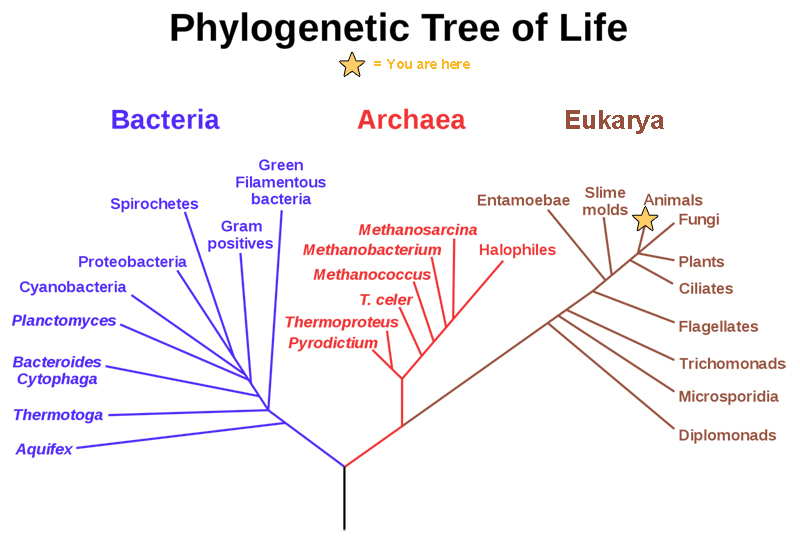
A phylogenetic tree (Figure 1.17) can summarize the evolution of various life forms on Earth. It is a diagram showing the evolutionary relationships among biological species based on similarities and differences in genetic or physical traits or both. Nodes and branches comprise a phylogenetic tree. The internal nodes represent ancestors and are points in evolution when, based on scientific evidence, researchers believe an ancestor has diverged to form two new species. In some phylogenetic trees, the length of each branch might be proportional to the time elapsed since the split.
OpenStax, Rice University; Biology 2e. (credit: Eric Gaba; NASA Astrobiology Institute) · CC BY 4.0 · Source出典
Figure 1.17図 1.17
Microbiologist Carl Woese constructed this phylogenetic tree using data that he obtained from sequencing ribosomal RNA genes. The tree shows the separation of living organisms into three domains: Bacteria, Archaea, and Eukarya. Bacteria and Archaea are prokaryotes, single-celled organisms lacking intracellular organelles. (credit: Eric Gaba; NASA Astrobiology Institute)
The scope of biology is broad and therefore contains many branches and subdisciplines. Biologists may pursue one of those subdisciplines and work in a more focused field. For instance, molecular biology and biochemistry study biological processes at the molecular and chemical level, including interactions among molecules such as DNA, RNA, and proteins, as well as the way they are regulated. Microbiology, the study of microorganisms, is the study of the structure and function of single-celled organisms. It is quite a broad branch itself, and depending on the subject of study, there are also microbial physiologists, ecologists, and geneticists, among others.
Another field of biological study, neurobiology, studies the biology of the nervous system, and although it is a branch of biology, it is also an interdisciplinary field of study known as neuroscience. Because of its interdisciplinary nature, this subdiscipline studies different nervous system functions using molecular, cellular, developmental, medical, and computational approaches.
Paleontology, another branch of biology, uses fossils to study life’s history (Figure 1.20). Zoology and botany are the study of animals and plants, respectively. Biologists can also specialize as biotechnologists, ecologists, or physiologists, to name just a few areas. This is just a small sample of the many fields that biologists can pursue.
Biology is the culmination of the achievements of the natural sciences from their inception to today. Excitingly, it is the cradle of emerging sciences, such as the biology of brain activity, genetic engineering of custom organisms, and the biology of evolution that uses the laboratory tools of molecular biology to retrace the earliest stages of life on Earth. A scan of news headlines—whether reporting on immunizations, a newly discovered species, sports doping, or a genetically-modified food—demonstrates the way biology is active in and important to our everyday world.