第1章生命の探究
Growth and Development成長と発生
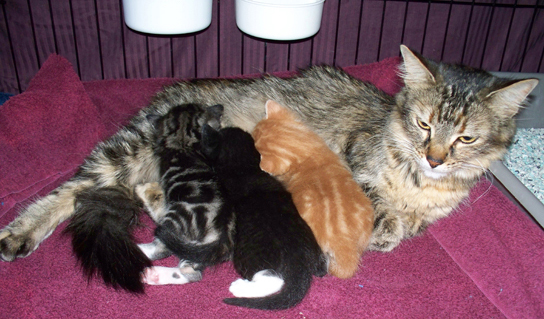
Organisms grow and develop as a result of genes providing specific instructions that will direct cellular growth and development. This ensures that a species’ young (Figure 1.12) will grow up to exhibit many of the same characteristics as its parents.
生物は、遺伝子が細胞の成長や発生を導く具体的な指示を与えることによって、成長し、発生する。そのため、ある種の子ども(図1.12)は、親と共通する多くの特徴を示すように育つ。
OpenStax, Rice University; Biology 2e. (credit: Rocky Mountain Feline Rescue) · CC BY 4.0 · Source出典
Figure 1.12図 1.12
Although no two look alike, these kittens have inherited genes from both parents and share many of the same characteristics. (credit: Rocky Mountain Feline Rescue)
英語のヒント
この子ネコたちは、どの二匹も同じ姿ではないが、両親から遺伝子を受け継ぎ、多くの特徴を共有している。(出典:Rocky Mountain Feline Rescue)
Regulation/Homeostasis調節と恒常性
Even the smallest organisms are complex and require multiple regulatory mechanisms to coordinate internal functions, respond to stimuli, and cope with environmental stresses. Homeostasis (literally, “steady state”) refers to the relatively stable internal environment required to maintain life. Two examples of internal functions regulated in an organism are nutrient transport and blood flow. Organs (groups of tissues working together) perform specific functions, such as carrying oxygen throughout the body, removing wastes, delivering nutrients to every cell, and cooling the body.
英語のヒント
最も小さな生物でさえ複雑であり、内部の働きを調整し、刺激に応答し、環境からのストレスに対処するために、複数の調節機構を必要とする。恒常性(homeostasis。文字どおりには「安定した状態」)とは、生命の維持に必要な、比較的安定した内部環境を指す。生物の内部で調節される機能の例として、栄養素の輸送と血流がある。器官、すなわち協働する組織の集まりは、体全体に酸素を運ぶ、老廃物を取り除く、すべての細胞へ栄養素を届ける、体を冷やすといった特定の機能を果たす。
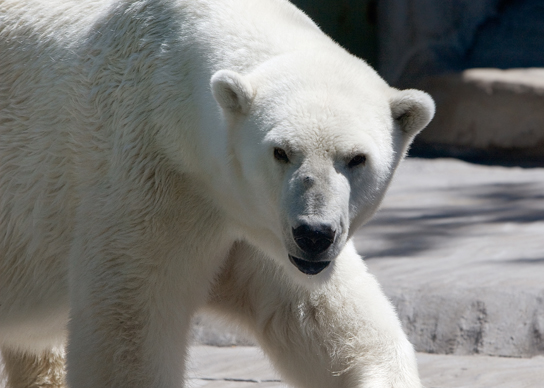


Figure 1.13図 1.13
Polar bears (Ursus maritimus) and other mammals living in ice-covered regions maintain their body temperature by generating heat and reducing heat loss through thick fur and a dense layer of fat under their skin. (credit: “longhorndave”/Flickr)
英語のヒント
ホッキョクグマ(Ursus maritimus)をはじめ、氷に覆われた地域にすむ哺乳類は、熱を生み出すとともに、厚い毛皮と皮下の厚い脂肪層で熱の損失を抑え、体温を保っている。(出典:“longhorndave”/Flickr)
In order to function properly, cells require appropriate conditions such as proper temperature, pH, and appropriate concentration of diverse chemicals. These conditions may, however, change from one moment to the next. Organisms are able to maintain homeostatic internal conditions within a narrow range almost constantly, despite environmental changes, by activation of regulatory mechanisms. For example, an organism needs to regulate body temperature through the thermoregulation process. Organisms that live in cold climates, such as the polar bear (Figure 1.13), have body structures that help them withstand low temperatures and conserve body heat. Structures that aid in this type of insulation include fur, feathers, blubber, and fat. In hot climates, organisms have methods (such as perspiration in humans or panting in dogs) that help them to shed excess body heat.
英語のヒント
細胞が正常に機能するには、適切な温度、pH、さまざまな化学物質の適切な濃度など、ふさわしい条件が必要である。しかし、これらの条件は刻々と変わりうる。生物は調節機構を作動させることで、環境が変わっても、内部の条件をほぼ常に狭い範囲に保ち、恒常性を維持できる。例えば、生物は体温調節によって体温を調整する必要がある。ホッキョクグマ(図1.13)のように寒い気候にすむ生物には、低温に耐え、体の熱を保つのに役立つ構造がある。この断熱を助ける構造には、毛皮、羽毛、皮下の厚い脂肪層、脂肪などがある。暑い気候では、生物は人間の発汗や犬のあえぎ呼吸などの方法によって、余分な体熱を放散する。
Energy Processingエネルギーの利用
OpenStax, Rice University; Biology 2e. (credit: Pacific Southwest Region U.S. Fish and Wildlife Service) · CC BY 4.0 · Source出典

Figure 1.14図 1.14
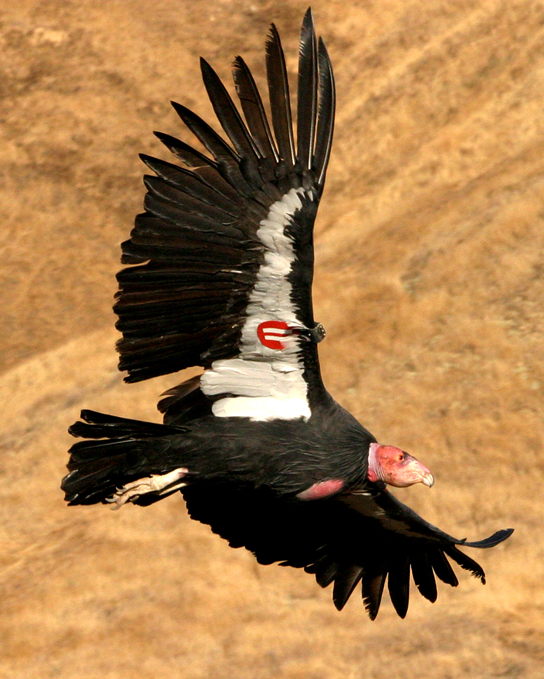
The California condor (Gymnogyps californianus) uses chemical energy derived from food to power flight. California condors are an endangered species. This bird has a wing tag that helps biologists identify the individual. (credit: Pacific Southwest Region U.S. Fish and Wildlife Service)
英語のヒント
カリフォルニアコンドル(Gymnogyps californianus)は、食物に由来する化学エネルギーを飛行の動力にしている。カリフォルニアコンドルは絶滅危惧種である。この鳥の翼には、生物学者が個体を識別するのに役立つタグが付いている。(出典:Pacific Southwest Region U.S. Fish and Wildlife Service)
All organisms use a source of energy for their metabolic activities. Some organisms capture energy from the sun and convert it into chemical energy in food. Others use chemical energy in molecules they take in as food (Figure 1.14).
英語のヒント
すべての生物は、代謝活動のためにエネルギー源を利用する。太陽からエネルギーを取り込み、食物の化学エネルギーに変える生物もいれば、食物として取り込んだ分子の化学エネルギーを使う生物もいる(図1.14)。
Evolution進化
The diversity of life on Earth is a result of mutations, or random changes in hereditary material over time. These mutations allow the possibility for organisms to adapt to a changing environment. An organism that evolves characteristics fit for the environment will have greater reproductive success, subject to the forces of natural selection.
英語のヒント
地球上の生命の多様性は、時間とともに遺伝物質に起こる無作為な変化、すなわち突然変異の結果である。こうした突然変異は、生物が変化する環境に適応する可能性をもたらす。環境に合う特徴を進化させた生物は、自然選択の力を受ける中で、より高い繁殖成功を収める。
Levels of Organization of Living Things生物を構成する階層
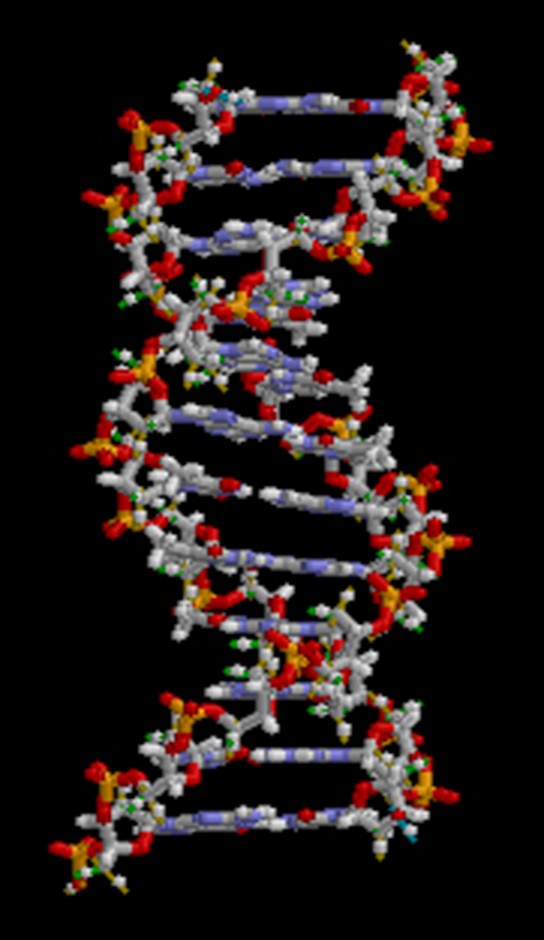
Living things are highly organized and structured, following a hierarchy that we can examine on a scale from small to large. The atom is the smallest and most fundamental unit of matter that retains the properties of an element. It consists of a nucleus surrounded by electrons. Atoms form molecules. A molecule is a chemical structure consisting of at least two atoms held together by one or more chemical bonds. Many molecules that are biologically important are macromolecules, large molecules that are typically formed by polymerization (a polymer is a large molecule that is made by combining smaller units called monomers, which are simpler than macromolecules). An example of a macromolecule is deoxyribonucleic acid (DNA) (Figure 1.15), which contains the instructions for the structure and functioning of all living organisms.
英語のヒント
生物は高度に組織化され、構造をもっている。その階層は、小さなものから大きなものまでの尺度で調べられる。原子は、元素の性質を保つ、物質の最小かつ最も基本的な単位である。原子は、電子に囲まれた原子核からなる。原子は分子をつくる。分子は、一つ以上の化学結合によってつながれた、少なくとも二つの原子からなる化学構造である。生物学的に重要な分子の多くは高分子である。高分子は、通常、重合によって形成される大きな分子である(重合体とは、単量体という、高分子より単純で小さな単位を結合させてできる大きな分子をいう)。高分子の一例はデオキシリボ核酸(DNA)(図1.15)であり、すべての生物の構造と働きについての指示を含んでいる。
OpenStax, Rice University; Biology 2e. (credit: “brian0918”/Wikimedia Commons) · CC BY 4.0 · Source出典

Figure 1.15図 1.15
All molecules, including this DNA molecule, are comprised of atoms. (credit: “brian0918”/Wikimedia Commons)
英語のヒント
このDNA分子を含め、すべての分子は原子で構成される。(出典:“brian0918”/Wikimedia Commons)
Some cells contain aggregates of macromolecules surrounded by membranes. We call these organelles. Organelles are small structures that exist within cells. Examples of organelles include mitochondria and chloroplasts, which carry out indispensable functions: mitochondria process energy to power the cell, while chloroplasts enable green plants to utilize the energy in sunlight to make sugars. All living things are made of cells. The cell itself is the smallest fundamental unit of structure and function in living organisms. (This requirement is why scientists do not consider viruses living: they are not made of cells. To make new viruses, they have to invade and hijack the reproductive mechanism of a living cell. Only then can they obtain the materials they need to reproduce.) Some organisms consist of a single cell and others are multicellular. Scientists classify cells as prokaryotic or eukaryotic. Prokaryotes are single-celled or colonial organisms that do not have membrane-bound nuclei. In contrast, the cells of eukaryotes do have membrane-bound organelles and a membrane-bound nucleus.
英語のヒント
細胞の中には、膜で囲まれた高分子の集合体を含むものがある。これらを細胞小器官と呼ぶ。細胞小器官は細胞内に存在する小さな構造である。ミトコンドリアや葉緑体がその例であり、いずれも欠かせない機能を果たす。ミトコンドリアは細胞を動かすためのエネルギーを処理し、葉緑体は緑色植物が太陽光のエネルギーを使って糖をつくることを可能にする。すべての生物は細胞からできている。細胞そのものが、生物の構造と機能の最小の基本単位である。(この条件があるため、科学者はウイルスを生物とはみなさない。ウイルスは細胞からできていないからだ。新しいウイルスをつくるには、生きた細胞に侵入し、その増殖の仕組みを乗っ取らなければならない。そうして初めて、増殖に必要な材料を得られる。)一つの細胞からなる生物もあれば、多細胞の生物もある。科学者は細胞を原核細胞と真核細胞に分類する。原核生物は単細胞または群体をつくる生物であり、膜に囲まれた核をもたない。これに対し、真核生物の細胞には、膜に囲まれた細胞小器官と核がある。
In larger organisms, cells combine to make tissues, which are groups of similar cells carrying out similar or related functions. Organs are collections of tissues grouped together performing a common function. Organs are present not only in animals but also in plants. An organ system is a higher level of organization that consists of functionally related organs. Mammals have many organ systems. For instance, the circulatory system transports blood through the body and to and from the lungs. It includes organs such as the heart and blood vessels. Organisms are individual living entities. For example, each tree in a forest is an organism. Single-celled prokaryotes and single-celled eukaryotes are also organisms, which biologists typically call microorganisms.
英語のヒント
より大きな生物では、細胞が集まって組織をつくる。組織とは、同じ、または関連する機能を果たす、似た細胞の集まりである。器官は、共通の機能を果たすようにまとめられた組織の集合である。器官は動物だけでなく植物にも存在する。器官系は、機能的に関連する器官からなる、さらに上位の構成階層である。哺乳類には多くの器官系がある。例えば、循環器系は体全体と肺の間で血液を運び、心臓や血管などの器官を含む。生物個体とは、それぞれ独立して生きている存在である。例えば、森の木は一本ずつが生物個体である。単細胞の原核生物や真核生物も生物であり、生物学者は通常、それらを微生物と呼ぶ。
Biologists collectively call all the individuals of a species living within a specific area a population. For example, a forest may include many pine trees, which represent the population of pine trees in this forest. Different populations may live in the same specific area. For example, the forest with the pine trees includes populations of flowering plants, insects, and microbial populations. A community is the sum of populations inhabiting a particular area. For instance, all of the trees, flowers, insects, and other populations in a forest form the forest’s community. The forest itself is an ecosystem. An ecosystem consists of all the living things in a particular area together with the abiotic, nonliving parts of that environment such as nitrogen in the soil or rain water. At the highest level of organization (Figure 1.16), the biosphere is the collection of all ecosystems, and it represents the zones of life on Earth. It includes land, water, and even the atmosphere to a certain extent.
英語のヒント
生物学者は、特定の地域にすむ、ある種のすべての個体をまとめて個体群と呼ぶ。例えば、森にたくさんのマツがあれば、それらはその森のマツの個体群をなす。同じ地域には、異なる個体群がすめる。例えば、マツのある森には、花を咲かせる植物、昆虫、微生物の個体群も含まれる。群集とは、ある地域にすむ個体群の総体である。例えば、森のすべての樹木、花、昆虫、その他の個体群が、その森の群集を形成する。森そのものは生態系である。生態系は、ある地域のすべての生物と、土壌中の窒素や雨水など、その環境の非生物的な部分とからなる。構成の最上位の階層(図1.16)にある生物圏は、すべての生態系の集まりであり、地球上で生命が存在する領域を表す。生物圏には陸域、水域、さらには大気の一部も含まれる。