第1章生命の探究
Scientific Reasoning科学的な推論
One thing is common to all forms of science: an ultimate goal “to know.” Curiosity and inquiry are the driving forces for the development of science. Scientists seek to understand the world and the way it operates. To do this, they use two methods of logical thinking: inductive reasoning and deductive reasoning.
英語のヒント
あらゆる科学に共通することが一つある。それは「知ること」という究極の目標である。好奇心と探究心は、科学の発展を進める力となる。科学者は、世界とその働き方を理解しようとする。そのために、帰納的推論と演繹的推論という二つの論理的思考法を用いる。
Inductive reasoning is a form of logical thinking that uses related observations to arrive at a general conclusion. This type of reasoning is common in descriptive science. A life scientist such as a biologist makes observations and records them. These data can be qualitative or quantitative, and one can supplement the raw data with drawings, pictures, photos, or videos. From many observations, the scientist can infer conclusions (inductions) based on evidence. Inductive reasoning involves formulating generalizations inferred from careful observation and analyzing a large amount of data. Brain studies provide an example. In this type of research, scientists observe many live brains while people are engaged in a specific activity, such as viewing images of food. The scientist then predicts the part of the brain that “lights up” during this activity to be the part controlling the response to the selected stimulus, in this case, images of food. Excess absorption of radioactive sugar derivatives by active areas of the brain causes the various areas to "light up". Scientists use a scanner to observe the resultant increase in radioactivity. Then, researchers can stimulate that part of the brain to see if similar responses result.
英語のヒント
帰納的推論とは、互いに関連する観察から一般的な結論に到達する論理的思考の一形態である。この推論は、記述的な科学でよく用いられる。生物学者などの生命科学者は観察を行い、その結果を記録する。データは定性的なことも定量的なこともあり、生のデータを図、絵、写真、動画で補うこともできる。科学者は、多くの観察から、証拠に基づいて結論を推論する(帰納する)。帰納的推論では、注意深い観察と大量のデータの分析から導かれた一般化を組み立てる。脳の研究が一例になる。この種の研究では、食べ物の画像を見るといった特定の活動をしている人の、生きた脳を多数観察する。研究者は、その活動中に「光る」脳の部位が、選んだ刺激、この場合は食べ物の画像に対する反応を制御している部位だと予測する。脳の活動している領域が放射性の糖誘導体を多く取り込むため、それぞれの領域が「光る」。科学者はスキャナーを使い、それによって生じる放射能の増加を観察する。次に、その脳の部位を刺激して、同様の反応が起こるかどうかを調べることができる。
Deductive reasoning or deduction is the type of logic used in hypothesis-based science. In deductive reasoning, the pattern of thinking moves in the opposite direction as compared to inductive reasoning. Deductive reasoning is a form of logical thinking that uses a general principle or law to predict specific results. From those general principles, a scientist can deduce and predict the specific results that would be valid as long as the general principles are valid. Studies in climate change can illustrate this type of reasoning. For example, scientists may predict that if the climate becomes warmer in a particular region, then the distribution of plants and animals should change.
英語のヒント
演繹的推論、または演繹とは、仮説に基づく科学で用いる論理の一種である。演繹的推論の思考は、帰納的推論とは逆の方向に進む。演繹的推論とは、一般的な原理や法則から個別の結果を予測する論理的思考の一形態である。その一般原理が成り立つ限り、科学者は、そこから導かれる個別の結果を推論し、予測できる。気候変動の研究で、この推論の仕方を説明できる。例えば、ある地域の気候が温暖になれば、植物や動物の分布が変化するはずだと予測できる。
Both types of logical thinking are related to the two main pathways of scientific study: descriptive science and hypothesis-based science. Descriptive (or discovery) science, which is usually inductive, aims to observe, explore, and discover, while hypothesis-based science, which is usually deductive, begins with a specific question or problem and a potential answer or solution that one can test. The boundary between these two forms of study is often blurred, and most scientific endeavors combine both approaches. The fuzzy boundary becomes apparent when thinking about how easily observation can lead to specific questions. For example, a gentleman in the 1940s observed that the burr seeds that stuck to his clothes and his dog’s fur had a tiny hook structure. On closer inspection, he discovered that the burrs’ gripping device was more reliable than a zipper. He eventually experimented to find the best material that acted similarly, and produced the hook-and-loop fastener popularly known today as Velcro. Descriptive science and hypothesis-based science are in continuous dialogue.
英語のヒント
この二つの論理的思考法は、科学研究の二つの主要な進め方、すなわち記述的な科学と仮説に基づく科学に関連している。記述的な科学(または発見の科学)は通常、帰納的であり、観察し、探究し、発見することを目指す。これに対し、仮説に基づく科学は通常、演繹的であり、特定の問いや問題と、検証可能な答えや解決策の候補から始まる。二つの研究の境界はしばしば曖昧であり、科学上の取り組みの多くは両方を組み合わせている。観察が容易に具体的な問いにつながることを考えると、この境界の曖昧さがはっきりする。例えば1940年代、ある男性は、自分の服や犬の毛にくっついた、とげのある実に小さな鉤状の構造があることに気づいた。詳しく調べると、実が引っかかる仕組みはファスナーより確実に働くと分かった。やがて彼は、同じように働く最適な材料を見つけるために実験し、現在ベルクロという名で広く知られる面ファスナーをつくり出した。記述的な科学と仮説に基づく科学は、絶えず互いに働きかけている。
The Scientific Method科学的方法
Biologists study the living world by posing questions about it and seeking science-based responses. Known as scientific method, this approach is common to other sciences as well. The scientific method was used even in ancient times, but England’s Sir Francis Bacon (1561–1626) first documented it (Figure 1.5). He set up inductive methods for scientific inquiry. The scientific method is not used only by biologists; researchers from almost all fields of study can apply it as a logical, rational problem-solving method.
英語のヒント
生物学者は、生物の世界について問いを立て、科学に基づく答えを探すことで、その世界を研究する。この進め方は科学的方法と呼ばれ、ほかの科学にも共通している。科学的方法は古代にも用いられていたが、初めて記録にまとめたのは、イングランドのサー・フランシス・ベーコン(1561〜1626年)である(図1.5)。彼は、科学的探究のための帰納的な方法を確立した。科学的方法を使うのは生物学者だけではない。ほとんどあらゆる分野の研究者が、論理的で合理的な問題解決の方法として適用できる。
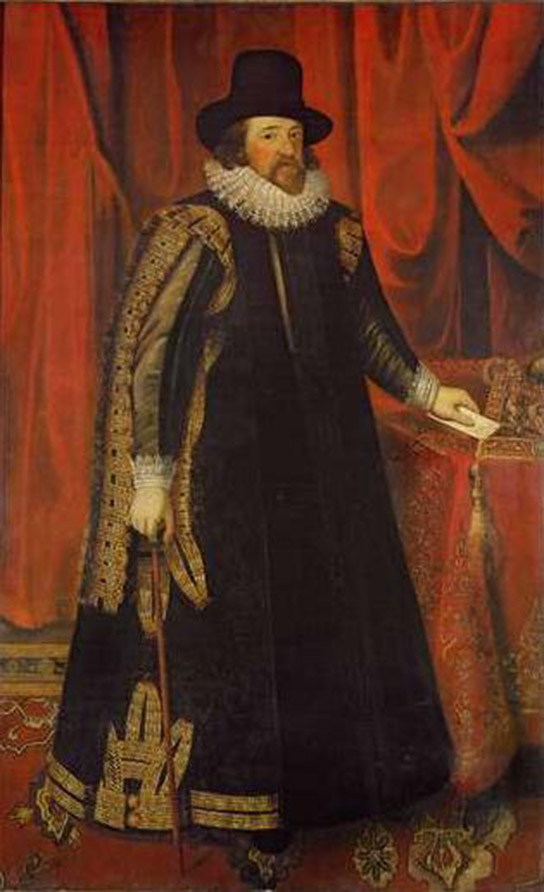

Figure 1.5図 1.5
Historians credit Sir Francis Bacon (1561–1626) as the first to define the scientific method. (credit: Paul van Somer)
英語のヒント
歴史家は、サー・フランシス・ベーコン(1561〜1626年)を、科学的方法を初めて定義した人物とみなしている。(出典:Paul van Somer)
The scientific process typically starts with an observation (often a problem to solve) that leads to a question. Let’s think about a simple problem that starts with an observation and apply the scientific method to solve the problem. One Monday morning, a student arrives at class and quickly discovers that the classroom is too warm. That is an observation that also describes a problem: the classroom is too warm. The student then asks a question: “Why is the classroom so warm?”
英語のヒント
科学の過程は通常、問いにつながる観察から始まる。観察で見つかるのは、解決すべき問題であることが多い。観察から始まる簡単な問題を考え、科学的方法を適用して解決してみよう。ある月曜日の朝、一人の学生が授業に来て、教室が暑すぎるとすぐに気づいた。これは観察であると同時に、「教室が暑すぎる」という問題を述べている。そこで学生は、「なぜ教室はこんなに暑いのだろう」と問いを立てる。