第9章細胞間の情報伝達
9.4 Signaling in Single-Celled Organisms9.4 単細胞生物のシグナル伝達
Learning Objectives学習目標
By the end of this section, you will be able to do the following:
この節を学び終えると、次のことができるようになる。
- Describe how single-celled yeasts use cell signaling to communicate with one another単細胞の酵母が細胞シグナル伝達を使って互いに連絡するしくみを説明する。
- Relate the role of quorum sensing to the ability of some bacteria to form biofilmsクオラムセンシングの役割を、一部の細菌がバイオフィルムを形成する能力と関連付ける。
Within-cell signaling allows bacteria to respond to environmental cues, such as nutrient levels. Some single-celled organisms also release molecules to signal to each other.
英語のヒント
細胞内のシグナル伝達により、細菌は栄養素の量など環境からの手がかりに応答できる。一部の単細胞生物は、互いにシグナルを送る分子も放出する。
Signaling in Yeast酵母のシグナル伝達
Yeasts are eukaryotes (fungi), and the components and processes found in yeast signals are similar to those of cell-surface receptor signals in multicellular organisms. Budding yeasts (Figure 9.16) are able to participate in a process that is similar to sexual reproduction that entails two haploid cells (cells with one-half the normal number of chromosomes) combining to form a diploid cell (a cell with two sets of each chromosome, which is what normal body cells contain). In order to find another haploid yeast cell that is prepared to mate, budding yeasts secrete a signaling molecule called mating factor. When mating factor binds to cell-surface receptors in other yeast cells that are nearby, they stop their normal growth cycles and initiate a cell signaling cascade that includes protein kinases and GTP-binding proteins that are similar to G-proteins.
英語のヒント
酵母は真核生物(菌類)であり、シグナル伝達の構成要素や過程は、多細胞生物の細胞表面受容体によるものに似ている。出芽酵母(図9.16)は、有性生殖に似た過程に参加できる。この過程では、通常の半数の染色体を持つ半数体の細胞が二つ結び付き、各染色体を2組持つ二倍体の細胞を作る。これは通常の体細胞が持つ染色体の状態である。接合できる別の半数体酵母細胞を見つけるため、出芽酵母は接合因子というシグナル分子を分泌する。近くの別の酵母細胞の細胞表面受容体に接合因子が結合すると、通常の増殖サイクルを止め、プロテインキナーゼやGタンパク質に似たGTP結合タンパク質を含むシグナル伝達カスケードを開始する。
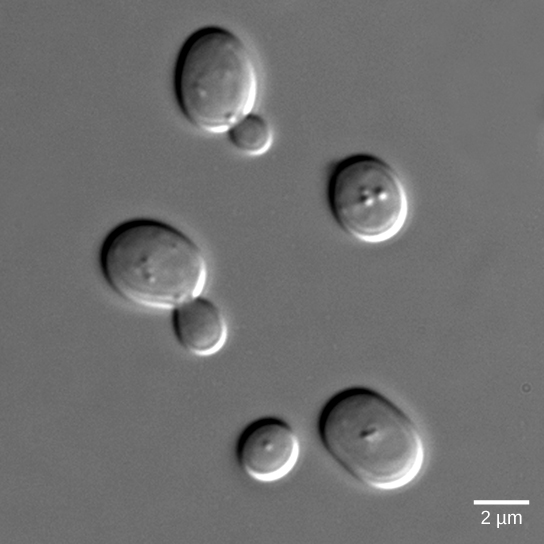

Figure 9.16図 9.16
Budding Saccharomyces cerevisiae yeast cells can communicate by releasing a signaling molecule called mating factor. In this micrograph, they are visualized using differential interference contrast microscopy, a light microscopy technique that enhances the contrast of the sample.
出芽酵母Saccharomyces cerevisiaeの細胞は、接合因子というシグナル分子を放出して連絡できる。この顕微鏡写真には、試料のコントラストを高める光学顕微鏡法である微分干渉顕微鏡法を用いている。
Signaling in Bacteria細菌のシグナル伝達
Signaling in bacteria enables bacteria to monitor extracellular conditions, ensure that there are sufficient amounts of nutrients, and ensure that hazardous situations are avoided. There are circumstances, however, when bacteria communicate with each other.
英語のヒント
細菌のシグナル伝達は、細胞外の条件を監視し、十分な栄養素があることを確かめ、危険な状況を避けることを可能にする。また、細菌どうしが連絡する状況もある。
The first evidence of bacterial communication was observed in a bacterium that has a symbiotic relationship with Hawaiian bobtail squid. When the population density of the bacteria reaches a certain level, specific gene expression is initiated, and the bacteria produce bioluminescent proteins that emit light. Because the number of cells present in the environment (cell density) is the determining factor for signaling, bacterial signaling was named quorum sensing. In politics and business, a quorum is the minimum number of members required to be present to vote on an issue.
英語のヒント
細菌間の連絡を示す最初の証拠は、ハワイヒメダンゴイカと共生する細菌で見つかった。細菌の個体群密度が一定に達すると特定の遺伝子発現が始まり、発光するタンパク質が作られる。環境内に存在する細胞数、すなわち細胞密度が伝達を決める要因なので、この細菌のシグナル伝達はクオラムセンシングと名付けられた。政治やビジネスでquorumは、議案への投票に出席しなければならない最低人数、定足数を意味する。
Quorum sensing uses autoinducers as signaling molecules. Autoinducers are signaling molecules secreted by bacteria to communicate with other bacteria of the same kind. The secreted autoinducers can be small, hydrophobic molecules, such as acyl-homoserine lactone (AHL), or larger peptide-based molecules; each type of molecule has a different mode of action. When AHL enters target bacteria, it binds to transcription factors, which then switch gene expression on or off. When the number of bacteria increases so does the concentration of the autoinducer, triggering increased expression of certain genes including autoinducers, which results in a self-amplifying cycle, also known as a positive feedback loop (Figure 9.17). The peptide autoinducers stimulate more complicated signaling pathways that include bacterial kinases. The changes in bacteria following exposure to autoinducers can be quite extensive. The pathogenic bacterium Pseudomonas aeruginosa has 616 different genes that respond to autoinducers.
英語のヒント
クオラムセンシングは、オートインデューサーをシグナル分子として使う。オートインデューサーは、同種の細菌と連絡するために細菌が分泌する分子である。アシルホモセリンラクトン(AHL)のような小さな疎水性分子の場合もあれば、より大きなペプチドを主体とする分子の場合もあり、種類によって作用のしかたが異なる。AHLは標的の細菌に入ると転写因子に結合し、遺伝子発現のオン・オフを切り替える。細菌数が増えるとオートインデューサーの濃度も上がり、オートインデューサーを含む特定の遺伝子の発現が増える。その結果、正のフィードバックループとも呼ばれる自己増幅の循環ができる(図9.17)。ペプチド性のオートインデューサーは、細菌のキナーゼを含む、さらに複雑な伝達経路を刺激する。オートインデューサーにさらされた後の細菌の変化は、非常に広範囲に及ぶことがある。病原菌である緑膿菌Pseudomonas aeruginosaには、オートインデューサーに応答する遺伝子が616種類ある。
Some species of bacteria that use quorum sensing form biofilms, complex colonies of bacteria (often containing several species) that exchange chemical signals to coordinate the release of toxins that will attack the host. Bacterial biofilms (Figure 9.18) can sometimes be found on medical equipment; when biofilms invade implants such as hip or knee replacements or heart pacemakers, they can cause life-threatening infections.
英語のヒント
クオラムセンシングを使う細菌の中には、バイオフィルムを形成する種がある。これは、多くの場合複数種を含む複雑な細菌群体で、化学シグナルを交換し、宿主を攻撃する毒素の放出を調整する。細菌のバイオフィルム(図9.18)は医療機器に見つかることがある。人工股関節、人工膝関節、心臓ペースメーカーなどの埋込機器に侵入すると、命を脅かす感染症を起こしうる。
Research on the details of quorum sensing has led to advances in growing bacteria for industrial purposes. Recent discoveries suggest that it may be possible to exploit bacterial signaling pathways to control bacterial growth; this process could replace or supplement antibiotics that are no longer effective in certain situations.
英語のヒント
クオラムセンシングの詳しい研究は、産業目的で細菌を培養する技術の進歩につながっている。最近の発見から、細菌の伝達経路を利用して増殖を制御できる可能性が示唆される。この方法は、ある状況では効かなくなった抗生物質を置き換えたり補ったりできるかもしれない。