第9章細胞間の情報伝達
Signaling Moleculesシグナル分子
Produced by signaling cells and the subsequent binding to receptors in target cells, ligands act as chemical signals that travel to the target cells to coordinate responses. The types of molecules that serve as ligands are incredibly varied and range from small proteins to small ions like calcium (Ca2+).
英語のヒント
シグナルを送る細胞が作り、その後標的細胞の受容体に結合するリガンドは、標的細胞へ移動して応答を調整する化学シグナルとして働く。リガンドとなる分子の種類は非常に多様で、小さなタンパク質からカルシウム(Ca2+)のような小さなイオンまである。
Small Hydrophobic Ligands小さな疎水性リガンド
Small hydrophobic ligands can directly diffuse through the plasma membrane and interact with internal receptors. Important members of this class of ligands are the steroid hormones. Steroids are lipids that have a hydrocarbon skeleton with four fused rings; different steroids have different functional groups attached to the carbon skeleton. Steroid hormones include the female sex hormone, estradiol, which is a type of estrogen; the male sex hormone, testosterone; and cholesterol, which is an important structural component of biological membranes and a precursor of steroid hormones (Figure 9.9). Other hydrophobic hormones include thyroid hormones and vitamin D. In order to be soluble in blood, hydrophobic ligands must bind to carrier proteins while they are being transported through the bloodstream.
英語のヒント
小さな疎水性リガンドは、細胞膜を直接拡散で通過し、細胞内受容体と相互作用できる。この群の重要なものがステロイドホルモンである。ステロイドは、四つの縮合環からなる炭化水素骨格を持つ脂質であり、種類によって骨格に結合する官能基が異なる。ステロイドホルモンには、エストロゲンの一種である女性ホルモンのエストラジオール、男性ホルモンのテストステロン、そして生体膜の重要な構造成分でありステロイドホルモンの前駆体でもあるコレステロールが含まれる(図9.9)。そのほかの疎水性ホルモンには、甲状腺ホルモンやビタミンDがある。疎水性リガンドは、血液中に溶けた状態で存在するために、血流で運ばれる間は担体タンパク質に結合しなければならない。
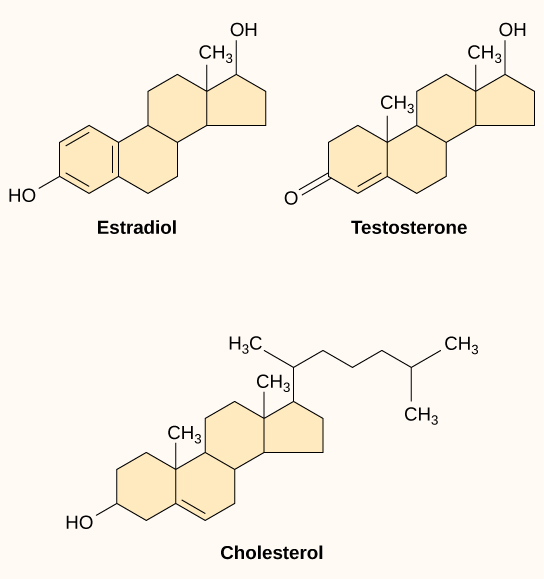

Figure 9.9図 9.9
Steroid hormones have similar chemical structures to their precursor, cholesterol. Because these molecules are small and hydrophobic, they can diffuse directly across the plasma membrane into the cell, where they interact with internal receptors.
ステロイドホルモンは、前駆体であるコレステロールに似た化学構造を持つ。小さく疎水性なので、細胞膜を直接拡散で通って細胞内へ入り、細胞内受容体と相互作用できる。
Water-Soluble Ligands水溶性リガンド
Water-soluble ligands are polar and, therefore, cannot pass through the plasma membrane unaided; sometimes, they are too large to pass through the membrane at all. Instead, most water-soluble ligands bind to the extracellular domain of cell-surface receptors. This group of ligands is quite diverse and includes small molecules, peptides, and proteins.
英語のヒント
水溶性リガンドは極性を持つため、助けを借りずに細胞膜を通過できない。大きすぎて膜をまったく通れない場合もある。その代わり、水溶性リガンドの多くは細胞表面受容体の細胞外ドメインに結合する。この群は非常に多様で、小分子、ペプチド、タンパク質を含む。
Other Ligandsその他のリガンド
Nitric oxide (NO) is a gas that also acts as a ligand. It is able to diffuse directly across the plasma membrane, and one of its roles is to interact with receptors in smooth muscle and induce relaxation of the tissue. NO has a very short half-life and, therefore, only functions over short distances. Nitroglycerin, a treatment for heart disease, acts by triggering the release of NO, which causes blood vessels to dilate (expand), thus restoring blood flow to the heart. NO has become better known recently because the pathway that it affects is targeted by prescription medications for erectile dysfunction, such as Viagra (erection involves dilated blood vessels).
英語のヒント
一酸化窒素(NO)はリガンドとしても働く気体である。細胞膜を直接拡散で通過でき、その役割の一つは平滑筋の受容体と相互作用して組織を弛緩させることである。NOは半減期が非常に短く、短い距離でしか働かない。心疾患の治療に使うニトログリセリンは、NOの放出を促して作用する。NOは血管を拡張させ、心臓への血流を回復させる。NOが作用する経路は、バイアグラなど勃起不全の処方薬の標的になるため、近年NOはよく知られるようになった(勃起には血管の拡張が伴う)。
Section Summaryこの節のまとめ
Cells communicate by both inter- and intracellular signaling. Signaling cells secrete ligands that bind to target cells and initiate a chain of events within the target cell. The four categories of signaling in multicellular organisms are paracrine signaling, endocrine signaling, autocrine signaling, and direct signaling across gap junctions. Paracrine signaling takes place over short distances. Endocrine signals are carried long distances through the bloodstream by hormones, and autocrine signals are received by the same cell that sent the signal or other nearby cells of the same kind. Gap junctions allow small molecules, including signaling molecules, to flow between neighboring cells.
細胞は細胞間と細胞内の両方のシグナル伝達によって連絡する。シグナルを送る細胞はリガンドを分泌し、リガンドが標的細胞に結合して、その内部で一連の出来事を開始させる。多細胞生物のシグナル伝達には、パラクリン、内分泌、オートクリン、ギャップ結合を介した直接伝達の4種類がある。パラクリンは短い距離で起こる。内分泌シグナルはホルモンによって血流中を長い距離運ばれる。オートクリンでは、シグナルを送った細胞自身、または近くの同種の細胞が受け取る。ギャップ結合は、シグナル分子を含む小分子を隣接細胞の間で流通させる。
Internal receptors are found in the cell cytoplasm. Here, they bind ligand molecules that cross the plasma membrane; these receptor-ligand complexes move to the nucleus and interact directly with cellular DNA. Cell-surface receptors transmit a signal from outside the cell to the cytoplasm. Ion channel-linked receptors, when bound to their ligands, form a pore through the plasma membrane through which certain ions can pass. G-protein-linked receptors interact with a G-protein on the cytoplasmic side of the plasma membrane, promoting the exchange of bound GDP for GTP and interacting with other enzymes or ion channels to transmit a signal. Enzyme-linked receptors transmit a signal from outside the cell to an intracellular domain of a membrane-bound enzyme. Ligand binding causes activation of the enzyme. Small hydrophobic ligands (like steroids) are able to penetrate the plasma membrane and bind to internal receptors. Water-soluble hydrophilic ligands are unable to pass through the membrane; instead, they bind to cell-surface receptors, which transmit the signal to the inside of the cell.
細胞内受容体は細胞質にあり、細胞膜を通過するリガンドに結合する。受容体とリガンドの複合体は核へ移動し、DNAと直接相互作用する。細胞表面受容体は、細胞外から細胞質へシグナルを伝える。イオンチャネル共役型受容体はリガンドと結合すると、細胞膜を貫く孔を作り、特定のイオンを通す。Gタンパク質共役型受容体は細胞膜の細胞質側でGタンパク質と相互作用し、結合しているGDPとGTPの交換を促す。さらに他の酵素やイオンチャネルと相互作用してシグナルを伝える。酵素共役型受容体は、細胞外から膜結合酵素の細胞内ドメインへシグナルを伝える。リガンドが結合すると酵素が活性化する。ステロイドなどの小さな疎水性リガンドは細胞膜を通過し、細胞内受容体に結合できる。水溶性で親水性のリガンドは膜を通れず、代わりに細胞表面受容体へ結合する。受容体がそのシグナルを細胞内へ伝える。
Visual Connection Questions図を使った問題
Exercises 1練習問題 1
Exercise 1問題 1
Figure 9.8 HER2 is a receptor tyrosine kinase. In 30 percent of human breast cancers, HER2 is permanently activated, resulting in unregulated cell division. Lapatinib, a drug used to treat breast cancer, inhibits HER2 receptor tyrosine kinase autophosphorylation (the process by which the receptor adds phosphates onto itself), thus reducing tumor growth by 50 percent. Besides autophosphorylation, which of the following steps would be inhibited by Lapatinib?
図9.8 HER2は受容体型チロシンキナーゼである。ヒトの乳がんの30%ではHER2が恒常的に活性化し、調節されない細胞分裂を起こす。乳がん治療薬ラパチニブはHER2受容体型チロシンキナーゼの自己リン酸化(受容体が自分にリン酸基を付ける過程)を阻害し、腫瘍の増殖を50%減らす。自己リン酸化のほかに、次のどの段階がラパチニブによって阻害されるか。
- Signaling molecule binding, dimerization, and the downstream cellular response.シグナル分子の結合、二量体化、および下流の細胞応答。
- Dimerization, and the downstream cellular response.二量体化、および下流の細胞応答。
- The downstream cellular response.下流の細胞応答。
- Phosphatase activity, dimerization, and the downsteam cellular response.ホスファターゼ活性、二量体化、および下流の細胞応答。
Solution解き方
Figure 9.8 C. The downstream cellular response would be inhibited.
図9.8 C。下流の細胞応答が阻害される。