第9章細胞間の情報伝達
9.3 Response to the Signal9.3 シグナルへの応答
Learning Objectives学習目標
By the end of this section, you will be able to do the following:
この節を学び終えると、次のことができるようになる。
- Describe how signaling pathways direct protein expression, cellular metabolism, and cell growthシグナル伝達経路がタンパク質発現、細胞代謝、細胞増殖を制御するしくみを説明する。
- Identify the function of PKC in signal transduction pathwaysシグナル伝達経路におけるPKCの働きを特定する。
- Recognize the role of apoptosis in the development and maintenance of a healthy organism健全な生物の発生と維持におけるアポトーシスの役割を理解する。
Inside the cell, ligands bind to their internal receptors, allowing them to directly affect the cell’s DNA and protein-producing machinery. Using signal transduction pathways, receptors in the plasma membrane produce a variety of effects on the cell. The results of signaling pathways are extremely varied and depend on the type of cell involved as well as the external and internal conditions. A small sampling of responses is described below.
英語のヒント
細胞内ではリガンドが細胞内受容体に結合し、細胞のDNAやタンパク質を作る装置に直接影響できる。一方、細胞膜の受容体はシグナル伝達経路を使って、細胞にさまざまな効果を及ぼす。経路の結果は極めて多様で、細胞型と細胞内外の条件によって異なる。以下に応答の一部を紹介する。
Gene Expression遺伝子発現
Some signal transduction pathways regulate the transcription of RNA. Others regulate the translation of proteins from mRNA. An example of a protein that regulates translation in the nucleus is the MAP kinase ERK. The MAPK/ERK pathway (also known as the Ras-Raf-MEK-ERK pathway) is a chain of proteins in the cell that communicates a signal from a receptor on the surface of the cell to the nuclear DNA. ERK is activated in a phosphorylation cascade when epidermal growth factor (EGF) binds the EGF receptor (see Figure 9.10). Upon phosphorylation, ERK enters the nucleus and activates a protein kinase that, in turn, regulates protein translation (Figure 9.14).
英語のヒント
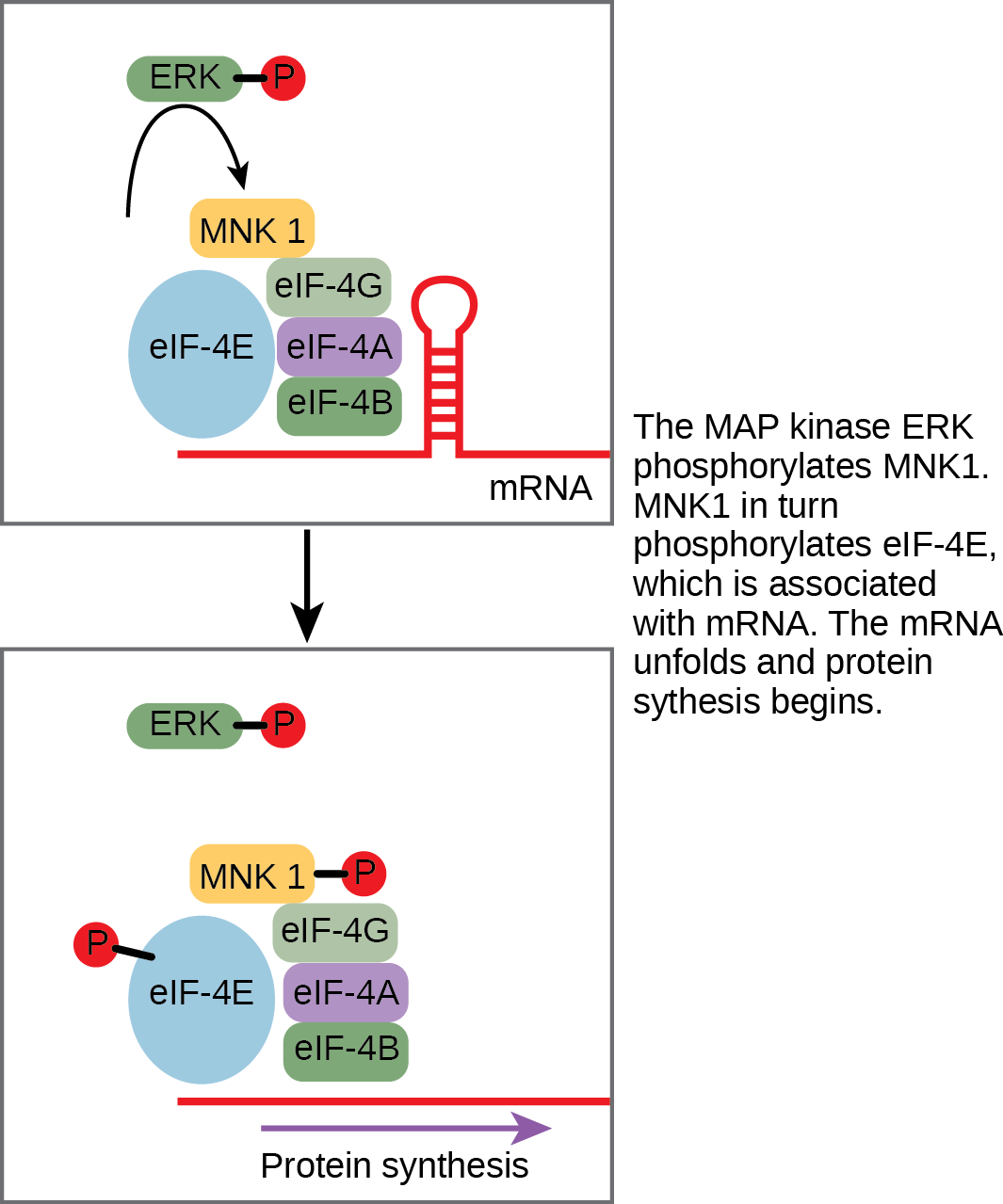

Figure 9.14図 9.14
ERK is a MAP kinase that activates translation when it is phosphorylated. ERK phosphorylates MNK1, which in turn phosphorylates eIF-4E, an elongation initiation factor that, with other initiation factors, is associated with mRNA. When eIF-4E becomes phosphorylated, the mRNA unfolds, allowing protein synthesis in the nucleus to begin. (See Figure 9.10 for the phosphorylation pathway that activates ERK.)
ERKはリン酸化されると翻訳を活性化するMAPキナーゼである。ERKはMNK1をリン酸化し、MNK1は次にeIF-4Eをリン酸化する。eIF-4Eは他の開始因子とともにmRNAに結び付く伸長開始因子である。eIF-4Eがリン酸化されるとmRNAがほどけ、核内でのタンパク質合成を開始できる。(ERKを活性化するリン酸化経路は図9.10を参照。)
Another mechanism of gene regulation involves PKC, which is a protein that acts as an inhibitor. An inhibitor is a molecule that binds to a protein and prevents it from functioning or reduces its function. In this case, the inhibitor is a protein called Iκ-B, which binds to the regulatory protein NF-κB. (The symbol κ represents the Greek letter kappa.) When Iκ-B is bound to NF-κB, the complex cannot enter the nucleus of the cell, but when Iκ-B is phosphorylated by PKC, it can no longer bind NF-κB, and NF-κB (a transcription factor) can enter the nucleus and initiate RNA transcription. In this case, the effect of phosphorylation is to inactivate an inhibitor and thereby activate the process of transcription.
英語のヒント
遺伝子調節の別のしくみには、阻害因子として働くタンパク質PKCがかかわる。阻害因子は、タンパク質に結合して働きを妨げたり弱めたりする分子である。この場合の阻害因子はIκ-Bというタンパク質で、調節タンパク質NF-κBに結合する。(κはギリシャ文字のカッパを表す。)Iκ-BがNF-κBに結合していると複合体は核内に入れないが、PKCによってIκ-Bがリン酸化されるとNF-κBに結合できなくなる。すると転写因子NF-κBは核に入ってRNAの転写を開始できる。この場合、リン酸化は阻害因子を不活性化し、それによって転写を活性化する。
Increase in Cellular Metabolism細胞代謝の増加
The result of another signaling pathway affects muscle cells. The activation of β-adrenergic receptors in muscle cells by adrenaline leads to an increase in cyclic AMP (cAMP) inside the cell. Also known as epinephrine, adrenaline is a hormone (produced by the adrenal gland located on top of the kidney) that readies the body for short-term emergencies. Cyclic AMP activates PKA (protein kinase A), which in turn phosphorylates two enzymes. The first enzyme promotes the degradation of glycogen by activating intermediate glycogen phosphorylase kinase (GPK) that in turn activates glycogen phosphorylase (GP) that catabolizes glycogen into its constituent glucose monomers. (Recall that your body converts excess glucose to glycogen for short-term storage. When energy is needed, glycogen is quickly reconverted to glucose.) Phosphorylation of the second enzyme, glycogen synthase (GS), inhibits its ability to form glycogen from glucose. In this manner, a muscle cell obtains a ready pool of glucose by activating its formation via glycogen degradation and by inhibiting the use of glucose to form glycogen, thus preventing a futile cycle of glycogen degradation and synthesis. The glucose is then available for use by the muscle cell in response to a sudden surge of adrenaline—the “fight or flight” reflex.
英語のヒント
別のシグナル伝達経路の結果は筋細胞に影響する。アドレナリンが筋細胞のβアドレナリン受容体を活性化すると、細胞内の環状AMP(cAMP)が増える。アドレナリンはエピネフリンともいい、腎臓の上にある副腎で作られ、短期的な緊急事態に備えて体を準備させるホルモンである。cAMPはPKA(プロテインキナーゼA)を活性化し、PKAが二つの酵素をリン酸化する。第一の酵素は中間のグリコーゲンホスホリラーゼキナーゼ(GPK)を活性化して、グリコーゲンの分解を促す。GPKはグリコーゲンホスホリラーゼ(GP)を活性化し、GPがグリコーゲンを構成単位であるグルコースへ分解する。(余分なグルコースを短期間の貯蔵のためにグリコーゲンへ変えることを思い出そう。エネルギーが必要になると、グリコーゲンはすぐにグルコースへ戻される。)第二の酵素、グリコーゲン合成酵素(GS)のリン酸化は、グルコースからグリコーゲンを作る能力を阻害する。こうして筋細胞は、グリコーゲンの分解でグルコースを作る過程を活性化し、逆にグルコースからグリコーゲンを作る過程を阻害して、すぐ使えるグルコースを確保する。これにより、グリコーゲンの分解と合成を無駄に繰り返すのを防ぐ。アドレナリンが急増する「闘争・逃走反応」に応じて、筋細胞はそのグルコースを利用できる。
Cell Growth細胞の増殖
Cell signaling pathways also play a major role in cell division. Cells do not normally divide unless they are stimulated by signals from other cells. The ligands that promote cell growth are called growth factors. Most growth factors bind to cell-surface receptors that are linked to tyrosine kinases. These cell-surface receptors are called receptor tyrosine kinases (RTKs). Activation of RTKs initiates a signaling pathway that includes a G-protein called RAS, which activates the MAP kinase pathway described earlier. The enzyme MAP kinase then stimulates the expression of proteins that interact with other cellular components to initiate cell division.
英語のヒント
細胞シグナル伝達経路は細胞分裂でも主要な役割を果たす。通常、細胞は他の細胞からのシグナルで刺激されなければ分裂しない。細胞増殖を促すリガンドを成長因子という。成長因子の多くは、チロシンキナーゼにつながる細胞表面受容体に結合する。この受容体を受容体型チロシンキナーゼ(RTK)という。RTKの活性化はRASというGタンパク質を含む経路を開始し、RASは先に述べたMAPキナーゼ経路を活性化する。続いてMAPキナーゼが、他の細胞成分と相互作用して細胞分裂を開始させるタンパク質の発現を促す。