第9章細胞間の情報伝達
Cell Death細胞死
When a cell is damaged, superfluous, or potentially dangerous to an organism, a cell can initiate a mechanism to trigger programmed cell death, or apoptosis. Apoptosis allows a cell to die in a controlled manner that prevents the release of potentially damaging molecules from inside the cell. There are many internal checkpoints that monitor a cell’s health; if abnormalities are observed, a cell can spontaneously initiate the process of apoptosis. However, in some cases, such as a viral infection or uncontrolled cell division due to cancer, the cell’s normal checks and balances fail. External signaling can also initiate apoptosis. For example, most normal animal cells have receptors that interact with the extracellular matrix, a network of glycoproteins that provides structural support for cells in an organism. The binding of cellular receptors to the extracellular matrix initiates a signaling cascade within the cell. However, if the cell moves away from the extracellular matrix, the signaling ceases, and the cell undergoes apoptosis. This system keeps cells from traveling through the body and proliferating out of control, as happens with tumor cells that metastasize.
英語のヒント
細胞が損傷したり、余分になったり、生物に危険を及ぼす可能性を持ったりすると、プログラムされた細胞死、すなわちアポトーシスを開始できる。アポトーシスでは、細胞内の有害になりうる分子が外へ放出されないように、制御された方法で細胞が死ぬ。細胞の健全性を監視する内部のチェックポイントは数多くあり、異常が見つかれば細胞は自発的にアポトーシスを始められる。しかし、ウイルス感染やがんによる制御不能な細胞分裂などでは、通常の抑制と均衡が働かなくなる場合がある。外部のシグナルもアポトーシスを開始できる。例えば、通常の動物細胞の多くは、生物体内で細胞を構造的に支える糖タンパク質の網である細胞外マトリックスと相互作用する受容体を持つ。受容体がマトリックスに結合すると細胞内のシグナル伝達カスケードが始まる。しかし細胞がマトリックスから離れると伝達が止まり、アポトーシスが起こる。このしくみは、転移する腫瘍細胞のように、細胞が体内を移動して無制御に増殖することを防ぐ。
Another example of external signaling that leads to apoptosis occurs in T-cell development. T-cells are immune cells that bind to foreign macromolecules and particles, and target them for destruction by the immune system. Normally, T-cells do not target “self” proteins (those of their own organism), a process that can lead to autoimmune diseases. In order to develop the ability to discriminate between self and non-self, immature T-cells undergo screening to determine whether they bind to so-called self proteins. If the receptor of the immature T-cell binds to self proteins, the T-cell undergoes apoptosis and removes the potentially dangerous cell.
英語のヒント
アポトーシスにつながる外部シグナルの別の例はT細胞の発達に見られる。T細胞は、異物である高分子や粒子に結合し、免疫系による破壊の標的にする免疫細胞である。通常、T細胞は「自己」のタンパク質、つまり自分の生物体のタンパク質を標的にしない。それを標的にすると自己免疫疾患につながりうる。自己と非自己を区別する能力を獲得するため、未熟なT細胞は、いわゆる自己タンパク質に結合するかどうかの選別を受ける。受容体が自己タンパク質に結合すれば、T細胞はアポトーシスを起こし、危険になりうる細胞が取り除かれる。
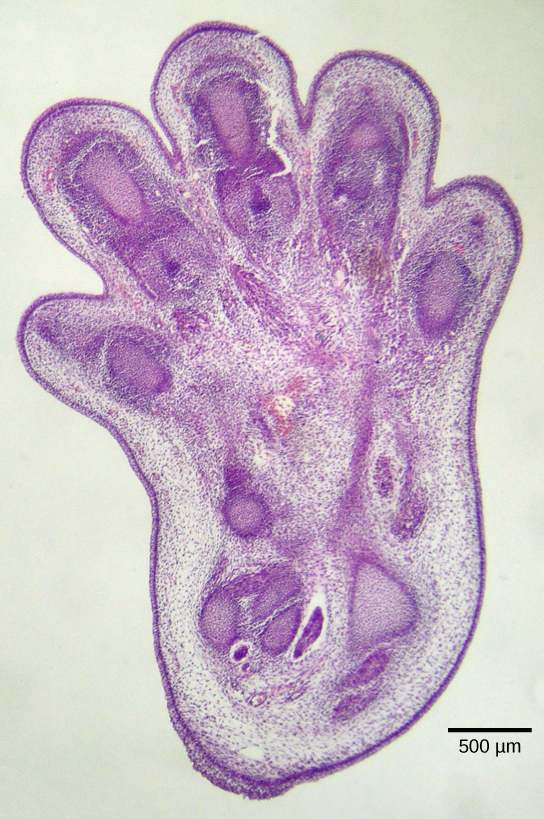
Apoptosis is also essential for normal embryological development. In vertebrates, for example, early stages of development include the formation of web-like tissue between individual fingers and toes (Figure 9.15). During the course of normal development, these unneeded cells must be eliminated, enabling fully separated fingers and toes to form. A cell signaling mechanism triggers apoptosis, which destroys the cells between the developing digits.
英語のヒント
アポトーシスは正常な胚発生にも不可欠である。例えば脊椎動物の発生初期には、手足の指の間に水かき状の組織ができる(図9.15)。正常な発生の過程で、この不要な細胞を除去し、完全に分かれた指を形成しなければならない。細胞シグナル伝達のしくみがアポトーシスを引き起こし、発達中の指の間の細胞を壊す。
OpenStax, Rice University; Biology 2e. (credit: modification of work by Michal Mañas) · CC BY 4.0 · Source出典

Figure 9.15図 9.15
The histological section of a foot of a 15-day-old mouse embryo, visualized using light microscopy, reveals areas of tissue between the toes, which apoptosis will eliminate before the mouse reaches its full gestational age at 27 days. (credit: modification of work by Michal Mañas)
光学顕微鏡で観察した胎齢15日のマウス胚の足の組織切片では、指の間の組織が見える。マウスが満期の胎齢27日に達するまでに、アポトーシスがこの組織を取り除く。(出典:Michal Mañasの作品を改変)
Termination of the Signal Cascadeシグナル伝達カスケードの終了
The aberrant signaling often seen in tumor cells is proof that the termination of a signal at the appropriate time can be just as important as the initiation of a signal. One method of stopping a specific signal is to degrade the ligand or remove it so that it can no longer access its receptor. One reason that hydrophobic hormones like estrogen and testosterone trigger long-lasting events is because they bind carrier proteins. These proteins allow the insoluble molecules to be soluble in blood, but they also protect the hormones from degradation by circulating enzymes.
英語のヒント
腫瘍細胞にしばしば見られる異常なシグナル伝達は、適切な時にシグナルを終わらせることが、その開始と同じほど重要でありうる証拠である。特定のシグナルを止める方法の一つは、リガンドを分解または除去して、受容体に近づけなくすることである。エストロゲンやテストステロンのような疎水性ホルモンが長く続く作用を起こす理由の一つは、担体タンパク質に結合することにある。これらのタンパク質は、不溶性の分子を血中で溶けた状態にするだけでなく、循環する酵素による分解からホルモンを守る。
Inside the cell, many different enzymes reverse the cellular modifications that result from signaling cascades. For example, phosphatases are enzymes that remove the phosphate group attached to proteins by kinases in a process called dephosphorylation. Cyclic AMP (cAMP) is degraded into AMP by phosphodiesterase, and the release of calcium stores is reversed by the Ca2+ pumps that are located in the external and internal membranes of the cell.
英語のヒント
細胞内では、さまざまな酵素がシグナル伝達カスケードによって生じた修飾を元に戻す。例えばホスファターゼは、キナーゼがタンパク質に付けたリン酸基を、脱リン酸化という過程で除去する酵素である。環状AMP(cAMP)はホスホジエステラーゼによってAMPへ分解される。また、貯蔵カルシウムの放出は、細胞の外側と内側の膜にあるCa2+ポンプによって逆向きに戻される。
Section Summaryこの節のまとめ
The initiation of a signaling pathway is a response to external stimuli. This response can take many different forms, including protein synthesis, a change in the cell’s metabolism, cell growth, or even cell death. Many pathways influence the cell by initiating gene expression, and the methods utilized are quite numerous. Some pathways activate enzymes that interact with DNA transcription factors. Others modify proteins and induce them to change their location in the cell. Depending on the status of the organism, cells can respond by storing energy as glycogen or fat, or making it available in the form of glucose. A signal transduction pathway allows muscle cells to respond to immediate requirements for energy in the form of glucose. Cell growth is almost always stimulated by external signals called growth factors. Uncontrolled cell growth leads to cancer, and mutations in the genes encoding protein components of signaling pathways are often found in tumor cells. Programmed cell death, or apoptosis, is important for removing damaged or unnecessary cells. The use of cellular signaling to organize the dismantling of a cell ensures that harmful molecules from the cytoplasm are not released into the spaces between cells, as they are in uncontrolled death, necrosis. Apoptosis also ensures the efficient recycling of the components of the dead cell. Termination of the cellular signaling cascade is very important so that the response to a signal is appropriate in both timing and intensity. Degradation of signaling molecules and dephosphorylation of phosphorylated intermediates of the pathway by phosphatases are two ways to terminate signals within the cell.
シグナル伝達経路の開始は外部刺激への応答である。その応答は、タンパク質合成、細胞代謝の変化、細胞増殖、さらには細胞死など、多様な形を取る。多くの経路は遺伝子発現を開始させて細胞に影響し、その方法も数多い。DNAの転写因子と相互作用する酵素を活性化する経路もあれば、タンパク質を修飾して細胞内の位置を変えさせる経路もある。生物の状態に応じて、細胞はエネルギーをグリコーゲンや脂肪として蓄えたり、グルコースとして利用可能にしたりする。あるシグナル伝達経路は、筋細胞がグルコースの形でエネルギーを急いで必要とする状況に応答できるようにする。細胞増殖はほぼ常に成長因子という外部シグナルによって刺激される。制御されない細胞増殖はがんにつながり、腫瘍細胞ではシグナル伝達経路のタンパク質成分をコードする遺伝子の変異がよく見つかる。プログラムされた細胞死、すなわちアポトーシスは、損傷した細胞や不要な細胞を除去するうえで重要である。シグナル伝達によって細胞の解体を統率することで、制御されない死である壊死の場合とは違い、細胞質の有害分子が細胞間へ放出されないようにする。アポトーシスは死細胞の成分の効率的な再利用も確保する。シグナルへの応答を時間と強さの両面で適切にするには、カスケードの終了が非常に重要である。シグナル分子の分解と、経路のリン酸化中間体をホスファターゼが脱リン酸化することは、細胞内のシグナルを終える二つの方法である。