第9章細胞間の情報伝達
Phosphorylationリン酸化
One of the most common chemical modifications that occurs in signaling pathways is the addition of a phosphate group (PO4–3) to a molecule such as a protein in a process called phosphorylation. The phosphate can be added to a nucleotide such as GMP to form GDP or GTP. Phosphates are also often added to serine, threonine, and tyrosine residues of proteins, where they replace the hydroxyl group of the amino acid (Figure 9.11). The transfer of the phosphate is catalyzed by an enzyme called a kinase. Various kinases are named for the substrate they phosphorylate. Phosphorylation of serine and threonine residues often activates enzymes. Phosphorylation of tyrosine residues can either affect the activity of an enzyme or create a binding site that interacts with downstream components in the signaling cascade. Phosphorylation may activate or inactivate enzymes, and the reversal of phosphorylation, dephosphorylation by a phosphatase, will reverse the effect.
英語のヒント
シグナル伝達経路で最もよく起こる化学修飾の一つは、リン酸化という過程によって、タンパク質などの分子にリン酸基(PO4–3)を付加することである。GMPのようなヌクレオチドにリン酸基を加えてGDPやGTPにすることもできる。タンパク質のセリン、トレオニン、チロシン残基にリン酸基を加え、アミノ酸のヒドロキシ基を置き換えることも多い(図9.11)。リン酸基の移動はキナーゼという酵素が触媒する。各種のキナーゼは、リン酸化する基質にちなんで命名されている。セリンとトレオニンのリン酸化は、しばしば酵素を活性化する。チロシン残基のリン酸化は、酵素活性に影響したり、カスケードの下流の成分と相互作用する結合部位を作ったりする。リン酸化は酵素を活性化することも不活性化することもあり、その逆反応であるホスファターゼによる脱リン酸化は、その効果を逆転させる。
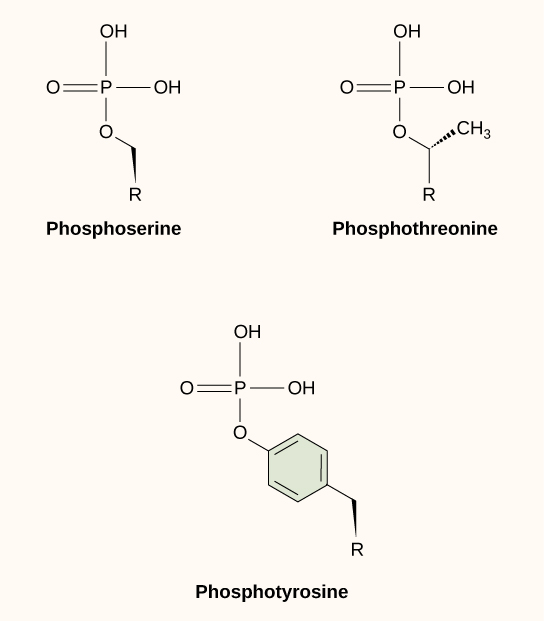
Figure 9.11図 9.11
In protein phosphorylation, a phosphate group (PO4 -3) is added to residues of the amino acids serine, threonine, and tyrosine.
タンパク質のリン酸化では、アミノ酸のセリン、トレオニン、チロシンの残基へリン酸基(PO4 -3)を付加する。
Second Messengersセカンドメッセンジャー
Second messengers are small molecules that propagate a signal after it has been initiated by the binding of the signaling molecule to the receptor. These molecules help to spread a signal through the cytoplasm by altering the behavior of certain cellular proteins.
英語のヒント
セカンドメッセンジャーは、シグナル分子の受容体への結合によって始まったシグナルを、その後に伝える小分子である。細胞内の特定のタンパク質の働きを変えることで、細胞質内にシグナルを広めるのを助ける。
Calcium ion is a widely used second messenger. The free concentration of calcium ions (Ca2+) within a cell is very low because ion pumps in the plasma membrane continuously remove it by using adenosine-5'-triphosphate (ATP). For signaling purposes, Ca2+ is stored in cytoplasmic vesicles, such as the endoplasmic reticulum, or accessed from outside the cell. When signaling occurs, ligand-gated calcium ion channels allow the higher levels of Ca2+ that are present outside the cell (or in intracellular storage compartments) to flow into the cytoplasm, which raises the concentration of cytoplasmic Ca2+. The response to the increase in Ca2+ varies and depends on the cell type involved. For example, in the β-cells of the pancreas, Ca2+ signaling leads to the release of insulin, and in muscle cells, an increase in Ca2+ leads to muscle contractions.
英語のヒント
カルシウムイオンは広く使われるセカンドメッセンジャーである。細胞内の遊離カルシウムイオン(Ca2+)の濃度は非常に低い。細胞膜のイオンポンプがアデノシン5′三リン酸(ATP)を使い、絶えず外へ除去するためである。シグナル伝達に用いるCa2+は、小胞体など細胞質内の小胞に蓄えられるか、細胞外から取り込まれる。シグナル伝達が起こると、リガンド作動性カルシウムイオンチャネルが、細胞外または細胞内の貯蔵区画に高濃度で存在するCa2+を細胞質へ流入させ、細胞質のCa2+濃度を高める。Ca2+の増加に対する応答は細胞型によって異なる。例えば、膵臓のβ細胞ではCa2+のシグナルがインスリンの放出を起こし、筋細胞ではCa2+の増加が筋収縮を起こす。
Another second messenger utilized in many different cell types is cyclic AMP (cAMP). Cyclic AMP is synthesized by the enzyme adenylyl cyclase from ATP (Figure 9.12). The main role of cAMP in cells is to bind to and activate an enzyme called cAMP-dependent kinase (A-kinase). A-kinase regulates many vital metabolic pathways: It phosphorylates serine and threonine residues of its target proteins, activating them in the process. A-kinase is found in many different types of cells, and the target proteins in each kind of cell are different. Differences give rise to the variation of the responses to cAMP in different cells.
英語のヒント
多くの異なる細胞型で使われるもう一つのセカンドメッセンジャーは、環状AMP(cAMP)である。cAMPは、アデニル酸シクラーゼという酵素がATPから合成する(図9.12)。細胞内での主な役割は、cAMP依存性キナーゼ(Aキナーゼ)という酵素に結合して活性化することである。Aキナーゼは多くの重要な代謝経路を調節する。標的タンパク質のセリンとトレオニン残基をリン酸化し、その過程で活性化する。Aキナーゼは多様な細胞に存在し、細胞型によって標的タンパク質が異なる。その違いが、cAMPへの応答の細胞間の違いを生む。
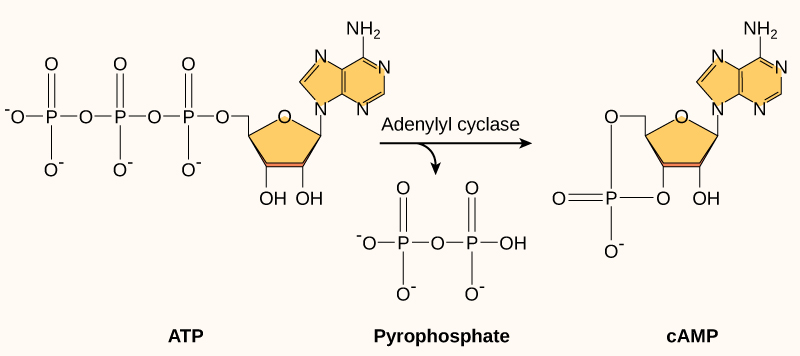
Figure 9.12図 9.12
This diagram shows the mechanism for the formation of cyclic AMP (cAMP). cAMP serves as a second messenger to activate or inactivate proteins within the cell. Termination of the signal occurs when an enzyme called phosphodiesterase converts cAMP into AMP.
環状AMP(cAMP)が形成されるしくみ。cAMPはセカンドメッセンジャーとして細胞内のタンパク質を活性化または不活性化する。ホスホジエステラーゼという酵素がcAMPをAMPへ変えるとシグナルは終了する。
Present in small concentrations in the plasma membrane, inositol phospholipids are lipids that can also be converted into second messengers. Because these molecules are membrane components, they are located near membrane-bound receptors and can easily interact with them. Phosphatidylinositol (PI) is the main phospholipid that plays a role in cellular signaling. Enzymes known as kinases phosphorylate PI to form PI-phosphate (PIP) and PI-bisphosphate (PIP2).
英語のヒント
細胞膜に低濃度で存在するイノシトールリン脂質も、セカンドメッセンジャーに変換できる脂質である。膜の構成要素なので膜結合受容体の近くに位置し、容易に相互作用できる。ホスファチジルイノシトール(PI)は細胞シグナル伝達で働く主なリン脂質である。キナーゼという酵素がPIをリン酸化し、PI一リン酸(PIP)とPI二リン酸(PIP2)を作る。
The enzyme phospholipase C cleaves PIP2 to form diacylglycerol (DAG) and inositol triphosphate (IP3) (Figure 9.13). These products of the cleavage of PIP2 serve as second messengers. Diacylglycerol (DAG) remains in the plasma membrane and activates protein kinase C (PKC), which then phosphorylates serine and threonine residues in its target proteins. IP3 diffuses into the cytoplasm and binds to ligand-gated calcium channels in the endoplasmic reticulum to release Ca2+ that continues the signal cascade.
英語のヒント
ホスホリパーゼCという酵素はPIP2を切断し、ジアシルグリセロール(DAG)とイノシトール三リン酸(IP3)を作る(図9.13)。これらのPIP2の切断産物はセカンドメッセンジャーとして働く。DAGは細胞膜にとどまり、プロテインキナーゼC(PKC)を活性化する。PKCは標的タンパク質のセリンとトレオニン残基をリン酸化する。IP3は細胞質に拡散し、小胞体のリガンド作動性カルシウムチャネルに結合してCa2+を放出させ、シグナル伝達カスケードを続ける。
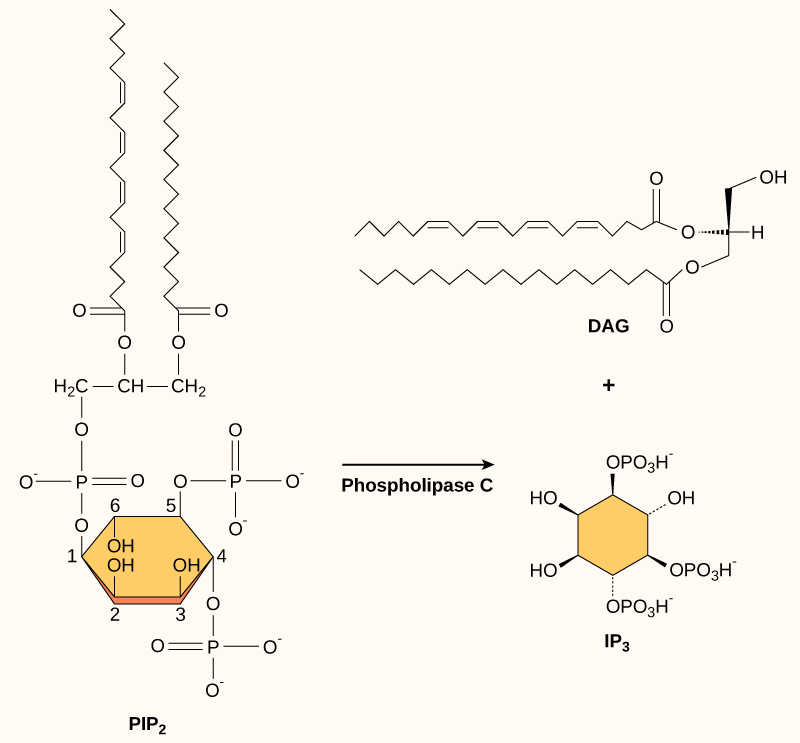


Figure 9.13図 9.13
The enzyme phospholipase C breaks down PIP2 into IP3 and DAG, both of which serve as second messengers.
ホスホリパーゼCはPIP2をIP3とDAGに分解する。両方ともセカンドメッセンジャーとして働く。
Section Summaryこの節のまとめ
Ligand binding to the receptor allows for signal transduction through the cell. The chain of events that conveys the signal through the cell is called a signaling pathway or cascade. Signaling pathways are often very complex because of the interplay between different proteins. A major component of cell signaling cascades is the phosphorylation of molecules by enzymes known as kinases. Phosphorylation adds a phosphate group to serine, threonine, and tyrosine residues in a protein, changing their shapes, and activating or inactivating the protein. Small molecules like nucleotides can also be phosphorylated. Second messengers are small, non-protein molecules that are used to transmit a signal within a cell. Some examples of second messengers are calcium ions (Ca2+), cyclic AMP (cAMP), diacylglycerol (DAG), and inositol triphosphate (IP3).
英語のヒント
リガンドが受容体に結合すると、細胞内へシグナルを伝達できる。細胞内でシグナルを伝える一連の出来事を、シグナル伝達経路またはカスケードという。異なるタンパク質の相互作用により、これらの経路は非常に複雑になることが多い。カスケードの重要な要素は、キナーゼという酵素による分子のリン酸化である。リン酸化はタンパク質のセリン、トレオニン、チロシン残基にリン酸基を加え、形を変えてタンパク質を活性化または不活性化する。ヌクレオチドなどの小分子もリン酸化できる。セカンドメッセンジャーはタンパク質ではない小分子で、細胞内のシグナル伝達に使われる。例にはカルシウムイオン(Ca2+)、環状AMP(cAMP)、ジアシルグリセロール(DAG)、イノシトール三リン酸(IP3)がある。