第9章細胞間の情報伝達
9.1 Signaling Molecules and Cellular Receptors9.1 シグナル分子と細胞の受容体
Learning Objectives学習目標
By the end of this section, you will be able to do the following:
この節を学び終えると、次のことができるようになる。
- Describe four types of signaling mechanisms found in multicellular organisms多細胞生物に見られる4種類のシグナル伝達のしくみを説明する。
- Compare internal receptors with cell-surface receptors細胞内受容体と細胞表面受容体を比較する。
- Recognize the relationship between a ligand’s structure and its mechanism of actionリガンドの構造と作用機序の関係を理解する。
There are two kinds of communication in the world of living cells. Communication between cells is called intercellular signaling, and communication within a cell is called intracellular signaling. An easy way to remember the distinction is by understanding the Latin origin of the prefixes: inter- means "between" (for example, intersecting lines are those that cross each other) and intra- means "inside" (as in intravenous).
英語のヒント
生きた細胞の世界には2種類のコミュニケーションがある。細胞と細胞の間の連絡を細胞間シグナル伝達、1個の細胞の内部での連絡を細胞内シグナル伝達という。この区別は、接頭辞のラテン語の意味を知ると覚えやすい。inter-は「間」を意味する(例えばintersecting linesは互いに交差する線)。intra-は「内部」を意味する(intravenous〔静脈内の〕など)。
Chemical signals are released by signaling cells in the form of small, usually volatile or soluble molecules called ligands. A ligand is a molecule that binds another specific molecule, in some cases, delivering a signal in the process. Ligands can thus be thought of as signaling molecules. Ligands interact with proteins in target cells, which are cells that are affected by chemical signals; these proteins are also called receptors. Ligands and receptors exist in several varieties; however, a specific ligand will have a specific receptor that typically binds only that ligand.
英語のヒント
化学シグナルは、リガンドと呼ばれる小さな、通常は揮発性または可溶性の分子としてシグナルを送る細胞から放出される。リガンドは特定の別の分子に結合する分子で、結合の過程でシグナルを伝える場合もある。そのため、リガンドはシグナル分子と考えられる。リガンドは、化学シグナルの影響を受ける標的細胞のタンパク質と相互作用する。このタンパク質は受容体とも呼ばれる。リガンドと受容体にはいくつかの種類があるが、特定のリガンドには、通常はそのリガンドだけに結合する特定の受容体がある。
Forms of Signalingシグナル伝達の形態
There are four categories of chemical signaling found in multicellular organisms: paracrine signaling, endocrine signaling, autocrine signaling, and direct signaling across gap junctions (Figure 9.2). The main difference between the different categories of signaling is the distance that the signal travels through the organism to reach the target cell. We should note here that not all cells are affected by the same signals.
英語のヒント
多細胞生物で見られる化学シグナル伝達には、パラクリンシグナル伝達、内分泌シグナル伝達、オートクリンシグナル伝達、ギャップ結合を介した直接のシグナル伝達の4種類がある(図9.2)。これらの主な違いは、シグナルが標的細胞に到達するまでに生物体内を移動する距離である。すべての細胞が同じシグナルの影響を受けるわけではないことに注意しよう。
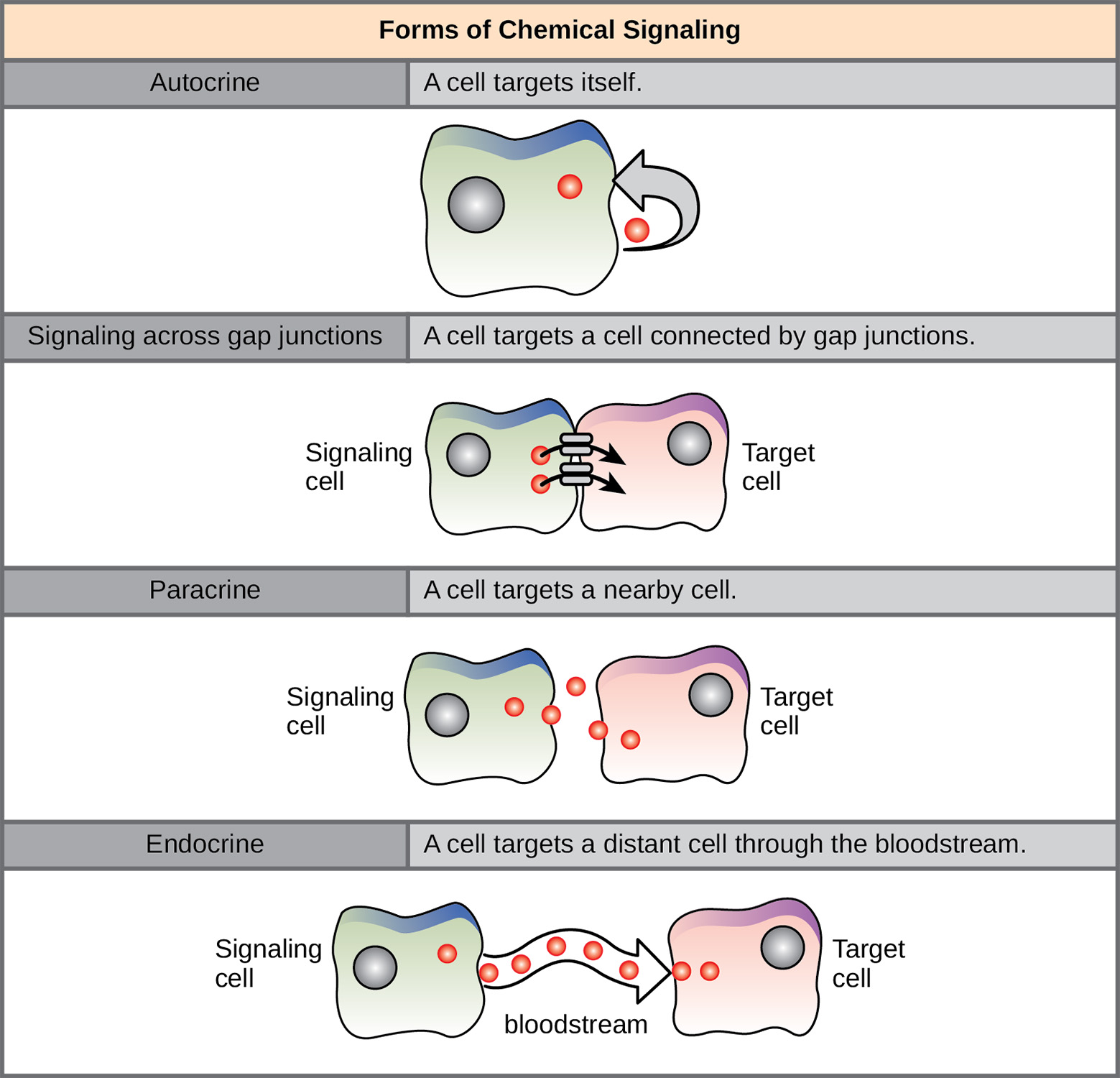
Figure 9.2図 9.2
In chemical signaling, a cell may target itself (autocrine signaling), a cell connected by gap junctions, a nearby cell (paracrine signaling), or a distant cell (endocrine signaling). Paracrine signaling acts on nearby cells, endocrine signaling uses the circulatory system to transport ligands, and autocrine signaling acts on the signaling cell. Signaling via gap junctions involves signaling molecules moving directly between adjacent cells.
化学シグナル伝達で細胞が標的にするのは、自分自身(オートクリン)、ギャップ結合でつながる細胞、近くの細胞(パラクリン)、または遠くの細胞(内分泌)である。パラクリンは近くの細胞に働き、内分泌は循環系でリガンドを運び、オートクリンはシグナルを送る細胞自身に働く。ギャップ結合を介した伝達では、シグナル分子が隣り合う細胞の間を直接移動する。
Paracrine Signalingパラクリンシグナル伝達
Signals that act locally between cells that are close together are called paracrine signals. Paracrine signals move by diffusion through the extracellular matrix. These types of signals usually elicit quick responses that last only a short period of time. In order to keep the response localized, paracrine ligand molecules are normally quickly degraded by enzymes or removed by neighboring cells. Removing the signals will reestablish the concentration gradient for the signal, allowing them to quickly diffuse through the intracellular space if released again.
英語のヒント
互いに近い細胞の間で局所的に作用するシグナルをパラクリンシグナルという。パラクリンシグナルは細胞外マトリックスを拡散して移動する。こうしたシグナルは通常、短時間だけ続く速い応答を引き起こす。応答を局所にとどめるため、パラクリンのリガンド分子は通常、酵素によって速やかに分解されるか、隣接細胞に取り除かれる。シグナルを取り除くとその濃度勾配が再びできるため、再度放出されたときに細胞内の空間を速やかに拡散できる。
One example of paracrine signaling is the transfer of signals across synapses between nerve cells. A nerve cell consists of a cell body, several short, branched extensions called dendrites that receive stimuli, and a long extension called an axon, which transmits signals to other nerve cells or muscle cells. The junction between nerve cells where signal transmission occurs is called a synapse. A synaptic signal is a chemical signal that travels between nerve cells. Signals within the nerve cells are propagated by fast-moving electrical impulses. When these impulses reach the end of the axon, the signal continues on to a dendrite of the next cell by the release of chemical ligands called neurotransmitters from the presynaptic cell (the cell emitting the signal). The neurotransmitters are transported across the very small distances (20–40 nanometers) between nerve cells, which are called chemical synapses (Figure 9.3). The small distance between nerve cells allows the signal to travel quickly; this enables an immediate response, such as, "Take your hand off the stove!"
英語のヒント
パラクリンシグナル伝達の一例は、神経細胞間のシナプスを介する伝達である。神経細胞は、細胞体、刺激を受け取る樹状突起という短く枝分かれした複数の突起、他の神経細胞や筋細胞へシグナルを伝える軸索という長い突起からなる。シグナルの伝達が起こる神経細胞間の接合部をシナプスという。シナプスシグナルは神経細胞間を移動する化学シグナルである。神経細胞内ではシグナルは速い電気的インパルスとして伝わる。インパルスが軸索の末端に届くと、シナプス前細胞(シグナルを送る細胞)から神経伝達物質という化学リガンドが放出され、次の細胞の樹状突起へシグナルが伝わる。神経伝達物質は、化学シナプスと呼ばれる、神経細胞間の非常に短い距離(20〜40ナノメートル)を運ばれる(図9.3)。距離が短いためシグナルはすばやく伝わり、「コンロから手を離せ!」といった即座の応答が可能になる。
When the neurotransmitter binds the receptor on the surface of the postsynaptic cell, the electrochemical potential of the target cell changes, and the next electrical impulse is launched. The neurotransmitters that are released into the chemical synapse are degraded quickly or get reabsorbed by the presynaptic cell so that the recipient nerve cell can recover quickly and be prepared to respond rapidly to the next synaptic signal.
英語のヒント
神経伝達物質がシナプス後細胞の表面の受容体に結合すると、標的細胞の電気化学的ポテンシャルが変化し、次の電気的インパルスが発生する。化学シナプスへ放出された神経伝達物質は速やかに分解されるか、シナプス前細胞に再吸収される。そのため、受け手の神経細胞はすぐに回復し、次のシナプスシグナルに速やかに応答する準備を整えられる。
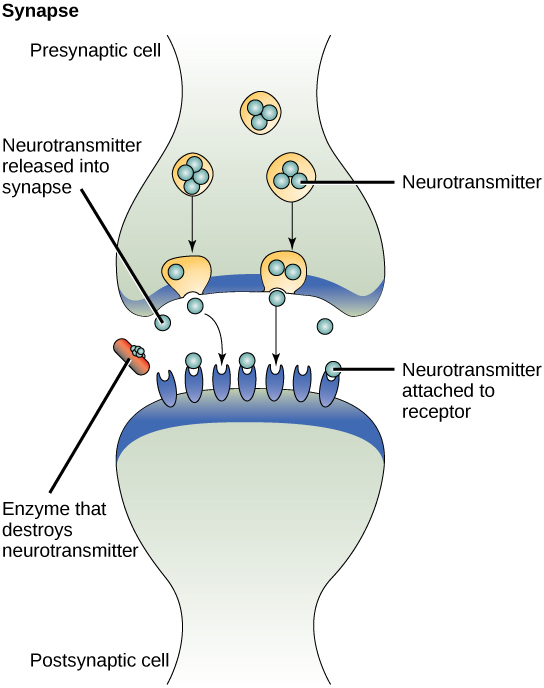


Figure 9.3図 9.3
The distance between the presynaptic cell and the postsynaptic cell—called the synaptic gap—is very small and allows for rapid diffusion of the neurotransmitter. Enzymes in the synapatic gap degrade some types of neurotransmitters to terminate the signal.
シナプス前細胞とシナプス後細胞の間のシナプス間隙は非常に狭く、神経伝達物質が速やかに拡散できる。シナプス間隙の酵素は一部の種類の神経伝達物質を分解し、シグナルを終わらせる。