第9章細胞間の情報伝達
Endocrine Signaling内分泌シグナル伝達
Signals from distant cells are called endocrine signals, and they originate from endocrine cells. (In the body, many endocrine cells are located in endocrine glands, such as the thyroid gland, the hypothalamus, and the pituitary gland.) These types of signals usually produce a slower response but have a longer-lasting effect. The ligands released in endocrine signaling are called hormones, signaling molecules that are produced in one part of the body but affect other body regions some distance away.
英語のヒント
遠くの細胞からのシグナルを内分泌シグナルといい、内分泌細胞から生じる。(体内の内分泌細胞の多くは、甲状腺、視床下部、下垂体などの内分泌腺にある。)こうしたシグナルは通常、応答が遅いものの、効果は長く続く。内分泌シグナル伝達で放出されるリガンドをホルモンという。ホルモンは体の一部で作られ、離れた別の領域に作用するシグナル分子である。
Hormones travel the large distances between endocrine cells and their target cells via the bloodstream, which is a relatively slow way to move throughout the body. Because of their form of transport, hormones become diluted and are present in low concentrations when they act on their target cells. This is different from paracrine signaling, in which local concentrations of ligands can be very high.
英語のヒント
ホルモンは血流を介して内分泌細胞から遠くの標的細胞まで移動する。これは全身を移動する方法としては比較的遅い。この輸送方法のためにホルモンは薄まり、標的細胞に作用するときには低濃度になっている。これは、リガンドの局所濃度が非常に高くなることもあるパラクリンシグナル伝達とは異なる。
Autocrine Signalingオートクリンシグナル伝達
Autocrine signals are produced by signaling cells that can also bind to the ligand that is released. This means the signaling cell and the target cell can be the same or a similar cell (the prefix auto- means self, a reminder that the signaling cell sends a signal to itself). This type of signaling often occurs during the early development of an organism to ensure that cells develop into the correct tissues and take on the proper function. Autocrine signaling also regulates pain sensation and inflammatory responses. Further, if a cell is infected with a virus, the cell can signal itself to undergo programmed cell death, killing the virus in the process. In some cases, neighboring cells of the same type are also influenced by the released ligand. In embryological development, this process of stimulating a group of neighboring cells may help to direct the differentiation of identical cells into the same cell type, thus ensuring the proper developmental outcome.
英語のヒント
オートクリンシグナルは、自分が放出したリガンドに自分でも結合できる細胞によって作られる。つまり、シグナルを送る細胞と標的細胞は、同一または同種の細胞でありうる(接頭辞auto-は「自己」を意味し、自分にシグナルを送ることを表す)。この伝達は、生物の初期発生にしばしば見られ、細胞が正しい組織へ発達し、適切な機能を担うようにする。オートクリンシグナル伝達は痛覚や炎症反応も調節する。また、細胞がウイルスに感染すると、自分自身にシグナルを送り、プログラムされた細胞死を起こして、その過程でウイルスを死滅させることもできる。放出されたリガンドが、近隣の同種の細胞にも影響する場合がある。胚発生では、このように隣り合う細胞群を刺激することが、同じ細胞を同じ細胞型へ分化させる助けとなり、適切な発生の結果を確保する可能性がある。
Direct Signaling Across Gap Junctionsギャップ結合を介した直接のシグナル伝達
Gap junctions in animals and plasmodesmata in plants are connections between the plasma membranes of neighboring cells. These fluid-filled channels allow small signaling molecules, called intracellular mediators, to diffuse between the two cells. Small molecules or ions, such as calcium ions (Ca2+), are able to move between cells, but large molecules like proteins and DNA cannot fit through the channels. The specificity of the channels ensures that the cells remain independent but can quickly and easily transmit signals. The transfer of signaling molecules communicates the current state of the cell that is directly next to the target cell; this allows a group of cells to coordinate their response to a signal that only one of them may have received. In plants, plasmodesmata are ubiquitous, making the entire plant into a giant communication network.
英語のヒント
動物のギャップ結合と植物の原形質連絡は、隣接する細胞の細胞膜どうしをつなぐ。この液体で満たされた通路を通って、細胞内メディエーターという小さなシグナル分子が2個の細胞の間を拡散する。カルシウムイオン(Ca2+)などの小分子やイオンは通過できるが、タンパク質やDNAのような大きな分子は通れない。通路の選択性により、細胞は独立性を保ちつつ、シグナルを簡単かつ迅速に伝えられる。シグナル分子の移動は、標的細胞のすぐ隣にある細胞の現在の状態を伝える。これにより、細胞群のうち1個だけが受け取ったかもしれないシグナルに対しても、集団として応答を調整できる。植物では原形質連絡が広く存在し、植物全体が巨大な連絡網になっている。
Types of Receptors受容体の種類
Receptors are protein molecules in the target cell or on its surface that bind ligand. There are two types of receptors, internal receptors and cell-surface receptors.
受容体は標的細胞の内部または表面にある、リガンドに結合するタンパク質分子である。受容体には細胞内受容体と細胞表面受容体の2種類がある。
Internal receptors細胞内受容体
Internal receptors, also known as intracellular or cytoplasmic receptors, are found in the cytoplasm of the cell and respond to hydrophobic ligand molecules that are able to travel across the plasma membrane. Once inside the cell, many of these molecules bind to proteins that act as regulators of mRNA synthesis (transcription) to mediate gene expression. Gene expression is the cellular process of transforming the information in a cell's DNA into a sequence of amino acids, which ultimately forms a protein. When the ligand binds to the internal receptor, a conformational change is triggered that exposes a DNA-binding site on the protein. The ligand-receptor complex moves into the nucleus, then binds to specific regulatory regions of the chromosomal DNA and promotes the initiation of transcription (Figure 9.4). Transcription is the process of copying the information in a cell's DNA into a special form of RNA called messenger RNA (mRNA); the cell uses information in the mRNA (which moves out into the cytoplasm and associates with ribosomes) to link specific amino acids in the correct order, producing a protein. Internal receptors can directly influence gene expression without having to pass the signal on to other receptors or messengers.
英語のヒント
細胞内受容体は細胞質受容体とも呼ばれ、細胞質に存在し、細胞膜を通過できる疎水性のリガンド分子に応答する。細胞内に入ったこうした分子の多くは、mRNA合成(転写)を調節するタンパク質に結合し、遺伝子発現を仲介する。遺伝子発現は、細胞のDNAの情報をアミノ酸配列に変え、最終的にタンパク質を作る細胞の過程である。リガンドが細胞内受容体に結合すると立体構造の変化が起こり、タンパク質のDNA結合部位が露出する。リガンドと受容体の複合体は核へ移動し、染色体DNAの特定の調節領域に結合して、転写の開始を促す(図9.4)。転写とは、細胞のDNAの情報を、伝令RNA(mRNA)という特別なRNAに写し取る過程である。細胞は、細胞質へ出てリボソームと結び付いたmRNAの情報を使って、特定のアミノ酸を正しい順序でつなぎ、タンパク質を作る。細胞内受容体は、別の受容体や伝達物質へシグナルを引き渡すことなく、遺伝子発現に直接影響できる。
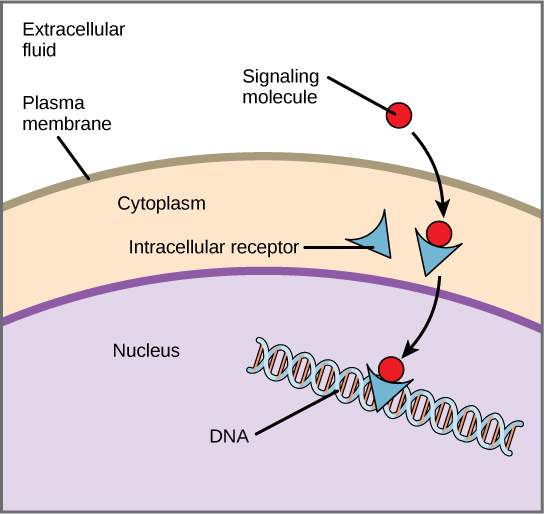

Figure 9.4図 9.4
Hydrophobic signaling molecules typically diffuse across the plasma membrane and interact with intracellular receptors in the cytoplasm. Many intracellular receptors are transcription factors that interact with DNA in the nucleus and regulate gene expression.
疎水性シグナル分子は通常、細胞膜を拡散で通り抜け、細胞質の細胞内受容体と相互作用する。細胞内受容体の多くは、核内のDNAと相互作用して遺伝子発現を調節する転写因子である。