付録
The Multiplier Effect乗数効果
The Keynesian policy prescription has one final twist. Assume that for a certain economy, the intersection of the aggregate expenditure function and the 45-degree line is at a GDP of 700, while the level of potential GDP for this economy is $800. By how much does government spending need to be increased so that the economy reaches the full employment GDP? The obvious answer might seem to be $800 – $700 = $100; so raise government spending by $100. But that answer is incorrect. A change of, for example, $100 in government expenditures will have an effect of more than $100 on the equilibrium level of real GDP. The reason is that a change in aggregate expenditures circles through the economy: households buy from firms, firms pay workers and suppliers, workers and suppliers buy goods from other firms, those firms pay their workers and suppliers, and so on. In this way, the original change in aggregate expenditures is actually spent more than once. This is called the multiplier effect: An initial increase in spending, cycles repeatedly through the economy and has a larger impact than the initial dollar amount spent.
英語のヒント
ケインズ派の政策処方には、最後にもう一つ工夫がある。ある経済で、総支出関数と45度線の交点がGDP700の点にあり、潜在GDPは800ドルだとする。完全雇用GDPに達するには、政府支出をどれだけ増やす必要があるか。明らかな答えは800ドル-700ドル=100ドルだから、政府支出を100ドル増やせばよさそうに思える。しかし、その答えは誤りである。たとえば政府支出が100ドル変わると、均衡実質GDPには100ドルを超える影響がある。その理由は、総支出の変化が経済を循環するからである。家計は企業から買い、企業は労働者と供給業者に払い、その労働者と供給業者は他社から財を買い、その企業が自社の労働者と供給業者に払う、と続く。このように、総支出の当初の変化は、実際には一度以上使われる。これを乗数効果と呼ぶ。初めの支出増加が繰り返し経済を循環し、当初の支出額より大きな影響を持つ。
How Does the Multiplier Work?
英語のヒント
乗数はどう働くか
To understand how the multiplier effect works, return to the example in which the current equilibrium in the Keynesian cross diagram is a real GDP of $700, or $100 short of the $800 needed to be at full employment, potential GDP. If the government spends $100 to close this gap, someone in the economy receives that spending and can treat it as income. Assume that those who receive this income pay 30% in taxes, save 10% of after-tax income, spend 10% of total income on imports, and then spend the rest on domestically produced goods and services.
英語のヒント
乗数効果の働きを理解するため、ケインズの交差図の現在の均衡が実質GDP700ドルで、完全雇用の潜在GDP800ドルに100ドル足りない例に戻ろう。政府がこの差を埋めるため100ドル支出すると、経済の誰かがその支出を受け取り、所得として扱える。その所得を受け取る人が30%を税として払い、税引後所得の10%を貯蓄し、総所得の10%を輸入に使い、残りを国内で生産された財・サービスに使うと仮定しよう。
As shown in the calculations in Figure D.10 and Table D.6, out of the original $100 in government spending, $53 is left to spend on domestically produced goods and services. That $53 which was spent, becomes income to someone, somewhere in the economy. Those who receive that income also pay 30% in taxes, save 10% of after-tax income, and spend 10% of total income on imports, as shown in Figure D.10, so that an additional $28.09 (that is, 0.53 × $53) is spent in the third round. The people who receive that income then pay taxes, save, and buy imports, and the amount spent in the fourth round is $14.89 (that is, 0.53 × $28.09).
英語のヒント
The Multiplier Effect乗数効果
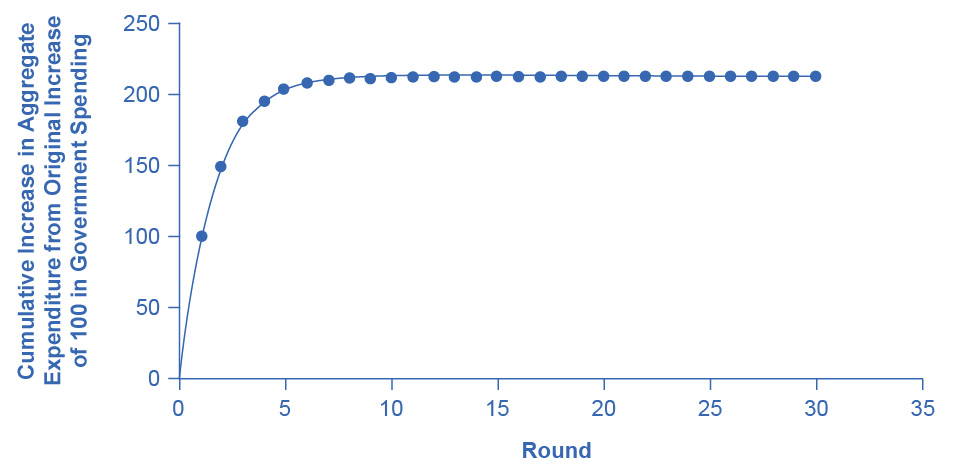
Figure D.10図 D.10
An original increase of government spending of $100 causes a rise in aggregate expenditure of $100. But that $100 is income to others in the economy, and after they save, pay taxes, and buy imports, they spend $53 of that $100 in a second round. In turn, that $53 is income to others. Thus, the original government spending of $100 is multiplied by these cycles of spending, but the impact of each successive cycle gets smaller and smaller. Given the numbers in this example, the original government spending increase of $100 raises aggregate expenditure by $213; therefore, the multiplier in this example is $213/$100 = 2.13.
英語のヒント
当初の政府支出100ドルの増加は、総支出を100ドル増やす。しかし、その100ドルは経済の他の人々の所得になり、彼らが貯蓄、納税、輸入品購入をした後、2巡目にはそのうち53ドルを支出する。そして、その53ドルも他の人々の所得になる。したがって、当初の政府支出100ドルは支出の循環によって何倍かになるが、各巡の影響は次第に小さくなる。この例の数値では、当初の政府支出100ドルの増加が総支出を213ドル増やす。したがって、乗数は213ドル/100ドル=2.13である。
Original increase in aggregate expenditure from government spending 政府支出による当初の総支出の増加 |
100 |
Which is income to people throughout the economy: Pay 30% in taxes. Save 10% of after-tax income. Spend 10% of income on imports. Second-round increase of… これが経済全体の人々の所得となる。30%を納税。税引後所得の10%を貯蓄。所得の10%を輸入に支出。2巡目の増加は… |
70 – 7 – 10 = 53 |
Which is $53 of income to people through the economy: Pay 30% in taxes. Save 10% of after-tax income. Spend 10% of income on imports. Third-round increase of… これが経済全体の人々の53ドルの所得となる。30%を納税。税引後所得の10%を貯蓄。所得の10%を輸入に支出。3巡目の増加は… |
37.1 – 3.71 – 5.3 = 28.09 |
Which is $28.09 of income to people through the economy: Pay 30% in taxes. Save 10% of after-tax income. Spend 10% of income on imports. Fourth-round increase of… これが経済全体の人々の28.09ドルの所得となる。30%を納税。税引後所得の10%を貯蓄。所得の10%を輸入に支出。4巡目の増加は… |
19.663 – 1.96633 – 2.809 = 14.89 |
Thus, over the first four rounds of aggregate expenditures, the impact of the original increase in government spending of $100 creates a rise in aggregate expenditures of $100 + $53 + $28.09 + $14.89 = $195.98. Figure D.10 shows these total aggregate expenditures after these first four rounds, and then the figure shows the total aggregate expenditures after 30 rounds. The additional boost to aggregate expenditures is shrinking in each round of consumption. After about 10 rounds, the additional increments are very small indeed—nearly invisible to the naked eye. After 30 rounds, the additional increments in each round are so small that they have no practical consequence. After 30 rounds, the cumulative value of the initial boost in aggregate expenditure is approximately $213. Thus, the government spending increase of $100 eventually, after many cycles, produced an increase of $213 in aggregate expenditure and real GDP. In this example, the multiplier is $213/$100 = 2.13.
英語のヒント
したがって、総支出の最初の4巡で、政府支出100ドルという当初の増加は、100ドル+53ドル+28.09ドル+14.89ドル=195.98ドルの総支出増加を生む。図D.10は最初の4巡後の総支出を示し、続いて30巡後の総支出を示す。総支出への追加的な押し上げは、消費の各巡で小さくなる。約10巡後には追加分は非常に小さくなり、肉眼ではほぼ見えない。30巡後には各巡の追加分が極めて小さく、実際上の影響はない。30巡後、当初の総支出増加の累積額は約213ドルである。こうして政府支出100ドルの増加は、多くの循環を経て、最終的に総支出と実質GDPを213ドル増やした。この例の乗数は213ドル/100ドル=2.13である。
Calculating the Multiplier
英語のヒント
乗数の計算
Fortunately for everyone who is not carrying around a computer with a spreadsheet program to project the impact of an original increase in expenditures over 20, 50, or 100 rounds of spending, there is a formula for calculating the multiplier.
英語のヒント
当初の支出増加が20巡、50巡、100巡にわたってもたらす影響を予測するため、表計算ソフト入りのコンピューターを持ち歩いていない人々にとって幸いなことに、乗数を計算する公式がある。
- Marginal Propensity to Save (MPS) = 30%
英語のヒント
限界貯蓄性向(MPS)=30% - Tax rate = 10%
英語のヒント
税率=10% - Marginal Propensity to Import (MPI) = 10%
英語のヒント
限界輸入性向(MPI)=10%
The MPC is equal to 1 – MPS, or 0.7. Therefore, the spending multiplier is:
英語のヒント
MPCは1-MPS、すなわち0.7に等しい。したがって、支出乗数は次のようになる。
A change in spending of $100 multiplied by the spending multiplier of 2.13 is equal to a change in GDP of $213. Not coincidentally, this result is exactly what was calculated in Figure D.10 after many rounds of expenditures cycling through the economy.
英語のヒント
支出の変化100ドルに支出乗数2.13を掛けると、GDPの変化213ドルになる。この結果が、図D.10で支出が何巡も経済を循環した後に計算した値とぴったり一致するのは偶然ではない。
The size of the multiplier is determined by what proportion of the marginal dollar of income goes into taxes, saving, and imports. These three factors are known as “leakages,” because they determine how much demand “leaks out” in each round of the multiplier effect. If the leakages are relatively small, then each successive round of the multiplier effect will have larger amounts of demand, and the multiplier will be high. Conversely, if the leakages are relatively large, then any initial change in demand will diminish more quickly in the second, third, and later rounds, and the multiplier will be small. Changes in the size of the leakages—a change in the marginal propensity to save, the tax rate, or the marginal propensity to import—will change the size of the multiplier.
英語のヒント
乗数の大きさは、追加的な所得1ドルのうち、どれだけの割合が税、貯蓄、輸入に回るかによって決まる。これら三つの要因は、乗数効果の各巡でどれだけの需要が「漏れ出す」かを決めるので、「漏出」と呼ばれる。漏出が比較的小さければ、乗数効果の次の各巡で需要額が大きくなり、乗数は大きい。逆に、漏出が比較的大きければ、需要の当初の変化は2巡目、3巡目、それ以降に速く減衰し、乗数は小さい。限界貯蓄性向、税率、限界輸入性向の変化という漏出の大きさの変化は、乗数の大きさを変える。
Calculating Keynesian Policy Interventions
英語のヒント
ケインズ派の政策介入を計算する
Returning to the original question: How much should government spending be increased to produce a total increase in real GDP of $100? If the goal is to increase aggregate demand by $100, and the multiplier is 2.13, then the increase in government spending to achieve that goal would be $100/2.13 = $47. Government spending of approximately $47, when combined with a multiplier of 2.13 (which is, remember, based on the specific assumptions about tax, saving, and import rates), produces an overall increase in real GDP of $100, restoring the economy to potential GDP of $800, as Figure D.11 shows.
英語のヒント
最初の問いに戻ろう。実質GDPを合計100ドル増やすには、政府支出をどれだけ増やすべきか。総需要を100ドル増やすことが目標で、乗数が2.13なら、その達成に必要な政府支出の増加は100ドル/2.13=47ドルである。約47ドルの政府支出が乗数2.13と組み合わさると(この乗数は税率、貯蓄率、輸入率に関する具体的な仮定に基づくことを思い出そう)、図D.11のように、実質GDP全体を100ドル増やし、経済を潜在GDP800ドルに戻す。
The Multiplier Effect in an Expenditure-Output Model支出・産出モデルでの乗数効果
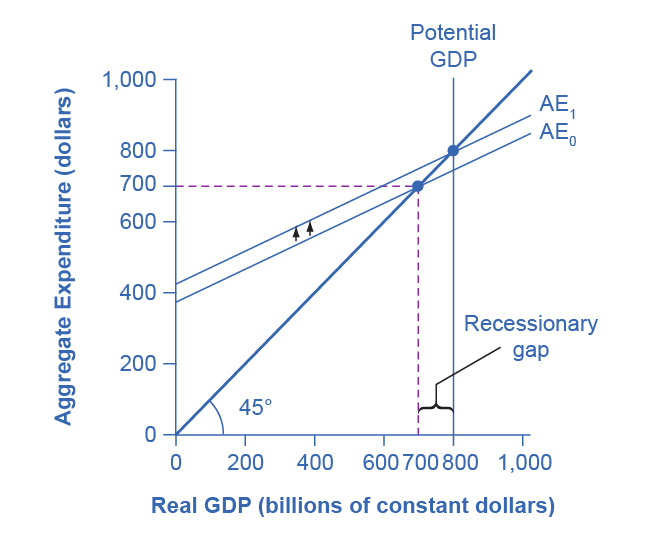


Figure D.11図 D.11
The power of the multiplier effect is that an increase in expenditure has a larger increase on the equilibrium output. The increase in expenditure is the vertical increase from AE0 to AE1. However, the increase in equilibrium output, shown on the horizontal axis, is clearly larger.
英語のヒント
乗数効果の力は、支出の増加が、それより大きな均衡産出量の増加をもたらすことである。支出の増加はAE0からAE1への垂直方向の増加である。しかし、横軸に示す均衡産出量の増加は、明らかにそれより大きい。
The multiplier effect is also visible on the Keynesian cross diagram. Figure D.11 shows the example we have been discussing: a recessionary gap with an equilibrium of $700, potential GDP of $800, the slope of the aggregate expenditure function (AE0) determined by the assumptions that taxes are 30% of income, savings are 0.1 of after-tax income, and imports are 0.1 of before-tax income. At AE1, the aggregate expenditure function is moved up to reach potential GDP.
英語のヒント
乗数効果はケインズの交差図でも見える。図D.11は、これまで論じてきた例を示す。均衡700ドル、潜在GDP800ドルの景気後退ギャップがあり、総支出関数AE0の傾きは、税が所得の30%、貯蓄が税引後所得の0.1、輸入が課税前所得の0.1という仮定で決まる。AE1では、潜在GDPに達するよう総支出関数が上方へ動いている。
Now, compare the vertical shift upward in the aggregate expenditure function, which is $47, with the horizontal shift outward in real GDP, which is $100 (as these numbers were calculated earlier). The rise in real GDP is more than double the rise in the aggregate expenditure function. (Similarly, if you look back at Figure D.9, you will see that the vertical movements in the aggregate expenditure functions are smaller than the change in equilibrium output that is produced on the horizontal axis. Again, this is the multiplier effect at work.) In this way, the power of the multiplier is apparent in the income–expenditure graph, as well as in the arithmetic calculation.
英語のヒント
次に、先に計算した数値である、総支出関数の47ドルの垂直方向の上昇と、実質GDPの100ドルの水平方向の拡大を比べよう。実質GDPの増加は、総支出関数の増加の2倍を超える。(同様に、図D.9を振り返ると、総支出関数の垂直方向の移動は、それが横軸にもたらす均衡産出量の変化より小さいことがわかる。ここでも乗数効果が働いている。)このように、乗数の力は算術計算だけでなく、所得・支出図にも表れている。
The multiplier does not just affect government spending, but applies to any change in the economy. Say that business confidence declines and investment falls off, or that the economy of a leading trading partner slows down so that export sales decline. These changes will reduce aggregate expenditures, and then will have an even larger effect on real GDP because of the multiplier effect. Read the following Clear It Up feature to learn how the multiplier effect can be applied to analyze the economic impact of professional sports.
英語のヒント
乗数は政府支出だけでなく、経済のあらゆる変化に適用される。企業の景況感が悪化して投資が減ったり、主要な貿易相手国の経済が減速して輸出販売が落ちたりするとしよう。これらの変化は総支出を減らし、乗数効果によって実質GDPにさらに大きな影響を与える。次の「疑問を解こう」を読み、プロスポーツの経済的影響を分析するため、乗数効果をどう適用できるかを学ぼう。