付録
Indifference Curves with Labor-Leisure and Intertemporal Choices労働・余暇と異時点間の選択における無差別曲線
The concept of an indifference curve applies to tradeoffs in any household choice, including the labor-leisure choice or the intertemporal choice between present and future consumption. In the labor-leisure choice, each indifference curve shows the combinations of leisure and income that provide a certain level of utility. In an intertemporal choice, each indifference curve shows the combinations of present and future consumption that provide a certain level of utility. The general shapes of the indifference curves—downward sloping, steeper on the left and flatter on the right—also remain the same.
英語のヒント
無差別曲線は、労働と余暇、現在と将来の消費など、家計のあらゆる選択の交換関係に使える。労働・余暇の選択では、一定の効用を与える余暇と所得の組み合わせを示す。異時点間の選択では、一定の効用を与える現在と将来の消費の組み合わせを示す。右下がりで左が急、右が平らという一般的な形も変わらない。
A Labor-Leisure Example
英語のヒント
労働・余暇の例
Petunia is working at a job that pays $12 per hour but she gets a raise to $20 per hour. After family responsibilities and sleep, she has 80 hours per week available for work or leisure. As shown in Figure B.5, the highest level of utility for Petunia, on her original budget constraint, is at choice A, where it is tangent to the lower indifference curve (Ul). Point A has 30 hours of leisure and thus 50 hours per week of work, with income of $600 per week (that is, 50 hours of work at $12 per hour). Petunia then gets a raise to $20 per hour, which shifts her budget constraint to the right. Her new utility-maximizing choice occurs where the new budget constraint is tangent to the higher indifference curve Uh. At B, Petunia has 40 hours of leisure per week and works 40 hours, with income of $800 per week (that is, 40 hours of work at $20 per hour).
英語のヒント
ペチュニアの時給が12ドルから20ドルに上がる。家族への責任と睡眠の時間を除くと、仕事か余暇に週80時間を使える。図B.5で、元の予算制約の下で最高の効用を得るのは、低い無差別曲線Ulと接するAだ。Aでは余暇30時間、労働50時間で、所得は週600ドル(50時間×12ドル)になる。時給が20ドルへ上がると予算制約が右へ移り、高いUhに接するBが新しい最適点になる。Bでは余暇40時間、労働40時間、所得は週800ドル(40時間×20ドル)だ。
Effects of a Change in Petunia’s Wageペチュニアの賃金変化の効果
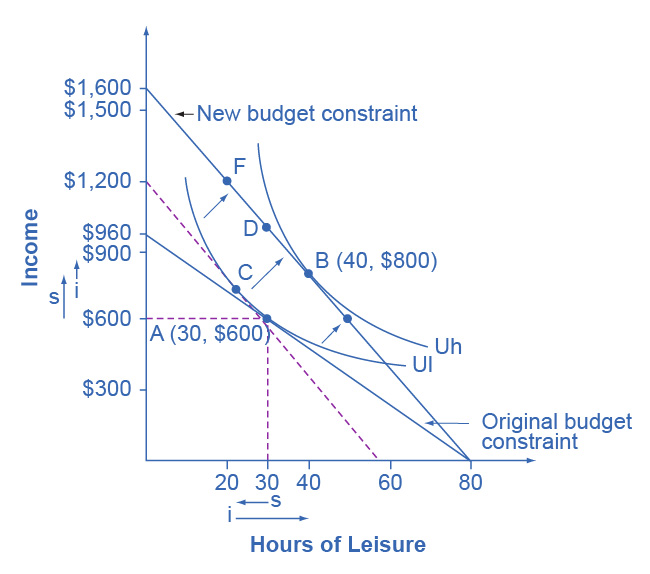
Figure B.5図 B.5
Petunia starts at choice A, the tangency between her original budget constraint and the lower indifference curve Ul. The wage increase shifts her budget constraint to the right, so that she can now choose B on indifference curve Uh. The substitution effect is the movement from A to C. In this case, the substitution effect would lead Petunia to choose less leisure, which is relatively more expensive, and more income, which is relatively cheaper to earn. The income effect is the movement from C to B. The income effect in this example leads to greater consumption of both goods. Overall, in this example, income rises because of both substitution and income effects. However, leisure declines because of the substitution effect but increases because of the income effect—leading, in Petunia’s case, to an overall increase in the quantity of leisure consumed.
英語のヒント
ペチュニアは元の予算制約と低いUlの接点Aから出発する。賃金上昇で予算制約が右へ移り、Uh上のBを選べる。代替効果はAからCへの移動で、相対的に高い余暇を減らし、相対的に得やすい所得を増やす。所得効果はCからBへの移動で、この例では両方を増やす。全体として所得は両効果で増える。余暇は代替効果で減り、所得効果で増えるが、ペチュニアの場合は差し引きで増える。
Substitution and income effects provide a vocabulary for discussing how Petunia reacts to a higher hourly wage. The dashed line serves as the tool for separating the two effects on the graph.
英語のヒント
代替効果と所得効果を使うと、時給上昇へのペチュニアの反応を論じられる。破線は図上で二つの効果を分ける道具になる。
The substitution effect tells how Petunia would have changed her hours of work if her wage had risen, so that income was relatively cheaper to earn and leisure was relatively more expensive, but if she had remained at the same level of utility. The slope of the budget constraint in a labor-leisure diagram is determined by the wage rate. Thus, the dashed line is carefully inserted with the slope of the new opportunity set, reflecting the labor-leisure tradeoff of the new wage rate, but tangent to the original indifference curve, showing the same level of utility or “buying power.” The shift from original choice A to point C, which is the point of tangency between the original indifference curve and the dashed line, shows that because of the higher wage, Petunia will want to consume less leisure and more income. The “s” arrows on the horizontal and vertical axes of Figure B.5 show the substitution effect on leisure and on income.
英語のヒント
代替効果は、賃金が上がって所得を相対的に得やすく、余暇を相対的に高くしながら、効用を元のままに保った場合の労働時間の変化を示す。労働・余暇の予算制約の傾きは賃金率で決まる。そのため破線を、新しい機会集合と同じ傾きにして新賃金の交換関係を反映しつつ、元の無差別曲線に接するよう入れる。効用や「購買力」は同じになる。元のAから、元の曲線と破線の接点Cへの移動は、高い賃金のため余暇を減らし所得を増やしたいことを示す。図B.5の横軸と縦軸のsの矢印が、余暇と所得への代替効果を表す。
The income effect is that the higher wage, by shifting the labor-leisure budget constraint to the right, makes it possible for Petunia to reach a higher level of utility. The income effect is the movement from point C to point B; that is, it shows how Petunia’s behavior would change in response to a higher level of utility or “buying power,” with the wage rate remaining the same (as shown by the dashed line being parallel to the new budget constraint). The income effect, encouraging Petunia to consume both more leisure and more income, is drawn with arrows on the horizontal and vertical axis of Figure B.5.
英語のヒント
所得効果は、賃金上昇が労働・余暇の予算制約を右へ移し、より高い効用に達せるようにすることだ。CからBへの移動で表す。破線と新しい予算制約が平行なので、賃金率は一定のまま、効用や「購買力」が上がったときの反応になる。余暇も所得も増やすよう促す所得効果を、図B.5の横軸と縦軸の矢印で示す。
Putting these effects together, Petunia responds to the higher wage by moving from choice A to choice B. This movement involves choosing more income, both because the substitution effect of higher wages has made income relatively cheaper or easier to earn, and because the income effect of higher wages has made it possible to have more income and more leisure. Her movement from A to B also involves choosing more leisure because, according to Petunia’s preferences, the income effect that encourages choosing more leisure is stronger than the substitution effect that encourages choosing less leisure.
英語のヒント
両効果を合わせると、ペチュニアは賃金上昇に対してAからBへ移る。代替効果で所得が相対的に得やすくなり、所得効果でも余暇と所得を増やせるため、所得を増やす。余暇も増やすのは、彼女の好みでは、余暇を増やす所得効果が、余暇を減らす代替効果より強いからだ。
Figure B.5 represents only Petunia’s preferences. Other people might make other choices. For example, a person whose substitution and income effects on leisure exactly counterbalanced each other might react to a higher wage with a choice like D, exactly above the original choice A, which means taking all of the benefit of the higher wages in the form of income while working the same number of hours. Yet another person, whose substitution effect on leisure outweighed the income effect, might react to a higher wage by making a choice like F, where the response to higher wages is to work more hours and earn much more income. To represent these different preferences, you could easily draw the indifference curve Uh to be tangent to the new budget constraint at D or F, rather than at B.
英語のヒント
図B.5はペチュニアの好みだけを示す。他の人なら別の選択もある。余暇への代替効果と所得効果がちょうど相殺する人は、元のAの真上のDを選び、労働時間を変えず、賃上げの利点をすべて所得として受け取るかもしれない。余暇への代替効果が所得効果を上回る人は、Fのように、労働時間を増やして所得を大幅に増やすかもしれない。こうした好みは、UhをBではなくDやFで新しい予算制約に接するよう描けば表せる。
An Intertemporal Choice Example
英語のヒント
異時点間の選択の例
Quentin has saved up $10,000. He is thinking about spending some or all of it on a vacation in the present, and then will save the rest for another big vacation five years from now. Over those five years, he expects to earn a total 80% rate of return. Figure B.6 shows Quentin’s budget constraint and his indifference curves between present consumption and future consumption. The highest level of utility that Quentin can achieve at his original intertemporal budget constraint occurs at point A, where he is consuming $6,000, saving $4,000 for the future, and expecting with the accumulated interest to have $7,200 for future consumption (that is, $4,000 in current financial savings plus the 80% rate of return).
英語のヒント
クエンティンは10,000ドル貯めた。その一部または全部を今の休暇に使い、残りを5年後の大きな休暇のために貯めようと考えている。5年間の総収益率は80%と予想する。図B.6は現在と将来の消費の予算制約と無差別曲線を示す。元の異時点間予算制約で最高の効用を得るAでは、現在6,000ドルを消費し、4,000ドルを貯蓄する。利子を合わせ、将来は7,200ドル(4,000ドルに収益率80%を加えた額)を消費できると期待する。
However, Quentin has just realized that his expected rate of return was unrealistically high. A more realistic expectation is that over five years he can earn a total return of 30%. In effect, his intertemporal budget constraint has pivoted to the left, so that his original utility-maximizing choice is no longer available. Will Quentin react to the lower rate of return by saving more, or less, or the same amount? Again, the language of substitution and income effects provides a framework for thinking about the motivations behind various choices. The dashed line, which is a graphical tool to separate the substitution and income effect, is carefully inserted with the same slope as the new opportunity set, so that it reflects the changed rate of return, but it is tangent to the original indifference curve, so that it shows no change in utility or “buying power.”
英語のヒント
しかし、予想収益率が非現実的に高いと気付いた。より現実的なのは、5年間で総収益率30%という予想だ。異時点間予算制約は左へ回転し、元の効用最大化の選択ができなくなる。収益率低下に対し、貯蓄を増やす、減らす、同じにするのどれを選ぶだろうか。ここでも代替効果と所得効果で、選択の動機を考えられる。二つを分ける破線は、新しい機会集合と同じ傾きで新収益率を反映しつつ、元の無差別曲線に接するように入れる。効用や「購買力」は変わらない状態を示す。
The substitution effect tells how Quentin would have altered his consumption because the lower rate of return makes future consumption relatively more expensive and present consumption relatively cheaper. The movement from the original choice A to point C shows how Quentin substitutes toward more present consumption and less future consumption in response to the lower interest rate, with no change in utility. The substitution arrows on the horizontal and vertical axes of Figure B.6 show the direction of the substitution effect motivation. The substitution effect suggests that, because of the lower interest rate, Quentin should consume more in the present and less in the future.
英語のヒント
代替効果は、収益率低下で将来の消費が相対的に高く、現在の消費が相対的に安くなることによる変化を示す。元のAからCへの移動は、効用を変えず、低い利子率に反応して現在の消費を増やし、将来の消費を減らす様子だ。図B.6の横軸と縦軸の代替の矢印が、この動機の方向を示す。代替効果からは、低い利子率によって現在を多く、将来を少なく消費することになる。
Quentin also has an income effect motivation. The lower rate of return shifts the budget constraint to the left, which means that Quentin’s utility or “buying power” is reduced. The income effect (assuming normal goods) encourages less of both present and future consumption. The impact of the income effect on reducing present and future consumption in this example is shown with “i” arrows on the horizontal and vertical axis of Figure B.6.
英語のヒント
クエンティンには所得効果の動機もある。収益率低下は予算制約を左へ移し、効用や「購買力」を下げる。上級財と仮定すると、所得効果は現在と将来の両方の消費を減らすよう促す。この例の効果は、図B.6の横軸と縦軸のiの矢印で示す。
Indifference Curve and an Intertemporal Budget Constraint無差別曲線と異時点間予算制約
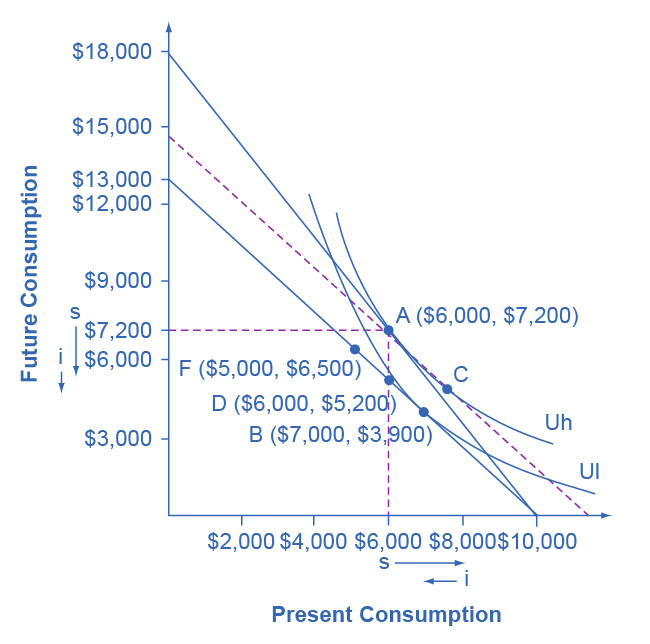


Figure B.6図 B.6
The original choice is A, at the tangency between the original budget constraint and the original indifference curve Uh. The dashed line is drawn parallel to the new budget set, so that its slope reflects the lower rate of return, but is tangent to the original indifference curve. The movement from A to C is the substitution effect: in this case, future consumption has become relatively more expensive, and present consumption has become relatively cheaper. The income effect is the shift from C to B; that is, the reduction in utility or “buying power” that causes a move to a lower indifference curve Ul, but with the relative price the same. It means less present and less future consumption. In the move from A to B, the substitution effect on present consumption is greater than the income effect, so the overall result is more present consumption. Notice that the lower indifference curve could have been drawn tangent to the lower budget constraint point D or point F, depending on personal preferences.
英語のヒント
元のAは、元の予算制約とUhの接点だ。破線は新しい機会集合に平行で低い収益率を反映しつつ、元の曲線に接する。AからCが代替効果で、将来の消費が相対的に高く、現在の消費が安くなったことによる移動だ。所得効果はCからBで、相対価格を同じに保ち、効用や「購買力」の低下によって低いUlへ移る。現在も将来も消費が減る。AからBへの全体の移動では、現在の消費への代替効果が所得効果より大きく、現在の消費は増える。好みによっては、低い曲線を新しい予算制約のDやFに接するよう描くこともできる。