付録
Utility-Maximizing with Indifference Curves無差別曲線で効用を最大にする
People seek the highest level of utility, which means that they wish to be on the highest possible indifference curve. However, people are limited by their budget constraints, which show what tradeoffs are actually possible.
英語のヒント
人は最も高い効用を求めるので、できるだけ高い無差別曲線上にいたい。しかし、実際に可能な交換関係を示す予算制約に制限される。
Maximizing Utility at the Highest Indifference Curve
英語のヒント
最も高い無差別曲線で効用を最大化する
Return to the situation of Lilly’s choice between paperback books and doughnuts. Say that books cost $6, doughnuts are 50 cents each, and that Lilly has $60 to spend. This information provides the basis for the budget line shown in Figure B.2. Along with the budget line are shown the three indifference curves from Figure B.1. What is Lilly’s utility-maximizing choice? Several possibilities are identified in the diagram.
英語のヒント
Indifference Curves and a Budget Constraint無差別曲線と予算制約
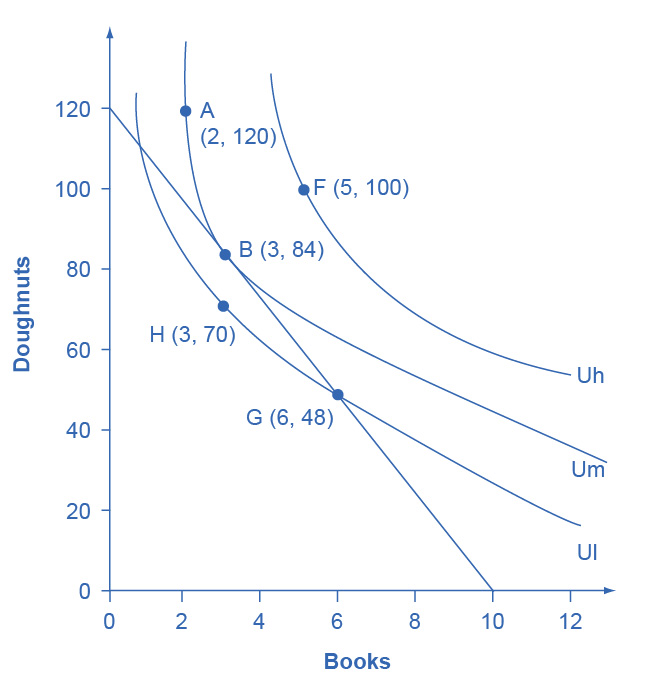
Figure B.2図 B.2
Lilly’s preferences are shown by the indifference curves. Lilly’s budget constraint, given the prices of books and doughnuts and her income, is shown by the straight line. Lilly’s optimal choice will be point B, where the budget line is tangent to the indifference curve Um. Lilly would have more utility at a point like F on the higher indifference curve Uh, but the budget line does not touch the higher indifference curve Uh at any point, so she cannot afford this choice. A choice like G is affordable to Lilly, but it lies on indifference curve Ul and thus provides less utility than choice B, which is on indifference curve Um.
英語のヒント
無差別曲線がリリーの好みを、直線が本・ドーナツの価格と所得から決まる予算制約を示す。最適な選択は、予算線がUmに接するBだ。高いUh上のFなら効用は増すが、予算線はUhのどこにも届かず、購入できない。Gは購入できるものの、Ul上にあり、Um上のBより効用が低い。
The choice of F with five books and 100 doughnuts is highly desirable, since it is on the highest indifference curve Uh of those shown in the diagram. However, it is not affordable given Lilly’s budget constraint. The choice of H with three books and 70 doughnuts on indifference curve Ul is a wasteful choice, since it is inside Lilly’s budget set, and as a utility-maximizer, Lilly will always prefer a choice on the budget constraint itself. Choices B and G are both on the opportunity set. However, choice G of six books and 48 doughnuts is on lower indifference curve Ul than choice B of three books and 84 doughnuts, which is on the indifference curve Um. If Lilly were to start at choice G, and then thought about whether the marginal utility she was deriving from doughnuts and books, she would decide that some additional doughnuts and fewer books would make her happier—which would cause her to move toward her preferred choice B. Given the combination of Lilly’s personal preferences, as identified by her indifference curves, and Lilly’s opportunity set, which is determined by prices and income, B will be her utility-maximizing choice.
英語のヒント
本5冊とドーナツ100個のFは、図で最も高いUh上にあり、とても望ましい。しかし予算制約の下では買えない。Ul上の本3冊と70個のHは予算集合の内側にあり、無駄のある選択だ。効用を最大にするリリーは、予算制約そのものの上の選択を常に好む。BとGはどちらも機会集合上にあるが、本6冊と48個のGは低いUl上、本3冊と84個のBはUm上だ。Gから始め、本とドーナツから得る限界効用を考えれば、本を少し減らしてドーナツを増やす方が幸せだと判断し、好ましいBへ向かう。無差別曲線が示すリリーの好みと、価格・所得が決める機会集合を組み合わせると、Bが効用最大化の選択になる。
The highest achievable indifference curve touches the opportunity set at a single point of tangency. Since an infinite number of indifference curves exist, even if only a few of them are drawn on any given diagram, there will always exist one indifference curve that touches the budget line at a single point of tangency. All higher indifference curves, like Uh, will be completely above the budget line and, although the choices on that indifference curve would provide higher utility, they are not affordable given the budget set. All lower indifference curves, like Ul, will cross the budget line in two separate places. When one indifference curve crosses the budget line in two places, however, there will be another, higher, attainable indifference curve sitting above it that touches the budget line at only one point of tangency.
英語のヒント
到達できる最も高い無差別曲線は、機会集合に一点で接する。図に数本しか描かれていなくても曲線は無数に存在するため、予算線に一点で接する曲線が常にある。Uhのような高い曲線は完全に予算線の上にあり、効用は高いが購入できない。Ulのような低い曲線は、予算線と二か所で交わる。二か所で交わる曲線があれば、その上に、予算線へ一点で接する到達可能な高い曲線がある。
Changes in Income所得の変化
A rise in income causes the budget constraint to shift to the right. In graphical terms, the new budget constraint will now be tangent to a higher indifference curve, representing a higher level of utility. A reduction in income will cause the budget constraint to shift to the left, which will cause it to be tangent to a lower indifference curve, representing a reduced level of utility. If income rises by, for example, 50%, exactly how much will a person alter consumption of books and doughnuts? Will consumption of both goods rise by 50%, or will the quantity of one good rise substantially, while the quantity of the other good rises only a little, or even declines?
英語のヒント
所得が増すと予算制約は右へ移り、より高い効用を表す高い無差別曲線に接する。所得が減ると左へ移り、低い効用を表す低い曲線に接する。例えば所得が50%増えたら、本とドーナツの消費はどれだけ変わるだろう。両方50%増えるのか。一方が大きく増え、他方は少ししか増えない、あるいは減ることもあるのか。
Since personal preferences and the shape of indifference curves are different for each individual, the response to changes in income will be different, too. For example, consider the preferences of Manuel and Natasha in Figure B.3 (a) and Figure B.3 (b). They each start with an identical income of $40, which they spend on yogurts that cost $1 and rental movies that cost $4. Thus, they face identical budget constraints. However, based on Manuel’s preferences, as revealed by his indifference curves, his utility-maximizing choice on the original budget set occurs where his opportunity set is tangent to the highest possible indifference curve at W, with three movies and 28 yogurts, while Natasha’s utility-maximizing choice on the original budget set at Y will be seven movies and 12 yogurts.
英語のヒント
Manuel and Natasha’s Indifference Curvesマヌエルとナターシャの無差別曲線
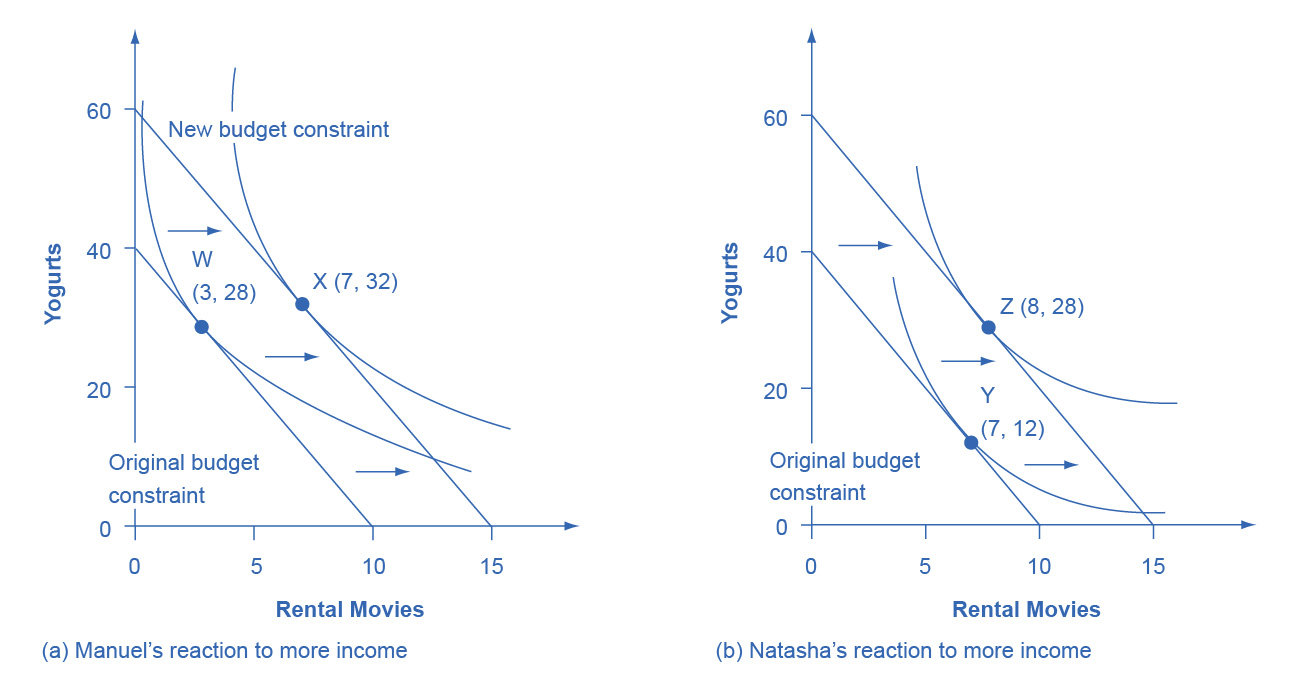


Figure B.3図 B.3
Manuel and Natasha originally face the same budget constraints; that is, same prices and same income. However, the indifference curves that illustrate their preferences are not the same. (a) Manuel’s original choice at W involves more yogurt and more movies, and he reacts to the higher income by mainly increasing consumption of movies at X. (b) Conversely, Natasha’s original choice (Y) involves relatively more movies, but she reacts to the higher income by choosing relatively more yogurts. Even when budget constraints are the same, personal preferences lead to different original choices and to different reactions in response to a change in income.
英語のヒント
2人の元の予算制約、つまり価格と所得は同じだが、好みを表す無差別曲線は異なる。(a)マヌエルの元のWはヨーグルトも映画も多く、所得増に対してXでは主に映画を増やす。(b)ナターシャの元のYは相対的に映画が多いが、所得増に対して相対的にヨーグルトを増やす。同じ予算制約でも、好みにより最初の選択も所得変化への反応も異なる。
Now, say that income rises to $60 for both Manuel and Natasha, so their budget constraints shift to the right. As shown in Figure B.3 (a), Manuel’s new utility maximizing choice at X will be seven movies and 32 yogurts—that is, Manuel will choose to spend most of the extra income on movies. Natasha’s new utility maximizing choice at Z will be eight movies and 28 yogurts—that is, she will choose to spend most of the extra income on yogurt. In this way, the indifference curve approach allows for a range of possible responses. However, if both goods are normal goods, then the typical response to a higher level of income will be to purchase more of them—although exactly how much more is a matter of personal preference. If one of the goods is an inferior good, the response to a higher level of income will be to purchase less of it.
英語のヒント
2人の所得が60ドルへ増え、予算制約が右へ移るとする。図B.3(a)のマヌエルの新しい最適点Xは、映画7本とヨーグルト32個だ。追加所得の大部分を映画に使う。ナターシャの新しい最適点Zは映画8本とヨーグルト28個で、大部分をヨーグルトに使う。このように、無差別曲線ではさまざまな反応を表せる。ただし両方が上級財なら、所得増に対する一般的な反応は両方を多く買うことで、どれだけ増やすかは好みによる。一方が下級財なら、所得が増えるとそれを少なく買う。