付録
Responses to Price Changes: Substitution and Income Effects価格変化への反応:代替効果と所得効果
A higher price for a good will cause the budget constraint to shift to the left, so that it is tangent to a lower indifference curve representing a reduced level of utility. Conversely, a lower price for a good will cause the opportunity set to shift to the right, so that it is tangent to a higher indifference curve representing an increased level of utility. Exactly how much a change in price will lead to the quantity demanded of each good will depend on personal preferences.
英語のヒント
財の価格が上がると予算制約は左へ移り、低い効用を表す低い無差別曲線に接する。逆に価格が下がると機会集合は右へ移り、高い効用を表す高い曲線に接する。各財の需要量がどれだけ変わるかは、個人の好みによる。
Anyone who faces a change in price will experience two interlinked motivations: a substitution effect and an income effect. The substitution effect is that when a good becomes more expensive, people seek out substitutes. If oranges become more expensive, fruit-lovers scale back on oranges and eat more apples, grapefruit, or raisins. Conversely, when a good becomes cheaper, people substitute toward consuming more. If oranges get cheaper, people fire up their juicing machines and ease off on other fruits and foods. The income effect refers to how a change in the price of a good alters the effective buying power of one’s income. If the price of a good that you have been buying falls, then in effect your buying power has risen—you are able to purchase more goods. Conversely, if the price of a good that you have been buying rises, then the buying power of a given amount of income is diminished. (One common source of confusion is that the “income effect” does not refer to a change in actual income. Instead, it refers to the situation in which the price of a good changes, and thus the quantities of goods that can be purchased with a fixed amount of income change. It might be more accurate to call the “income effect” a “buying power effect,” but the “income effect” terminology has been used for decades, and it is not going to change during this economics course.) Whenever a price changes, consumers feel the pull of both substitution and income effects at the same time.
英語のヒント
価格が変わると、誰もが結び付いた二つの動機、代替効果と所得効果を経験する。代替効果は、財が高くなると代わりを探すことだ。オレンジが高くなれば、果物好きはオレンジを減らし、リンゴ、グレープフルーツ、レーズンを増やす。逆に安くなれば、その財を多く消費する方へ切り替える。オレンジが安くなれば、ジューサーを動かし、ほかの果物や食品を控える。所得効果は、価格変化が所得の実質的な購買力をどう変えるかを指す。買っていた財の価格が下がると購買力が上がり、より多くの財を買える。価格が上がれば、一定の所得の購買力は下がる。よくある混乱は、「所得効果」が実際の所得の変化を指すと思うことだ。そうではなく、財の価格が変わり、同じ所得で買える量が変わる状況を指す。「購買力効果」の方が正確かもしれないが、「所得効果」は何十年も使われ、この講義中に名称が変わることはない。価格が変わるたび、消費者は代替効果と所得効果の両方を同時に受ける。
Using indifference curves, you can illustrate the substitution and income effects on a graph. In Figure B.4, Ogden faces a choice between two goods: haircuts or personal pizzas. Haircuts cost $20, personal pizzas cost $6, and he has $120 to spend.
英語のヒント
無差別曲線を使うと、代替効果と所得効果を図で示せる。図B.4のオグデンは散髪と1人用ピザから選ぶ。散髪は20ドル、ピザは6ドル、予算は120ドルだ。
Substitution and Income Effects代替効果と所得効果
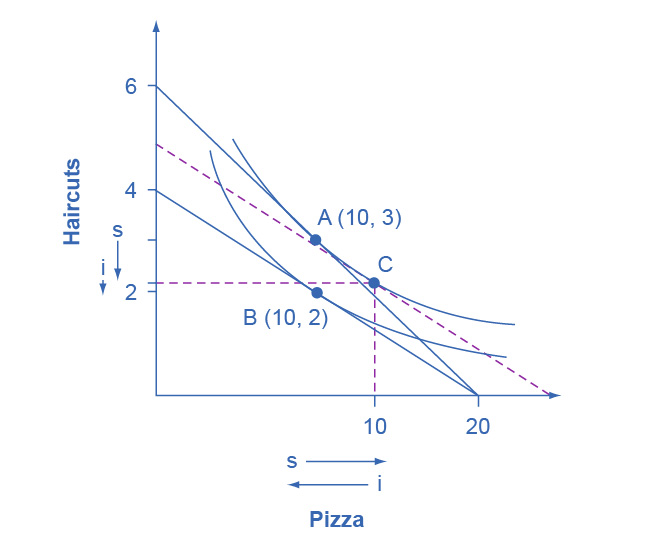

Figure B.4図 B.4
The original choice is A, the point of tangency between the original budget constraint and indifference curve. The new choice is B, the point of tangency between the new budget constraint and the lower indifference curve. Point C is the tangency between the dashed line, where the slope shows the new higher price of haircuts, and the original indifference curve. The substitution effect is the shift from A to C, which means getting fewer haircuts and more pizza. The income effect is the shift from C to B; that is, the reduction in buying power that causes a shift from the higher indifference curve to the lower indifference curve, with relative prices remaining unchanged. The income effect results in less consumed of both goods. Both substitution and income effects cause fewer haircuts to be consumed. For pizza, in this case, the substitution effect and income effect cancel out, leading to the same amount of pizza consumed.
英語のヒント
元の選択Aは元の予算制約と無差別曲線の接点、新しい選択Bは新しい予算制約と低い曲線の接点だ。Cは、散髪の新しい高い価格を傾きで示す破線と、元の曲線の接点である。代替効果はAからCへの移動で、散髪を減らしピザを増やす。所得効果はCからBへの移動で、相対価格を変えず、購買力低下により高い曲線から低い曲線へ移る。所得効果では両方の消費が減る。散髪は両効果で減る。ピザでは両効果が相殺され、消費量は同じになる。
The price of haircuts rises to $30. Ogden starts at choice A on the higher opportunity set and the higher indifference curve. After the price of haircuts increases, he chooses B on the lower opportunity set and the lower indifference curve. Point B with two haircuts and 10 personal pizzas is immediately below point A with three haircuts and 10 personal pizzas, showing that Ogden reacted to a higher price of haircuts by cutting back only on haircuts, while leaving his consumption of pizza unchanged.
英語のヒント
散髪が30ドルへ値上がりする。オグデンは元は高い機会集合と高い無差別曲線上のAを選んでいたが、値上げ後は低い機会集合と低い曲線上のBを選ぶ。散髪2回・ピザ10枚のBは、散髪3回・ピザ10枚のAの真下にある。散髪の値上げに対し、ピザは変えず、散髪だけ減らしたことを示す。
The dashed line in the diagram, and point C, are used to separate the substitution effect and the income effect. To understand their function, start by thinking about the substitution effect with this question: How would Ogden change his consumption if the relative prices of the two goods changed, but this change in relative prices did not affect his utility? The slope of the budget constraint is determined by the relative price of the two goods; thus, the slope of the original budget line is determined by the original relative prices, while the slope of the new budget line is determined by the new relative prices. With this thought in mind, the dashed line is a graphical tool inserted in a specific way: It is inserted so that it is parallel with the new budget constraint, so it reflects the new relative prices, but it is tangent to the original indifference curve, so it reflects the original level of utility or buying power.
英語のヒント
図の破線とCは、代替効果と所得効果を分けるために使う。働きを理解するには、次の問いから代替効果を考えよう。二つの財の相対価格が変わっても効用に影響しないとしたら、オグデンは消費をどう変えるだろうか。予算制約の傾きは二つの財の相対価格で決まる。元の線は元の相対価格、新しい線は新しい相対価格を反映する。そこで破線を、新しい予算制約に平行にして新しい相対価格を表しつつ、元の無差別曲線に接するように入れる。これで、元の効用や購買力を保った状態を図示できる。
Thus, the movement from the original choice (A) to point C is a substitution effect; it shows the choice that Ogden would make if relative prices shifted (as shown by the different slope between the original budget set and the dashed line) but if buying power did not shift (as shown by being tangent to the original indifference curve). The substitution effect will encourage people to shift away from the good which has become relatively more expensive—in Ogden’s case, the haircuts on the vertical axis—and toward the good which has become relatively less expensive—in this case, the pizza on the vertical axis. The two arrows labeled with “s” for “substitution effect,” one on each axis, show the direction of this movement.
英語のヒント
元のAからCへの移動が代替効果だ。相対価格は変わる(元の予算線と破線の傾きが異なる)が、購買力は変わらない(元の無差別曲線に接する)ときの選択を示す。代替効果は、相対的に高くなった財、ここでは縦軸の散髪を減らし、相対的に安くなった財、ここでは縦軸のピザを増やすよう促す。各軸の「代替効果」を表すsの矢印が、移動の方向を示す。
The income effect is the movement from point C to B, which shows how Ogden reacts to a reduction in his buying power from the higher indifference curve to the lower indifference curve, but holding constant the relative prices (because the dashed line has the same slope as the new budget constraint). In this case, where the price of one good increases, buying power is reduced, so the income effect means that consumption of both goods should fall (if they are both normal goods, which it is reasonable to assume unless there is reason to believe otherwise). The two arrows labeled with “i” for “income effect,” one on each axis, show the direction of this income effect movement.
英語のヒント
所得効果はCからBへの移動だ。相対価格を一定にして、高い無差別曲線から低い曲線へ購買力が下がったときの反応を示す。破線と新しい予算制約の傾きが同じなので、相対価格は一定である。一方の財が値上がりすると購買力が下がるため、両方が上級財なら、所得効果によって両方の消費が減るはずだ。反対の理由がなければ、上級財と考えるのが妥当である。各軸の「所得効果」を表すiの矢印が、その移動方向を示す。
Now, put the substitution and income effects together. When the price of pizza increased, Ogden consumed less of it, for two reasons shown in the exhibit: the substitution effect of the higher price led him to consume less and the income effect of the higher price also led him to consume less. However, when the price of pizza increased, Ogden consumed the same quantity of haircuts. The substitution effect of a higher price for pizza meant that haircuts became relatively less expensive (compared to pizza), and this factor, taken alone, would have encouraged Ogden to consume more haircuts. However, the income effect of a higher price for pizza meant that he wished to consume less of both goods, and this factor, taken alone, would have encouraged Ogden to consume fewer haircuts. As shown in Figure B.4, in this particular example the substitution effect and income effect on Ogden’s consumption of haircuts are offsetting—so he ends up consuming the same quantity of haircuts after the price increase for pizza as before.
英語のヒント
二つの効果を合わせよう。ピザが値上がりしたとき、オグデンがピザを減らしたのは、図の二つの理由による。値上げの代替効果も所得効果も、消費を減らす方向に働いた。しかしピザが値上がりしても、散髪の消費量は同じだった。ピザの値上げで散髪が相対的に安くなる代替効果だけなら、散髪を増やすよう促す。所得効果だけなら、両方の財を減らしたいので、散髪も減らすよう促す。図B.4のこの例では、散髪への代替効果と所得効果が相殺されるため、ピザの値上げ前後で散髪の回数は同じになる。
The size of these income and substitution effects will differ from person to person, depending on individual preferences. For example, if Ogden’s substitution effect away from pizza and toward haircuts is especially strong, and outweighs the income effect, then a higher price for pizza might lead to increased consumption of haircuts. This case would be drawn on the graph so that the point of tangency between the new budget constraint and the relevant indifference curve occurred below point B and to the right. Conversely, if the substitution effect away from pizza and toward haircuts is not as strong, and the income effect on is relatively stronger, then Ogden will be more likely to react to the higher price of pizza by consuming less of both goods. In this case, his optimal choice after the price change will be above and to the left of choice B on the new budget constraint.
英語のヒント
所得効果と代替効果の大きさは、個人の好みによって違う。ピザから散髪へ移る代替効果が特に強く、所得効果を上回るなら、ピザの値上げで散髪が増えるかもしれない。図では、新しい予算制約と無差別曲線の接点がBの右下に来る。逆に、その代替効果が弱く、所得効果が相対的に強ければ、ピザの値上げに対して両方を減らす可能性が高い。この場合、新しい最適点は新しい予算制約上でBの左上になる。
Although the substitution and income effects are often discussed as a sequence of events, it should be remembered that they are twin components of a single cause—a change in price. Although you can analyze them separately, the two effects are always proceeding hand in hand, happening at the same time.
英語のヒント
代替効果と所得効果は出来事の順序のように説明されることが多いが、一つの原因、すなわち価格変化の二つの構成要素だと覚えておこう。別々に分析はできても、常に一緒に、同時に進んでいる。