付録
Indifference Curves無差別曲線
Economists use a vocabulary of maximizing utility to describe people’s preferences. In Consumer Choices, the level of utility that a person receives is described in numerical terms. This appendix presents an alternative approach to describing personal preferences, called indifference curves, which avoids any need for using numbers to measure utility. By setting aside the assumption of putting a numerical valuation on utility—an assumption that many students and economists find uncomfortably unrealistic—the indifference curve framework helps to clarify the logic of the underlying model.
英語のヒント
経済学者は、人の好みを説明するために効用最大化という言葉を使う。「消費者の選択」では、得られる効用の水準を数値で表した。この付録では、効用を数値で測らずに好みを表す別の方法、無差別曲線を紹介する。効用に数値を付けるという、多くの学生や経済学者が現実離れしていて落ち着かないと感じる仮定を外すことで、モデルの背後の論理を明確にできる。
What Is an Indifference Curve?無差別曲線とは何か
People cannot really put a numerical value on their level of satisfaction. However, they can, and do, identify what choices would give them more, or less, or the same amount of satisfaction. An indifference curve shows combinations of goods that provide an equal level of utility or satisfaction. For example, Figure B.1 presents three indifference curves that represent Lilly’s preferences for the tradeoffs that she faces in her two main relaxation activities: eating doughnuts and reading paperback books. Each indifference curve (Ul, Um, and Uh) represents one level of utility. First we will explore the meaning of one particular indifference curve and then we will look at the indifference curves as a group.
英語のヒント
満足度に実際の数値を付けることはできない。しかし、どの選択なら満足が増える、減る、同じになるかは判断でき、実際にそうしている。無差別曲線は、等しい効用や満足をもたらす財の組み合わせを示す。図B.1の3本の無差別曲線は、リリーの主な楽しみであるドーナツを食べることとペーパーバックを読むことの間の選択について、好みを示す。Ul、Um、Uhの各曲線が、一つの効用水準に対応する。まず1本の意味を調べ、次に曲線群を見る。
Lilly’s Indifference Curvesリリーの無差別曲線
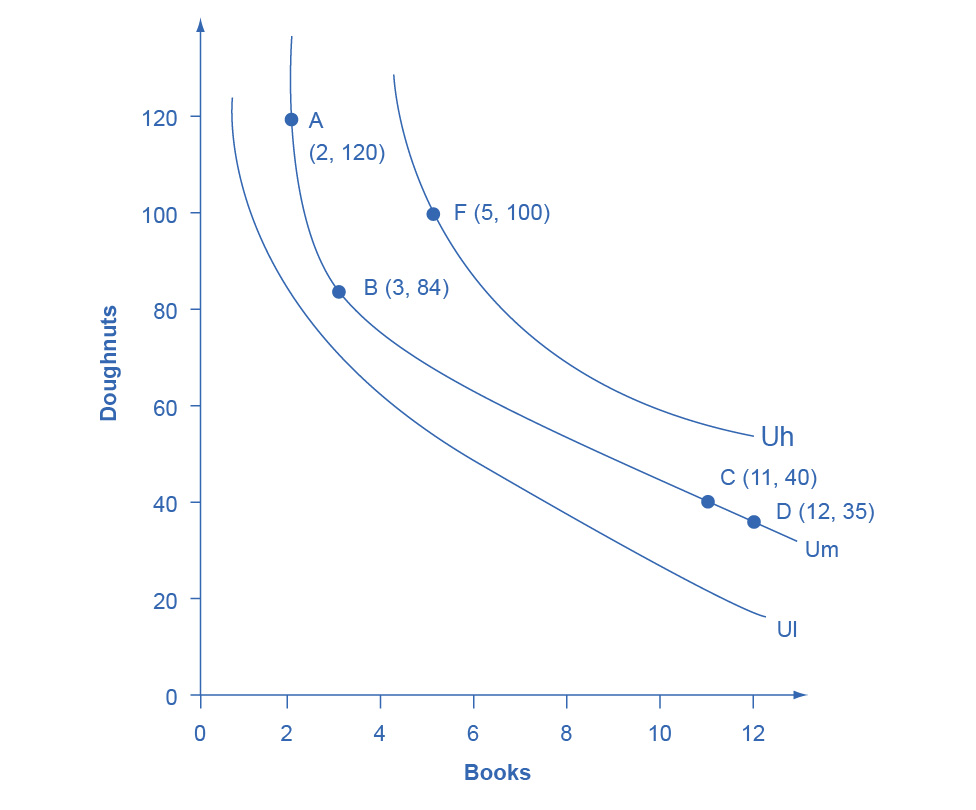

Figure B.1図 B.1
Lilly would receive equal utility from all points on a given indifference curve. Any points on the highest indifference curve Uh, like F, provide greater utility than any points like A, B, C, and D on the middle indifference curve Um. Similarly, any points on the middle indifference curve Um provide greater utility than any points on the lowest indifference curve Ul.
英語のヒント
同じ無差別曲線上のすべての点から、リリーは同じ効用を得る。最も高いUh上のFなどの点は、中間のUm上のA、B、C、Dなどのどの点より効用が高い。同様にUm上のどの点も、最も低いUl上のどの点より効用が高い。
The Shape of an Indifference Curve
英語のヒント
無差別曲線の形
The indifference curve Um has four points labeled on it: A, B, C, and D. Since an indifference curve represents a set of choices that have the same level of utility, Lilly must receive an equal amount of utility, judged according to her personal preferences, from two books and 120 doughnuts (point A), from three books and 84 doughnuts (point B) from 11 books and 40 doughnuts (point C) or from 12 books and 35 doughnuts (point D). She would also receive the same utility from any of the unlabeled intermediate points along this indifference curve.
英語のヒント
Um上にはA、B、C、Dの4点が示されている。同じ効用を与える選択肢の集まりなので、リリーの好みで判断すれば、本2冊とドーナツ120個のA、本3冊と84個のB、本11冊と40個のC、本12冊と35個のDから得る効用は等しい。曲線上で印のない中間の点からも、同じ効用を得る。
Indifference curves have a roughly similar shape in two ways: 1) they are downward sloping from left to right; 2) they are convex with respect to the origin. In other words, they are steeper on the left and flatter on the right. The downward slope of the indifference curve means that Lilly must trade off less of one good to get more of the other, while holding utility constant. For example, points A and B sit on the same indifference curve Um, which means that they provide Lilly with the same level of utility. Thus, the marginal utility that Lilly would gain from, say, increasing her consumption of books from two to three must be equal to the marginal utility that she would lose if her consumption of doughnuts was cut from 120 to 84—so that her overall utility remains unchanged between points A and B. Indeed, the slope along an indifference curve as the marginal rate of substitution, which is the rate at which a person is willing to trade one good for another so that utility will remain the same.
英語のヒント
無差別曲線の形には、おおむね二つの共通点がある。左から右へ下がることと、原点に対して凸であることだ。つまり左側は急で、右側は平らになる。右下がりであることは、効用を一定に保つには、一方の財を増やすために他方を減らす必要があることを意味する。AとBは同じUm上なので、リリーに同じ効用を与える。したがって本を2冊から3冊へ増やして得る限界効用は、ドーナツを120個から84個へ減らして失う限界効用と等しい。全体の効用は変わらない。無差別曲線の傾きは限界代替率であり、効用を同じに保ちながら、一方の財を他方と交換してもよいと考える比率を表す。
Indifference curves like Um are steeper on the left and flatter on the right. The reason behind this shape involves diminishing marginal utility—the notion that as a person consumes more of a good, the marginal utility from each additional unit becomes lower. Compare two different choices between points that all provide Lilly an equal amount of utility along the indifference curve Um: the choice between A and B, and between C and D. In both choices, Lilly consumes one more book, but between A and B her consumption of doughnuts falls by 36 (from 120 to 84) and between C and D it falls by only five (from 40 to 35). The reason for this difference is that points A and C are different starting points, and thus have different implications for marginal utility. At point A, Lilly has few books and many doughnuts. Thus, her marginal utility from an extra book will be relatively high while the marginal utility of additional doughnuts is relatively low—so on the margin, it will take a relatively large number of doughnuts to offset the utility from the marginal book. At point C, however, Lilly has many books and few doughnuts. From this starting point, her marginal utility gained from extra books will be relatively low, while the marginal utility lost from additional doughnuts would be relatively high—so on the margin, it will take a relatively smaller number of doughnuts to offset the change of one marginal book. In short, the slope of the indifference curve changes because the marginal rate of substitution—that is, the quantity of one good that would be traded for the other good to keep utility constant—also changes, as a result of diminishing marginal utility of both goods.
英語のヒント
Umのような無差別曲線が左で急、右で平らになる理由には、限界効用逓減がある。財を多く消費するほど、追加1単位の限界効用が小さくなるという考えだ。同じ効用を与えるAからBへの選択と、CからDへの選択を比べよう。どちらも本が1冊増えるが、ドーナツはAからBでは36個(120から84)、CからDでは5個(40から35)しか減らない。出発点AとCでは、限界効用が異なるためだ。Aでは本が少なくドーナツが多い。本1冊の追加から得る限界効用は比較的高く、ドーナツの追加から得る限界効用は低い。そのため、本1冊の効用を相殺するには比較的多くのドーナツが必要になる。Cでは本が多くドーナツが少ない。本の追加から得る限界効用は低く、ドーナツをさらに減らして失う限界効用は高い。そのため、本1冊の変化を相殺するドーナツの数は少なくて済む。要するに、両方の財の限界効用が逓減する結果、効用を一定にする交換比率である限界代替率も変わるので、無差別曲線の傾きが変わる。
The Field of Indifference Curves
英語のヒント
無差別曲線の集まり
Each indifference curve represents the choices that provide a single level of utility. Every level of utility will have its own indifference curve. Thus, Lilly’s preferences will include an infinite number of indifference curves lying nestled together on the diagram—even though only three of the indifference curves, representing three levels of utility, appear on Figure B.1. In other words, an infinite number of indifference curves are not drawn on this diagram—but you should remember that they exist.
英語のヒント
各無差別曲線は、一つの効用水準を与える選択肢を表す。どの効用水準にも、それぞれの曲線がある。図B.1には3水準に対応する3本しか描かれていないが、リリーの好みは、図の中に重なるように並ぶ無数の無差別曲線で表される。描かれていない無数の曲線も存在すると覚えておこう。
Higher indifference curves represent a greater level of utility than lower ones. In Figure B.1, indifference curve Ul can be thought of as a “low” level of utility, while Um is a “medium” level of utility and Uh is a “high” level of utility. All of the choices on indifference curve Uh are preferred to all of the choices on indifference curve Um, which in turn are preferred to all of the choices on Ul.
英語のヒント
高い無差別曲線ほど高い効用を表す。図B.1のUlは「低」、Umは「中」、Uhは「高」の効用と考えられる。Uh上のどの選択もUm上のすべての選択より好まれ、Um上のどの選択もUl上のすべての選択より好まれる。
To understand why higher indifference curves are preferred to lower ones, compare point B on indifference curve Um to point F on indifference curve Uh. Point F has greater consumption of both books (five to three) and doughnuts (100 to 84), so point F is clearly preferable to point B. Given the definition of an indifference curve—that all the points on the curve have the same level of utility—if point F on indifference curve Uh is preferred to point B on indifference curve Um, then it must be true that all points on indifference curve Uh have a higher level of utility than all points on Um. More generally, for any point on a lower indifference curve, like Ul, you can identify a point on a higher indifference curve like Um or Uh that has a higher consumption of both goods. Since one point on the higher indifference curve is preferred to one point on the lower curve, and since all the points on a given indifference curve have the same level of utility, it must be true that all points on higher indifference curves have greater utility than all points on lower indifference curves.
英語のヒント
高い曲線が好まれる理由を見るため、Um上のBとUh上のFを比べよう。Fは本が3冊から5冊、ドーナツが84個から100個へ、両方とも多いので、明らかにBより好ましい。同じ曲線上のすべての点が同じ効用を与えるという定義から、Uh上のFがUm上のBより好まれるなら、Uh上のすべての点がUm上のすべての点より高い効用を与えるはずだ。一般に、Ulのような低い曲線上のどの点にも、UmやUhのような高い曲線上で両方の財が多い点を見つけられる。高い曲線上の一点が低い曲線上の一点より好まれ、各曲線内では効用が等しいので、高い曲線上のすべての点の効用が低い曲線上のすべての点より高くなる。
These arguments about the shapes of indifference curves and about higher or lower levels of utility do not require any numerical estimates of utility, either by the individual or by anyone else. They are only based on the assumptions that when people have less of one good they need more of another good to make up for it, if they are keeping the same level of utility, and that as people have more of a good, the marginal utility they receive from additional units of that good will diminish. Given these gentle assumptions, a field of indifference curves can be mapped out to describe the preferences of any individual.
英語のヒント
曲線の形や効用の高低についてのこの議論には、本人も他人も、効用を数値で見積もる必要がない。仮定は、効用を同じに保つなら一方の財の減少を他方の増加で補う必要があることと、財を多く持つほど追加1単位から得る限界効用が小さくなることだけだ。この穏やかな仮定の下で、どの人の好みも無差別曲線の集まりで描ける。
The Individuality of Indifference Curves
英語のヒント
無差別曲線の個人差
Each person determines their own preferences and utility. Thus, while indifference curves have the same general shape—they slope down, and the slope is steeper on the left and flatter on the right—the specific shape of indifference curves can be different for every person. Figure B.1, for example, applies only to Lilly’s preferences. Indifference curves for other people would probably travel through different points.
英語のヒント
好みと効用は各人が決める。無差別曲線には、右下がりで左側が急、右側が平らという共通の形があるが、具体的な形は人によって異なり得る。例えば図B.1はリリーだけに当てはまる。他の人の曲線は、おそらく別の点を通るだろう。