付録
How Open Market Operations Affect Balance Sheets in a Limited Reserves Environment限定的準備のもとで公開市場操作が貸借対照表に及ぼす影響
As we noted in our discussion of open market operations, in a limited reserves environment the FOMC can affect banks' balance sheets and the money supply. The following figures shows this process in detail.
英語のヒント
公開市場操作の説明で述べたように、限定的準備のもとでは、FOMCは銀行の貸借対照表と貨幣供給に影響を及ぼせる。以下の図は、その過程を詳しく示す。
Changes in Happy Bank's Balance Sheet
英語のヒント
ハッピー銀行の貸借対照表の変化
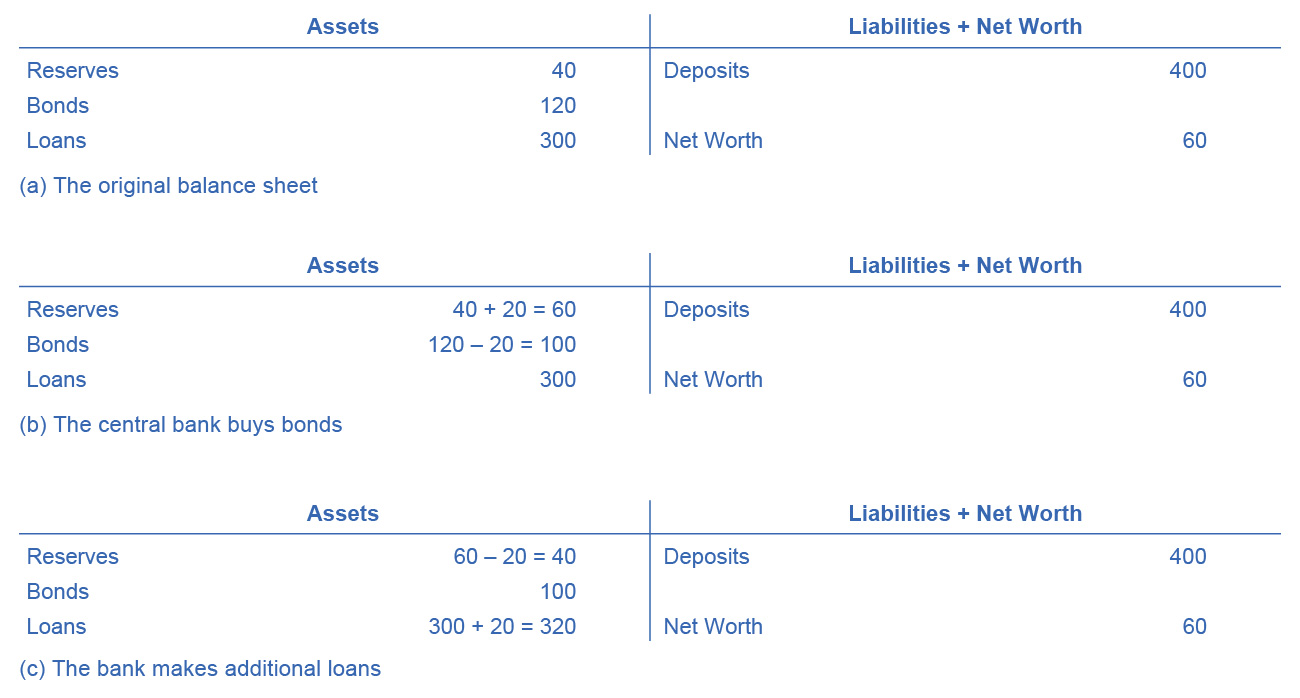
Figure E.1図 E.1
Figure E.1 (a) shows that Happy Bank starts with $460 million in assets, divided among reserves, bonds and loans, and $400 million in liabilities in the form of deposits, with a net worth of $60 million. When the central bank purchases $20 million in bonds from Happy Bank, the bond holdings of Happy Bank fall by $20 million and the bank’s reserves rise by $20 million, as Figure E.1 (b) shows. However, Happy Bank only wants to hold $40 million in reserves (the quantity of reserves with which it started in Figure 15.5) (a), so the bank decides to loan out the extra $20 million in reserves and its loans rise by $20 million, as Figure E.1 (c) shows.
英語のヒント
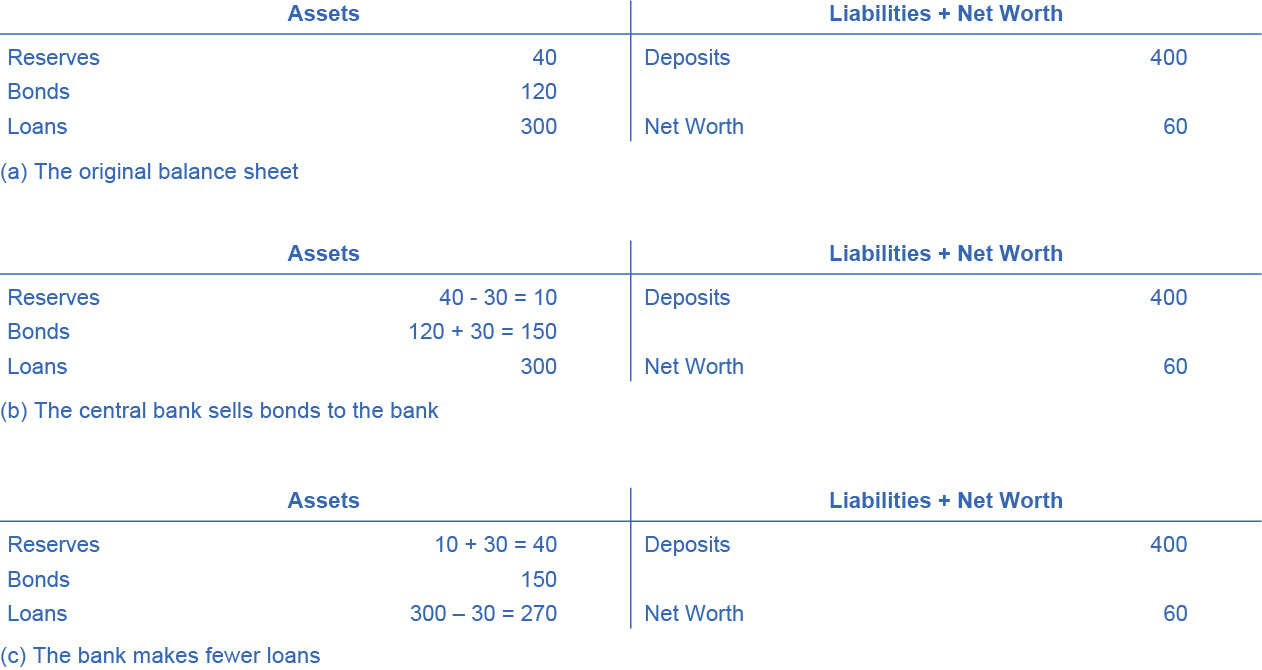


Figure E.2図 E.2
Figure E.2 (a) shows the balance sheet of Happy Bank before the central bank sells bonds in the open market. When Happy Bank purchases $30 million in bonds, Happy Bank sends $30 million of its reserves to the central bank, but now holds an additional $30 million in bonds, as Figure E.2 (b) shows. However, Happy Bank wants to hold $40 million in reserves, as in Figure E.2 (a), so it will adjust down the quantity of its loans by $30 million, to bring its reserves back to the desired level, as Figure E.2 (c) shows.