第14章労働市場と所得
14.6 Immigration14.6 移民
Learning Objectives学習目標
Learning Objectives学習目標
By the end of this section, you will be able to:
英語のヒント
この節を学ぶと、次のことができるようになる。
- Describe historical patterns of immigration to the U.S.
英語のヒント
米国への移民の歴史的傾向を説明する。 - Explain the economic impacts of immigration
英語のヒント
移民の経済的影響を説明する。 - Analyze the impact of immigration reform proposals
英語のヒント
移民改革案の影響を分析する。
Most Americans would be outraged if a law prevented them from moving to another city or another state. However, when the conversation turns to crossing national borders and is about other people arriving in the United States, laws preventing such movement often seem more reasonable. Some of the tensions over immigration stem from worries over how it might affect a country’s culture, including differences in language, and patterns of family, authority, or gender relationships. Economics does not have much to say about such cultural issues. Some of the worries about immigration do, however, have to do with its effects on wages and income levels, and how it affects government taxes and spending. On those topics, economists have insights and research to offer.
英語のヒント
別の都市や州への移動を法律で禁止されれば、米国人の大半は憤慨するだろう。しかし、話が国境を越えることや、他国の人が米国へ来ることになると、その移動を妨げる法律は、よりもっともらしく思われることが多い。移民をめぐる緊張の一部は、言語の違い、家族、権威、男女関係のあり方を含め、国の文化にどう影響するかへの心配から生じる。経済学がそのような文化的問題について言えることはあまりない。しかし移民への懸念の一部は、賃金や所得水準、政府の税収や支出に与える影響に関係する。それらの主題では、経済学者は知見と研究を提供できる。
Historical Patterns of Immigration移民の歴史的傾向
Supporters and opponents of immigration look at the same data and see different patterns. Those who express concern about immigration levels to the United States point to graphics like Figure 14.17 which shows total inflows of immigrants decade by decade through the twentieth and into the twenty-first century. Clearly, the level of immigration has been high and rising in recent years, reaching and exceeding the towering levels of the early twentieth century. However, those who are less worried about immigration point out that the high immigration levels of the early twentieth century happened when total population was much lower. Since the U.S. population roughly tripled during the twentieth century, the seemingly high levels in immigration in the 1990s and 2000s look relatively smaller when they are divided by the population.
英語のヒント
移民の支持者と反対者は、同じデータを見て異なる傾向を読み取る。米国への移民の水準に懸念を示す人々は、20世紀から21世紀にかけて、10年ごとの移民流入総数を示す図14.17のようなグラフを指す。明らかに近年の移民水準は高く、上昇し、20世紀初めの非常に高い水準に達し、それを超えている。しかし、移民をあまり心配しない人々は、20世紀初めの高い移民水準は、総人口がはるかに少ないときに生じたと指摘する。米国の人口は20世紀中にほぼ3倍になったため、1990年代と2000年代の一見高い移民水準も、人口で割ると相対的には小さく見える。
Immigration Since 19001900年以降の移民
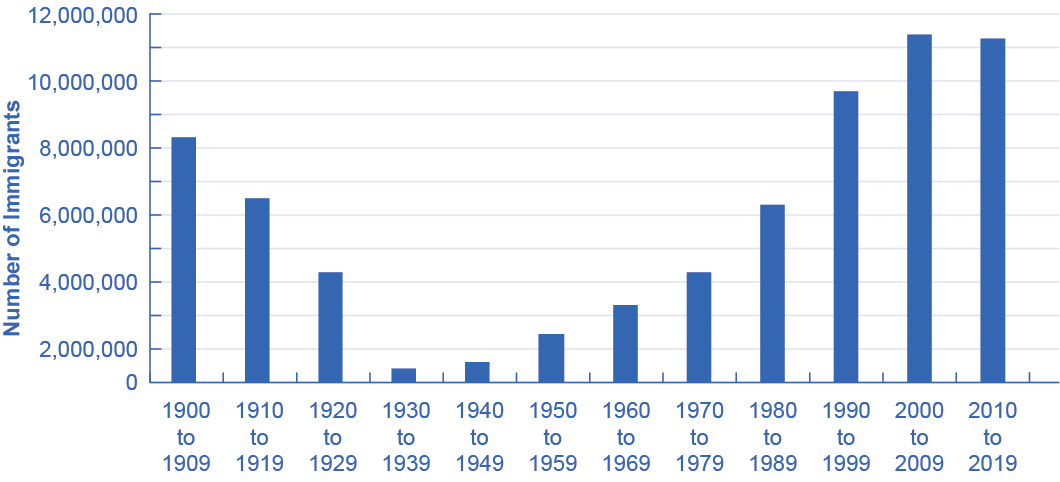

Figure 14.17図 14.17
The number of immigrants in each decade declined between 1900 and the 1940s, rose sharply through 2009 and started to decline from 2010 to the present. (Source: U.S. Census)
英語のヒント
10年ごとの移民数は、1900年から1940年代にかけて減り、2009年まで急増し、2010年から現在にかけて減少し始めた。(出典:米国国勢調査)
From where have the immigrants come? Immigrants from Europe were more than 90% of the total in the first decade of the twentieth century, but less than 20% of the total by the end of the century. By the 2000s, about half of U.S. immigration came from the rest of the Americas, especially Mexico, and about a quarter came from various countries in Asia.
英語のヒント
移民はどこから来たのだろうか。20世紀最初の10年間には欧州からの移民が全体の90%超を占めたが、世紀末には20%未満だった。2000年代までには、米国への移民の約半分が米州のほかの地域、とくにメキシコから、約4分の1がアジアのさまざまな国から来るようになった。
Economic Effects of Immigration移民の経済的影響
A surge of immigration can affect the economy in a number of different ways. In this section, we will consider how immigrants might benefit the rest of the economy, how they might affect wage levels, and how they might affect government spending at the federal and local level.
英語のヒント
移民の急増は、さまざまな形で経済に影響しうる。この節では、移民が経済のほかの部分にどのような便益をもたらしうるか、賃金水準や、連邦・地方政府の支出にどう影響しうるかを考える。
To understand the economic consequences of immigration, consider the following scenario. Imagine that the immigrants entering the United States matched the existing U.S. population in age range, education, skill levels, family size, and occupations. How would immigration of this type affect the rest of the U.S. economy? Immigrants themselves would be much better off, because their standard of living would be higher in the United States. Immigrants would contribute to both increased production and increased consumption. Given enough time for adjustment, the range of jobs performed, income earned, taxes paid, and public services needed would not be much affected by this kind of immigration. It would be as if the population simply increased a little.
英語のヒント
移民の経済的帰結を理解するため、次の状況を考えよう。米国に入る移民が、年齢構成、教育、技能水準、家族の人数、職業の点で、既存の米国人口と同じだと想像しよう。この種の移民は、米国経済のほかの部分にどう影響するだろうか。移民自身は、米国での生活水準が高くなるため、はるかによい暮らしを送れる。移民は生産と消費の両方の増加に寄与する。調整に十分な時間があれば、行われる仕事、得られる所得、払われる税、必要とされる公共サービスの範囲は、この種の移民ではあまり影響を受けない。人口が単に少し増えたかのようになる。
Now, consider the reality of recent immigration to the United States. Immigrants are not identical to the rest of the U.S. population. About one-third of immigrants over the age of 25 lack a high school diploma. As a result, many of the recent immigrants end up in jobs like restaurant and hotel work, lawn care, and janitorial work. This kind of immigration represents a shift to the right in the supply of unskilled labor for a number of jobs, which will lead to lower wages for these jobs. The middle- and upper-income households that purchase the services of these unskilled workers will benefit from these lower wages. However, low-skilled U.S. workers who must compete with low-skilled immigrants for jobs will tend to be negatively impacted by immigration.
英語のヒント
次に、近年の米国への移民の現実を考えよう。移民は、ほかの米国人口と同じではない。25歳を超える移民の約3分の1は、高校卒業資格を持たない。その結果、最近の移民の多くは、飲食店やホテルの仕事、芝生の手入れ、清掃のような仕事に就く。この種の移民は、多くの仕事において未熟練労働の供給を右へ移動させ、その仕事の賃金を下げる。これらの未熟練労働者のサービスを買う中・高所得世帯は、低い賃金から便益を得る。しかし、仕事を得るために低技能の移民と競争しなければならない低技能の米国労働者は、移民によって悪影響を受ける傾向がある。
The difficult policy questions about immigration are not so much about the overall gains to the rest of the economy, which seem to be real but small in the context of the U.S. economy, as they are about the disruptive effects of immigration in specific labor markets. One disruptive effect, as we noted, is that immigration weighted toward low-skill workers tends to reduce wages for domestic low-skill workers. A study by Michael S. Clune found that for each 10% rise in the number of employed immigrants with no more than a high school diploma in the labor market, high school students reduced their annual number of hours worked by 3%. The effects on wages of low-skill workers are not large—perhaps in the range of decline of about 1%. These effects are likely kept low, in part, because of the legal floor of federal and state minimum wage laws. In addition, immigrants are also thought to contribute to increased demand for local goods and services which can stimulate the local low skilled labor market. It is also possible that employers, in the face of abundant low-skill workers, may choose production processes which are more labor intensive than otherwise would have been. These various factors would explain the small negative wage effect that the native low-skill workers observed as a result of immigration.
英語のヒント
移民に関する難しい政策上の問いは、経済のほかの部分への全体的な利益そのものよりも、特定の労働市場で移民が引き起こす混乱に関するものである。全体的な利益は実在するように見えるが、米国経済全体の中では小さい。すでに述べた混乱の1つは、低技能の労働者に偏る移民が、国内の低技能労働者の賃金を下げる傾向を持つことである。マイケル・S・クルーンの研究は、労働市場で、高校卒業以下の学歴の雇用された移民が10%増えるごとに、高校生が年間労働時間を3%減らすと見いだした。低技能労働者の賃金への影響は大きくなく、おそらく約1%の低下の範囲である。連邦と州の最低賃金法による法的下限があることが、一部には影響を小さく保っていると考えられる。また移民は、地元の財やサービスの需要を増やし、地元の低技能労働市場を刺激すると考えられる。さらに雇用者は、豊富な低技能労働者に直面して、そうでなければ選んだものより労働集約的な生産過程を選ぶ可能性もある。こうした諸要因は、移民の結果として観察される、国内生まれの低技能労働者への小さな負の賃金効果を説明するだろう。
Another potential disruptive effect is the impact on state and local government budgets. Many of the costs imposed by immigrants are costs that arise in state-run programs, like the cost of public schooling and of welfare benefits. However, many of the taxes that immigrants pay are federal taxes like income taxes and Social Security taxes. Many immigrants do not own property (such as homes and cars), so they do not pay property taxes, which are one of the main sources of state and local tax revenue. However, they do pay sales taxes, which are state and local, and the landlords of property they rent pay property taxes. According to the nonprofit Rand Corporation, the effects of immigration on taxes are generally positive at the federal level, but they are negative at the state and local levels in places where there are many low-skilled immigrants.
英語のヒント
混乱を生む可能性のある別の影響は、州・地方政府の予算への影響である。移民がもたらす費用の多くは、公立学校や福祉給付の費用など、州が運営する事業で生じる。しかし移民が払う税の多くは、所得税や社会保障税のような連邦税である。多くの移民は住宅や自動車などの財産を持たないため、州・地方税収の主な源の1つである財産税を払わない。ただし、州・地方の税である売上税は払い、借りている不動産の家主は財産税を払う。非営利のランド研究所によると、税に対する移民の影響は、連邦レベルでは一般にプラスだが、低技能の移民が多い場所の州・地方レベルではマイナスである。