第14章労働市場と所得
14.4 Bilateral Monopoly14.4 双方独占
Learning Objectives学習目標
Learning Objectives学習目標
By the end of this section, you will be able to explain:
英語のヒント
この節を終えると、次のことを説明できるようになる。
- How firms determine wages and employment when a specific labor market combines a union and a monopsony
英語のヒント
特定の労働市場で労働組合と買手独占企業が組み合わさる場合、企業が賃金と雇用をどのように決めるか。
What happens when there is market power on both sides of the labor market, in other words, when a union meets a monopsony? Economists call such a situation a bilateral monopoly.
英語のヒント
労働市場の両側に市場支配力があると、言い換えれば、労働組合が買手独占企業に向き合うと、何が起こるだろうか。経済学者は、このような状況を双方独占と呼ぶ。
Bilateral Monopoly双方独占
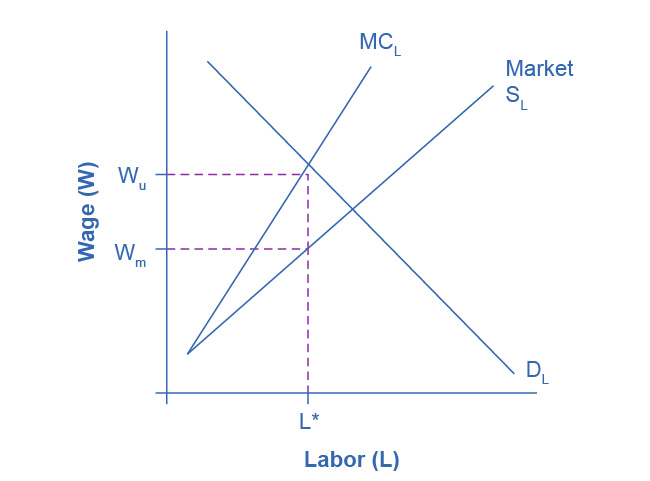

Figure 14.14図 14.14
Employment, L*, will be lower in a bilateral monopoly than in a competitive labor market, but the equilibrium wage is indeterminate, somewhere in the range between Wu, what the union would choose, and Wm, what the monopsony would choose.
英語のヒント
双方独占の雇用L*は、競争的な労働市場より少ないが、均衡賃金は一意に定まらず、組合が選ぶWuと、買手独占企業が選ぶWmの間のどこかとなる。
Figure 14.14 is a combination of Figure 14.6 and Figure 14.11. A monopsony wants to reduce wages as well as employment, Wm and L* in the figure. A union wants to increase wages, but at the cost of lower employment, Wu and L* in the figure. Since both sides want to reduce employment, we can be sure that the outcome will be lower employment compared to a competitive labor market. What happens to the wage, though, is based on the monopsonist’s relative bargaining power compared to the bargaining power of the union. The actual outcome is indeterminate in the graph, but it will be closer to Wu if the union has more power and closer to Wm if the monopsonist has more power.
英語のヒント
図14.14は、図14.6と図14.11を組み合わせたものである。買手独占企業は、図のWmとL*のように、賃金と雇用の両方を減らしたい。組合は、図のWuとL*のように、雇用の減少を代償として賃金を上げたい。双方とも雇用を減らしたいため、競争的な労働市場と比べて雇用が減ることは確実である。しかし賃金がどうなるかは、組合の交渉力と比べた買手独占企業の相対的な交渉力による。実際の結果はグラフからは一意に定まらないが、組合の力が強ければWuに近づき、買手独占企業の力が強ければWmに近づく。
Key Concepts and Summary重要概念とまとめ
A bilateral monopoly is a labor market with a union on the supply side and a monopsony on the demand side. Since both sides have monopoly power, the equilibrium level of employment will be lower than that for a competitive labor market, but the equilibrium wage could be higher or lower depending on which side negotiates better. The union favors a higher wage, while the monopsony favors a lower wage, but the outcome is indeterminate in the model.
英語のヒント
双方独占は、供給側に労働組合、需要側に買手独占企業がある労働市場である。双方が独占力を持つため、均衡雇用水準は競争的な労働市場より低くなるが、均衡賃金は、どちらがうまく交渉するかにより高くも低くもなりうる。組合は高い賃金を、買手独占企業は低い賃金を望むが、このモデルでは結果は一意に定まらない。
Review Questions復習問題
Exercises 22–26練習問題 22–26
Exercise 22問題 22
What is a monopsony?
英語のヒント
買手独占とは何か。
Exercise 23問題 23
What is the marginal cost of labor?
英語のヒント
労働の限界費用とは何か。
Exercise 24問題 24
How does monopsony affect the equilibrium wage and employment levels?
英語のヒント
買手独占は、均衡賃金水準と均衡雇用水準にどのように影響するか。
Exercise 25問題 25
What is a bilateral monopoly?
英語のヒント
双方独占とは何か。
Exercise 26問題 26
How does a bilateral monopoly affect the equilibrium wage and employment levels compared to a perfectly competitive labor market?
英語のヒント
双方独占は、完全競争的な労働市場と比べ、均衡賃金水準と均衡雇用水準にどのように影響するか。
bilateral monopoly
双方独占
a labor market with a monopsony on the demand side and a union on the supply side
英語のヒント
需要側に買手独占企業、供給側に労働組合がある労働市場