第14章労働市場と所得
What Determines the Going Market Wage Rate?何が現行の市場賃金率を決めるのか
In the chapter on Labor and Financial Markets, we learned that the labor market has demand and supply curves like other markets. The demand for labor curve is a downward sloping function of the wage rate. The market demand for labor is the horizontal sum of all firms’ demands for labor. The supply of labor curve is an upward sloping function of the wage rate. This is because if wages for a particular type of labor increase in a particular labor market, people with appropriate skills may change jobs, and vacancies will attract people from outside the geographic area. The market supply of labor is the horizontal summation of all individuals’ supplies of labor.
英語のヒント
「労働市場と金融市場」の章では、労働市場にも、ほかの市場と同じように需要曲線と供給曲線があると学んだ。労働需要曲線は、賃金率の右下がりの関数である。市場の労働需要は、すべての企業の労働需要を水平方向に足し合わせたものとなる。労働供給曲線は、賃金率の右上がりの関数である。これは、特定の労働市場で、ある種類の労働の賃金が上がると、適切な技能を持つ人が転職し、求人がその地域の外から人々を引きつける可能性があるためである。市場の労働供給は、すべての個人の労働供給を水平方向に足し合わせたものとなる。
The Market Wage Rate市場賃金率
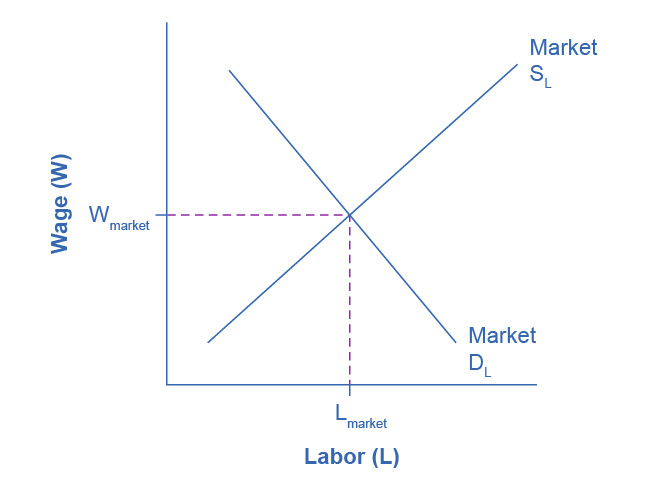

Figure 14.7図 14.7
In a competitive labor market, the equilibrium wage and employment level are determined where the market demand for labor equals the market supply of labor.
英語のヒント
競争的な労働市場では、市場の労働需要が市場の労働供給と等しくなるところで、均衡賃金と雇用水準が決まる。
Like all equilibrium prices, the market wage rate is determined through the interaction of supply and demand in the labor market. Thus, we can see in Figure 14.7 for competitive markets the wage rate and number of workers hired.
英語のヒント
すべての均衡価格と同様に、市場賃金率は労働市場の需要と供給の相互作用を通じて決まる。したがって図14.7で、競争市場の賃金率と雇用される労働者数を見ることができる。
The FRED database has a great deal of data on labor markets, starting at the wage rate and number of workers hired.
英語のヒント
FREDデータベースには、賃金率と雇用される労働者数をはじめ、労働市場に関する大量のデータがある。
The United States Census Bureau for the Bureau of Labor Statistics publishes The Current Population Survey, which is a monthly survey of households (you can find a link to it by going to the FRED database found in the previous link), which provides data on labor supply, including numerous measures of the labor force size (disaggregated by age, gender and educational attainment), labor force participation rates for different demographic groups, and employment. It also includes more than 3,500 measures of earnings by different demographic groups.
英語のヒント
米国国勢調査局は労働統計局のために、世帯を毎月調べる『現在人口調査』を公表している。前のリンクのFREDデータベースに行けば、そのリンクを見つけられる。この調査は、年齢、性別、教育達成度別に分けた労働力人口の大きさのさまざまな指標、人口集団別の労働参加率、雇用を含む労働供給のデータを提供する。また、人口集団別の所得に関する3,500以上の指標も含む。
The Current Employment Statistics, which is a survey of businesses, offers alternative estimates of employment across all sectors of the economy.
英語のヒント
企業を対象とする調査である『現在雇用統計』は、経済のすべての部門にわたる雇用について、別の推計値を提供する。
The FRED database, found in the previous link, also has a link labeled "Productivity and Costs" has a wide range of data on productivity, labor costs, and profits across the business sector.
英語のヒント
前のリンクで示したFREDデータベースには、「生産性と費用」というリンクもあり、企業部門全体の生産性、労働費用、利潤に関する幅広いデータがある。
Key Concepts and Summary重要概念とまとめ
A firm demands labor because of the value of the labor’s marginal productivity. For a firm operating in a perfectly competitive output market, this will be the value of the marginal product, which we define as the marginal product of labor multiplied by the firm’s output price. For a firm which is not perfectly competitive, the appropriate concept is the marginal revenue product, which we define as the marginal product of labor multiplied by the firm’s marginal revenue. Profit maximizing firms employ labor up to the point where the market wage is equal to the firm’s demand for labor. In a competitive labor market, we determine market wage through the interaction between the market supply and market demand for labor.
英語のヒント
企業が労働を需要するのは、その労働の限界生産性が持つ価値のためである。完全競争的な生産物市場で活動する企業の場合、これは限界生産物価値であり、労働の限界生産物に企業の産出物価格を掛けたものと定義する。完全競争でない企業に適切な概念は限界収入生産物であり、労働の限界生産物に企業の限界収入を掛けたものと定義する。利潤を最大化する企業は、市場賃金がその企業の労働需要と等しくなる点まで労働を雇う。競争的な労働市場では、市場の労働供給と労働需要の相互作用を通じて、市場賃金が決まる。
Self-Check Questions理解度確認問題
Exercises 1–7練習問題 1–7
Exercise 1問題 1
Table 14.4 shows levels of employment (Labor), the marginal product at each of those levels, and the price at which the firm can sell output in the perfectly competitive market where it operates.
英語のヒント
表14.4は、雇用水準(労働)、各水準での限界生産物、企業が活動する完全競争市場で産出物を販売できる価格を示す。
Labor 労働 |
Marginal Product of Labor 労働の限界生産物 |
Price of the Product 製品の価格 |
|---|---|---|
1 |
10 |
$4 |
2 |
8 |
$4 |
3 |
7 |
$4 |
4 |
5 |
$4 |
5 |
3 |
$4 |
6 |
1 |
$4 |
- What is the value of the marginal product at each level of labor?
英語のヒント
各労働水準での限界生産物価値はいくらか。 - If the firm operates in a perfectly competitive labor market where the going market wage is $12, what is the firm’s profit maximizing level of employment?
英語のヒント
企業が、現行の市場賃金が12ドルの完全競争的な労働市場で活動する場合、その企業の利潤を最大化する雇用水準はいくらか。
Solution解き方
- For a firm operating in a perfectly competitive output market, the value of the marginal product is the marginal product of labor multiplied by the firm’s output price.
英語のヒント
完全競争的な生産物市場で活動する企業では、限界生産物価値は、労働の限界生産物に企業の産出物価格を掛けたものとなる。 - In a perfectly competitive labor market where the going market wage is $12, a profit-maximizing firm will hire workers up to the point where the market wage equals the marginal revenue product. In this case, the market wage equals the marginal revenue product when the labor is 5 because at that level, the marginal revenue product is $12.
英語のヒント
現行の市場賃金が12ドルの完全競争的な労働市場では、利潤を最大化する企業は、市場賃金が限界収入生産物と等しくなる点まで労働者を雇う。この場合、労働が5のときに両者が等しくなる。その水準で限界収入生産物は12ドルだからである。
Exercise 2問題 2
Table 14.5 shows levels of employment (Labor), the marginal product at each of those levels, and a monopoly’s marginal revenue.
英語のヒント
表14.5は、雇用水準(労働)、各水準での限界生産物、独占企業の限界収入を示す。
Labor 労働 |
Marginal Product of Labor 労働の限界生産物 |
Price of the Product 製品の価格 |
|---|---|---|
1 |
10 |
$10 |
2 |
8 |
$7 |
3 |
7 |
$5 |
4 |
5 |
$4 |
5 |
3 |
$2 |
6 |
1 |
$1 |
- What is the monopoly’s marginal revenue product at each level of employment?
英語のヒント
各雇用水準での独占企業の限界収入生産物はいくらか。 - If the monopoly operates in a perfectly competitive labor market where the going market wage is $20, what is the firm’s profit maximizing level of employment?
英語のヒント
独占企業が、現行の市場賃金が20ドルの完全競争的な労働市場で活動する場合、その企業の利潤を最大化する雇用水準はいくらか。
Solution解き方
- For firms with some market power in their output market, like a monopoly, the value of additional output sold is the firm’s marginal revenue, not the price. This is because they face a downward sloping demand curve for output, which means that in order to sell additional output, the firm must lower its price. The marginal revenue product equals the marginal product of labor multiplied by the marginal revenue.
英語のヒント
独占企業のように生産物市場である程度の市場支配力を持つ企業では、追加で売る産出物の価値は、価格ではなく企業の限界収入である。右下がりの生産物需要曲線に直面し、追加の産出物を売るには価格を下げなければならないためである。限界収入生産物は、労働の限界生産物に限界収入を掛けたものに等しい。 - A profit-maximizing firm will hire workers up to the point where the market wage equals the marginal revenue product. If the going market wage is $20, in this scenario, the profit-maximizing level of employment is 4 because at that point, the marginal revenue product is $20.
英語のヒント
利潤を最大化する企業は、市場賃金が限界収入生産物と等しくなる点まで労働者を雇う。現行の市場賃金が20ドルなら、この場合、利潤を最大化する雇用水準は4である。その点で限界収入生産物が20ドルになるからである。
Exercise 3問題 3
Table 14.6 shows the quantity demanded and supplied in the labor market for driving city buses in the town of Unionville, where all the bus drivers belong to a union.
英語のヒント
表14.6は、ユニオンビルという町の市内バス運転の労働市場における需要量と供給量を示す。この町では、すべてのバス運転手が労働組合に所属している。
Wage Per Hour 1時間当たり賃金 |
Quantity of Workers Demanded 労働者の需要量 |
Quantity of Workers Supplied 労働者の供給量 |
|---|---|---|
$14 |
12,000 |
6,000 |
$16 |
10,000 |
7,000 |
$18 |
8,000 |
8,000 |
$20 |
6,000 |
9,000 |
$22 |
4,000 |
10,000 |
$24 |
2,000 |
11,000 |
- What would the equilibrium wage and quantity be in this market if no union existed?
英語のヒント
労働組合がなければ、この市場の均衡賃金と均衡数量はいくらになるか。 - Assume that the union has enough negotiating power to raise the wage to $4 per hour higher than it would otherwise be. Is there now excess demand or excess supply of labor?
英語のヒント
組合には、賃金を組合がない場合より1時間当たり4ドル高くするだけの交渉力があると仮定する。このとき労働は超過需要か、超過供給か。
Solution解き方
- With no union, the equilibrium wage rate would be $18 per hour and there would be 8,000 bus drivers.
英語のヒント
組合がなければ、均衡賃金率は1時間当たり18ドル、バス運転手は8,000人となる。 - If the union has enough negotiating power to raise the wage to $4 per hour higher than under the original equilibrium, the new wage would be $22 per hour. At this wage, 4,000 workers would be demanded while 10,000 would be supplied, leading to an excess supply of 6,000 workers.
英語のヒント
組合に、当初の均衡より賃金を1時間当たり4ドル高くするだけの交渉力があれば、新しい賃金は1時間当たり22ドルとなる。この賃金では、4,000人の労働者が需要されるのに対して10,000人が供給され、6,000人の労働者の超過供給が生じる。
Exercise 4問題 4
Do unions typically oppose new technology out of a fear that it will reduce the number of union jobs? Why or why not?
英語のヒント
労働組合は通常、組合員の仕事が減ることを恐れて、新技術に反対するか。そうする、またはそうしない理由は何か。
Solution解き方
Unions have sometimes opposed new technology out of a fear of losing jobs, but in other cases unions have helped to facilitate the introduction of new technology because unionized workers felt that the union was looking after their interests or that their higher skills meant that their jobs were essentially protected. And the new technologies meant increased productivity.
英語のヒント
労働組合は、雇用を失うことへの恐れから新技術に反対したこともあるが、新技術の導入を助けた場合もある。組合員が、組合は自分たちの利益を守っていると感じたり、自分たちの高い技能によって仕事が実質的に保護されていると感じたりしたためである。また、新技術は生産性の上昇を意味した。
Exercise 5問題 5
Compared with the share of workers in most other high-income countries, is the share of U.S. workers whose wages are determined by union bargaining higher or lower? Why or why not?
英語のヒント
ほかの大半の高所得国の労働者の割合と比べ、労働組合の交渉によって賃金が決まる米国の労働者の割合は、高いか低いか。その理由は何か。
Solution解き方
In a few other countries (such as France and Spain), the percentage of workers belonging to a union is similar to that in the United States. Union membership rates, however, are generally lower in the United States. When the share of workers whose wages are determined by union negotiations is considered, the United States ranks by far the lowest (because in countries like France and Spain, union negotiations often determine pay even for nonunion employees).
英語のヒント
フランスやスペインなど、いくつかの国では、組合に所属する労働者の割合は米国と似ている。しかし、一般に組合加入率は米国のほうが低い。組合の交渉によって賃金が決まる労働者の割合で見ると、米国は群を抜いて最下位となる。フランスやスペインのような国では、組合の交渉が非組合員の給与まで決めることが多いためである。
Exercise 6問題 6
Are firms with a high percentage of union employees more likely to go bankrupt because of the higher wages that they pay? Why or why not?
英語のヒント
組合員の割合が高い企業は、高い賃金を払うため、倒産しやすいか。そうである、またはそうでない理由は何か。
Solution解き方
No. While some unions may cause firms to go bankrupt, other unions help firms to become more competitive. No overall pattern exists.
英語のヒント
いいえ。一部の組合は企業を倒産させるかもしれないが、ほかの組合は企業の競争力を高める。全体としての傾向は存在しない。
Exercise 7問題 7
Do countries with a higher percentage of unionized workers usually have less growth in productivity because of strikes and other disruptions caused by the unions? Why or why not?
英語のヒント
労働組合に加入する労働者の割合が高い国は、組合が起こすストライキやほかの混乱によって、通常、生産性の伸びが小さくなるか。そうである、またはそうでない理由は何か。
Solution解き方
From a social point of view, the benefits of unions and the costs seem to counterbalance. There is no evidence that in countries with a higher percentage of unionized workers, the economies grow more or less slowly.
英語のヒント
社会的な観点では、労働組合の便益と費用は釣り合うように見える。組合に加入する労働者の割合が高い国で、経済の成長が速くなったり遅くなったりするという証拠はない。