第14章労働市場と所得
14.3 Market Power on the Supply Side of Labor Markets: Unions14.3 労働市場の供給側の市場支配力:労働組合
Learning Objectives学習目標
Learning Objectives学習目標
By the end of this section, you will be able to:
英語のヒント
この節を学ぶと、次のことができるようになる。
- Explain the concept of labor unions, including membership levels and wages
英語のヒント
加入水準と賃金を含め、労働組合の概念を説明する。 - Evaluate arguments for and against labor unions
英語のヒント
労働組合を支持する議論と批判する議論を評価する。 - Analyze reasons for the decline in U.S. union membership
英語のヒント
米国の組合加入が減少した理由を分析する。
A labor union is an organization of workers that negotiates with employers over wages and working conditions. A labor union seeks to change the balance of power between employers and workers by requiring employers to deal with workers collectively, rather than as individuals. As such, a labor union operates like a monopoly in a labor market. We sometimes call negotiations between unions and firms collective bargaining.
英語のヒント
労働組合は、賃金と労働条件について雇用者と交渉する労働者の組織である。雇用者に、労働者を個人としてではなく集団として扱うよう求めることにより、雇用者と労働者の力の均衡を変えようとする。この意味で、労働組合は労働市場の独占者のように機能する。労働組合と企業の間の交渉を、団体交渉と呼ぶことがある。
The subject of labor unions can be controversial. Supporters of labor unions view them as the workers’ primary line of defense against efforts by profit-seeking firms to hold down wages and benefits. Critics of labor unions view them as having a tendency to grab as much as they can in the short term, even if it means injuring workers in the long run by driving firms into bankruptcy or by blocking the new technologies and production methods that lead to economic growth. We will start with some facts about union membership in the United States.
英語のヒント
労働組合という主題は、論争を招くことがある。労働組合の支持者は、利潤を求める企業が賃金と福利厚生を抑えようとする努力に対する、労働者の主な防衛線として組合を見る。批判者は、企業を倒産に追い込んだり、経済成長につながる新技術や生産方法を妨げたりすることで、長期的には労働者を傷つけることになっても、短期的に取れるだけ取ろうとする傾向が組合にはあると見る。まず、米国の組合加入に関するいくつかの事実から始めよう。
Facts about Union Membership and Pay組合加入と給与に関する事実
According to the U.S. Bureau of Labor and Statistics, about 10.3% of all U.S. workers belong to unions. This represents nearly a 50% reduction since 1983 (the earliest year for which comparable data are available), when union members were 20.1% of all workers. Following are some facts about unions for 2021 (note that we are using the population categories and group names utilized in the data collection and publication):
英語のヒント
米国労働統計局によると、米国の全労働者の約10.3%が組合に所属する。これは、比較可能なデータが得られる最初の年である1983年の20.1%から、ほぼ50%の減少である。2021年の組合に関する事実には、次のようなものがある。なお、ここではデータの収集と公表で使われた人口区分と集団名を用いる。
- 10.6% of U.S. male workers belong to unions; 9.9% of female workers do
英語のヒント
米国の男性労働者の10.6%、女性労働者の9.9%が組合に所属する。 - 10.7% of White workers, 12.3% of Black workers, and 9.8 % of Hispanic workers belong to unions
英語のヒント
白人労働者の10.7%、黒人労働者の12.3%、ヒスパニック労働者の9.8%が組合に所属する。 - 11.8% of full-time workers and 5.7% of part-time workers are union members
英語のヒント
フルタイム労働者の11.8%、パートタイム労働者の5.7%が組合員である。 - 4.4% of workers ages 16–24 belong to unions, as do 13.2% of workers ages 45-54
英語のヒント
16~24歳の労働者の4.4%、45~54歳の労働者の13.2%が組合に所属する。 - Occupations in which relatively high percentages of workers belong to unions are the federal government (26.0% belong to a union), state government (29.9%), local government (41.7%); transportation and utilities (17.6%); natural resources, construction, and maintenance (15.9%); and production, transportation, and material moving (13.3%)
英語のヒント
労働者の組合加入割合が比較的高い職種は、連邦政府(加入率26.0%)、州政府(29.9%)、地方政府(41.7%)、運輸・公益事業(17.6%)、天然資源・建設・保守(15.9%)、生産・運輸・運搬(13.3%)である。 - Occupations that have relatively low percentages of unionized workers are agricultural workers (1.7%), financial services (1.9%), professional and business services (2.2%), leisure and hospitality (2.2%), and wholesale and retail trade (4.5%)
英語のヒント
労働者の組合加入割合が比較的低い職種は、農業労働者(1.7%)、金融サービス(1.9%)、専門・企業向けサービス(2.2%)、娯楽・接客業(2.2%)、卸売・小売業(4.5%)である。
In summary, the percentage of workers belonging to a union is higher for men than women; higher for Black than for White or Hispanic people; higher for the 45–64 age range; and higher among workers in government and manufacturing than workers in agriculture or service-oriented jobs. Table 14.9 lists the largest U.S. labor unions and their membership.
英語のヒント
要約すると、組合に所属する労働者の割合は、女性より男性、白人やヒスパニックより黒人で高く、45~64歳で高く、農業やサービス業の労働者より、政府や製造業の労働者で高い。表14.9は、米国の最大の労働組合とその組合員数を挙げる。
Union 労働組合 |
Membership 組合員数 |
|---|---|
National Education Association (NEA) 全米教育協会(NEA) |
3.0 million 300万人 |
Service Employees International Union (SEIU) サービス従業員国際労働組合(SEIU) |
2.0 million 200万人 |
American Federation of Teachers (AFT) 米国教員連盟(AFT) |
1.7 million 170万人 |
International Brotherhood of Teamsters (IBT) 国際チームスターズ労働組合(IBT) |
1.4 million 140万人 |
The American Federation of State, County, and Municipal Workers (AFSCME) 米国州・郡・市職員連盟(AFSCME) |
1.6 million 160万人 |
United Food and Commercial Workers International Union 全米食品商業労働組合 |
1.3 million 130万人 |
International Brotherhood of Electrical Workers (IBEW) 国際電気労働者友愛組合(IBEW) |
775,000 |
United Steelworkers 全米鉄鋼労働組合 |
625,000 |
International Association of Machinists and Aerospace Workers 国際機械工・航空宇宙労働者協会 |
569,000 |
International Union, United Automobile, Aerospace and Agricultural Implement Workers of America (UAW) 全米自動車・航空宇宙・農業機械労働者国際組合(UAW) |
408,000 |
In terms of pay, benefits, and hiring, U.S. unions offer a good news/bad news story. The good news for unions and their members is that their members earn about 20% more than nonunion workers, even after adjusting for factors such as years of work experience and education level. The bad news for unions is that the share of U.S. workers who belong to a labor union has been steadily declining for 50 years, as Figure 14.11 shows. About one-quarter of all U.S. workers belonged to a union in the mid-1950s, but only 10.3% of U.S. workers are union members today. If you leave out government workers (which includes teachers in public schools), only 6.1% of the workers employed by private firms now work for a union.
英語のヒント
給与、福利厚生、採用の面で、米国の組合にはよい面と悪い面がある。組合と組合員にとってよいのは、職務経験年数や教育水準などの要因を調整しても、組合員は非組合員より約20%多く稼ぐことである。悪いのは、図14.11が示すように、労働組合に所属する米国の労働者の割合が、50年間着実に低下してきたことである。1950年代半ばには米国の全労働者の約4分の1が組合に所属していたが、現在の組合員は10.3%にすぎない。公立学校の教員を含む政府職員を除くと、民間企業に雇われる労働者のうち、現在、組合の下で働くのは6.1%にすぎない。
Percentage of Wage and Salary Workers Who Are Union Members賃金・給与所得者に占める組合員の割合
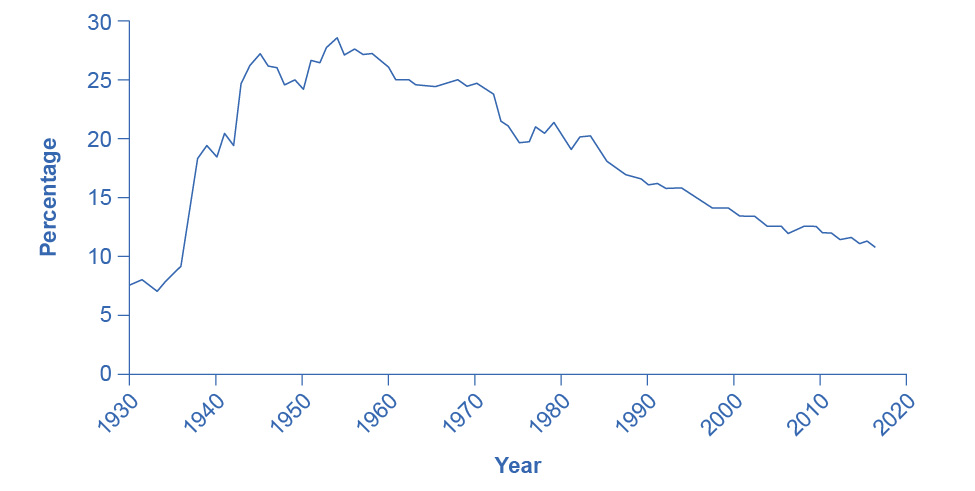

Figure 14.11図 14.11
The share of wage and salary workers who belong to unions rose sharply in the 1930s and 1940s, but has tailed off since then to 10.3% of all workers in 2021.
英語のヒント
組合に所属する賃金・給与所得者の割合は、1930年代と1940年代に急上昇したが、その後は低下し、2021年には全労働者の10.3%となった。
The following section analyzes the higher pay union workers receive compared the pay rates for nonunion workers. The section after that analyzes declining union membership levels. An overview of these two issues will allow us to discuss many aspects of how unions work.
英語のヒント
次の節では、非組合員の給与率と比べ、組合員が受け取る給与が高いことを分析する。その次の節では、組合員数の減少を分析する。この2つの問題を概観することで、組合がどのように働くかの多くの側面を論じられる。