第14章労働市場と所得
Higher Wages for Union Workers組合員の高い賃金
How does a union affect wages and employment? Because a union is the sole supplier of labor, it can act like a monopoly and ask for whatever wage rate it can obtain for its workers. If employers need workers, they have to meet the union’s wage demand.
英語のヒント
組合は賃金と雇用にどのように影響するだろうか。組合は唯一の労働供給者なので、独占企業のように行動し、組合員のために得られるどの賃金率でも要求できる。雇用者が労働者を必要とするなら、組合の賃金要求を受け入れなければならない。
What are the limits on how much higher pay union workers can receive? To analyze these questions, let’s consider a situation where all firms in an industry must negotiate with a single union, and no firm is allowed to hire nonunion labor. If no labor union existed in this market, then equilibrium (E) in the labor market would occur at the intersection of the demand for labor (D) and the supply of labor (S) as we see in Figure 14.12. This is the same result as we showed in Figure 14.6 above. The union can, however, threaten that, unless firms agree to the wages they demand, the workers will strike. As a result, the labor union manages to achieve, through negotiations with the firms, a union wage of Wu for its members, above what the equilibrium wage would otherwise have been.
英語のヒント
組合員が受け取れる高い給与には、どのような限界があるだろうか。この問いを分析するため、ある産業のすべての企業が単一の組合と交渉しなければならず、どの企業も非組合員を雇うことが許されない状況を考えよう。この市場に労働組合がなければ、図14.12のように、労働市場の均衡Eは労働需要Dと労働供給Sの交点で生じる。これは先の図14.6で示したのと同じ結果である。しかし組合は、要求する賃金に企業が同意しなければ、労働者がストライキを行うと脅すことができる。その結果、労働組合は企業との交渉を通じて、組合がなければ成立した均衡賃金より高い組合賃金Wuを、組合員のために獲得する。
Union Wage Negotiations組合の賃金交渉
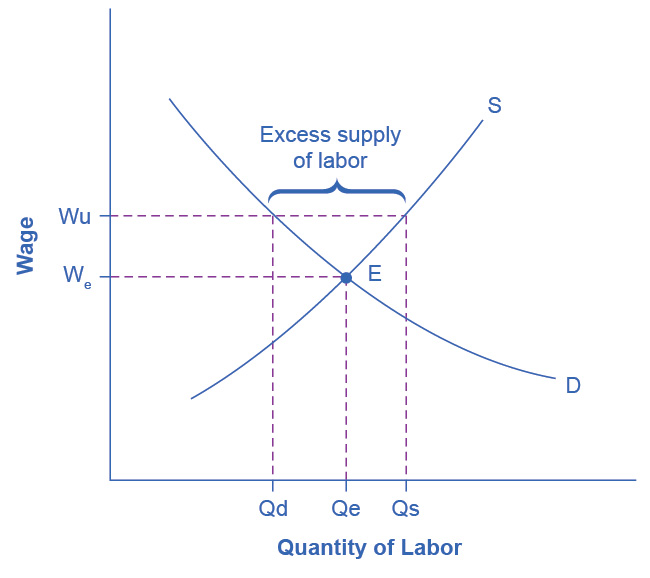

Figure 14.12図 14.12
Without a union, the equilibrium at E would have involved the wage We and the quantity of labor Qe. However, the union is able to use its bargaining power to raise the wage to Wu. The result is an excess supply of labor for union jobs. That is, a quantity of labor supplied, Qs is greater than firms’ quantity demanded for labor, Qd.
英語のヒント
組合がなければ、Eでの均衡は賃金Weと労働量Qeを伴う。しかし組合は交渉力を用い、賃金をWuまで上げられる。その結果、組合のある仕事に対する労働の超過供給が生じる。すなわち、労働供給量Qsは企業の労働需要量Qdより大きい。
This labor market situation resembles what a monopoly firm does in selling a product, but in this case a union is a monopoly selling labor to firms. At the higher union wage Wu, the firms in this industry will hire less labor than they would have hired in equilibrium. Moreover, an excess supply of workers want union jobs, but firms will not be hiring for such jobs.
英語のヒント
この労働市場の状況は、独占企業が製品を売るときの行動に似ているが、ここでは組合が、企業に労働を売る独占者である。より高い組合賃金Wuでは、この産業の企業は、均衡で雇ったはずの量より少ない労働を雇う。さらに、組合のある仕事を望む労働者が過剰に供給されるが、企業はそのような仕事に人を雇わない。
From the union point of view, workers who receive higher wages are better off. However, notice that the quantity of workers (Qd) hired at the union wage Wu is smaller than the quantity Qe that the firm would have hired at the original equilibrium wage. A sensible union must recognize that when it pushes up the wage, it also reduces the firms’ incentive to hire. This situation does not necessarily mean that union workers are fired. Instead, it may be that when union workers move on to other jobs or retire, they are not always replaced, or perhaps when a firm expands production, it expands employment somewhat less with a higher union wage than it would have done with the lower equilibrium wage. Other situations could be that a firm decides to purchase inputs from nonunion producers, rather than producing them with its own highly paid unionized workers, or perhaps the firm moves or opens a new facility in a state or country where unions are less powerful.
英語のヒント
組合の観点では、高い賃金を受け取る労働者の暮らしはよくなる。しかし、組合賃金Wuで雇われる労働者数Qdは、元の均衡賃金で企業が雇ったはずの労働者数Qeより少ないことに注意しよう。分別のある組合は、賃金を押し上げると、企業が雇う誘因も減らすことを認識しなければならない。この状況は、組合員が解雇されることを必ずしも意味しない。組合員が転職したり退職したりしたときに必ずしも補充されない、あるいは企業が生産を拡大するとき、高い組合賃金の下では、低い均衡賃金の場合ほど雇用を増やさない、ということかもしれない。ほかにも、自社の高給の組合員に生産させる代わりに、組合のない生産者から投入物を買うと企業が決める場合や、組合の力が弱い州や国へ移転したり、新施設を開いたりする場合がある。
From the firm’s point of view, the key question is whether union workers’ higher wages are matched by higher productivity. If so, then the firm can afford to pay the higher union wages and, the demand curve for “unionized” labor could actually shift to the right. This could reduce the job losses as the equilibrium employment level shifts to the right and the difference between the equilibrium and the union wages will have been reduced. If worker unionization does not increase productivity, then the higher union wage will cause lower profits or losses for the firm.
英語のヒント
企業の観点で重要なのは、組合員の高い賃金に、より高い生産性が見合っているかどうかである。見合っていれば、企業は高い組合賃金を負担でき、「組合化された」労働への需要曲線は実際に右へ移動しうる。均衡雇用水準が右へ移動し、均衡賃金と組合賃金の差が縮まるため、雇用の喪失を減らせる可能性がある。組合化によって労働者の生産性が高まらなければ、高い組合賃金は企業の利潤を減らすか、損失を生む。
Union workers might have higher productivity than nonunion workers for a number of reasons. First, higher wages may elicit higher productivity. Second, union workers tend to stay longer at a given job, a trend that reduces the employer’s costs for training and hiring and results in workers with more years of experience. Many unions also offer job training and apprenticeship programs.
英語のヒント
いくつかの理由から、組合員は非組合員より高い生産性を持つかもしれない。第1に、高い賃金が高い生産性を引き出すことがある。第2に、組合員は同じ仕事に長くとどまる傾向があり、これにより雇用者の訓練・採用費用が減り、経験年数の長い労働者が生まれる。多くの組合は、職業訓練や徒弟制度のプログラムも提供する。
In addition, firms that are confronted with union demands for higher wages may choose production methods that involve more physical capital and less labor, resulting in increased labor productivity. Table 14.10 provides an example. Assume that a firm can produce a home exercise cycle with three different combinations of labor and manufacturing equipment. Say that the firm pays labor $16 an hour (including benefits) and the machines for manufacturing cost $200 each. Under these circumstances, the total cost of producing a home exercise cycle will be lowest if the firm adopts the plan of 50 hours of labor and one machine, as the table shows. Now, suppose that a union negotiates a wage of $20 an hour including benefits. In this case, it makes no difference to the firm whether it uses more hours of labor and fewer machines or less labor and more machines, although it might prefer to use more machines and to hire fewer union workers. (After all, machines never threaten to strike—but they do not buy the final product or service either.)
英語のヒント
さらに、高い賃金を求める組合の要求に直面した企業は、物的資本を多く、労働を少なく使う生産方法を選び、その結果、労働生産性が上がることがある。表14.10が例を示す。ある企業が、労働と製造設備の3通りの組合せで、家庭用エアロバイクを生産できると仮定する。労働には福利厚生を含めて1時間当たり16ドルを払い、製造機械は1台200ドルかかるとしよう。この場合、表のように、50時間の労働と機械1台を使う計画を採れば、エアロバイクの生産総費用が最も低くなる。次に、組合が福利厚生を含めて時給20ドルを交渉で獲得するとする。この場合、労働時間を多くして機械を少なくするか、労働を少なくして機械を多くするかで、企業にとって差はない。ただし、機械を多く使い、雇う組合員を少なくするほうを好むかもしれない。(結局、機械は決してストライキを脅しに使わないが、最終製品やサービスを買うこともない。)
In the final column of the table, the wage has risen to $24 an hour. In this case, the firm clearly has an incentive for using the plan that involves paying for fewer hours of labor and using three machines. If management responds to union demands for higher wages by investing more in machinery, then union workers can be more productive because they are working with more or better physical capital equipment than the typical nonunion worker. However, the firm will need to hire fewer workers.
英語のヒント
表の最後の列では、賃金が時給24ドルに上昇している。この場合、企業には、より少ない労働時間に対して支払い、機械3台を使う計画を採る明確な誘因がある。経営側が高賃金を求める組合の要求に対して、機械への投資を増やして応えるなら、組合員は通常の非組合員より多く、または優れた物的資本設備で働くため、生産性を高められる。しかし、企業が雇う必要のある労働者は少なくなる。
Hours of Labor 労働時間 |
Number of Machines 機械の台数 |
Cost of Labor + Cost of Machine $16/hour 労働費用+機械費用、時給16ドル |
Cost of Labor + Cost of Machine $20/hour 労働費用+機械費用、時給20ドル |
Cost of Labor + Cost of Machine $24/hour 労働費用+機械費用、時給24ドル |
|---|---|---|---|---|
30 |
3 |
$480 + $600 = $1,080 |
$600 + $600 = $1,200 |
$720 + $600 = $1,320 |
40 |
2 |
$640 + $400 = $1,040 |
$800 + $400 = $1,200 |
$960 + $400 = $1,360 |
50 |
1 |
$800 + $200 = $1,000 |
$1,000 + $200 = $1,200 |
$1,200 + $200 = $1,400 |
In some cases, unions have discouraged the use of labor-saving physical capital equipment—out of the reasonable fear that new machinery will reduce the number of union jobs. For example, in 2015, the union representing longshoremen who unload ships and the firms that operate shipping companies and port facilities staged a work stoppage that shut down the ports on the western coast of the United States. Two key issues in the dispute were the desire of the shipping companies and port operators to use handheld scanners for record-keeping and computer-operated cabs for loading and unloading ships—changes which the union opposed, along with overtime pay. President Obama threatened to use the Labor Management Relations Act of 1947—commonly known as the Taft-Hartley Act—where a court can impose an 80-day “cooling-off period” in order to allow time for negotiations to proceed without the threat of a work stoppage. Federal mediators were called in, and the two sides agreed to a deal in February 2015. The ultimate agreement allowed the new technologies, but also kept wages, health, and pension benefits high for workers. In the past, presidential use of the Taft-Hartley Act sometimes has made labor negotiations more bitter and argumentative but, in this case, it seems to have smoothed the road to an agreement.
英語のヒント
組合が省力的な物的資本設備の利用を妨げた場合もある。新しい機械が組合員の仕事を減らすという、もっともな恐れのためである。例えば2015年、船から荷を下ろす港湾労働者を代表する組合と、海運会社・港湾施設を運営する企業が操業を停止し、米国西海岸の港が閉鎖された。紛争の2つの重要な争点は、海運会社と港湾運営者が、記録管理用の携帯スキャナーと、船の荷積み・荷下ろし用のコンピューター操作の運転室を使いたいと考えたことだった。組合はこれらの変更に反対し、割増残業賃金も争点となった。オバマ大統領は、一般にタフト=ハートレー法と呼ばれる1947年労使関係法を使うと警告した。同法の下では、操業停止の脅威なしで交渉を進める時間を確保するため、裁判所が80日間の「冷却期間」を命じられる。連邦の調停者が呼ばれ、双方は2015年2月に合意した。最終合意は新技術を認めたが、労働者の賃金、医療給付、年金給付も高い水準に保った。過去には、大統領によるタフト=ハートレー法の使用が労働交渉を一層険悪で論争的にしたこともあったが、今回は合意への道を円滑にしたようである。
In other instances, unions have proved quite willing to adopt new technologies. In one prominent example, during the 1950s and 1960s, the United Mineworkers union demanded that mining companies install labor-saving machinery in the mines. The mineworkers’ union realized that over time, the new machines would reduce the number of jobs in the mines, but the union leaders also knew that the mine owners would have to pay higher wages if the workers became more productive, and mechanization was a necessary step toward greater productivity.
英語のヒント
別の場合には、組合は新技術を積極的に採用する姿勢を示した。有名な例として、1950年代と1960年代に、全米鉱山労働組合は鉱山会社に、省力機械を鉱山に設置するよう要求した。組合は、新しい機械が時間とともに鉱山の仕事を減らすと理解していた。しかし組合指導者は、労働者の生産性が高まれば、鉱山の所有者は高い賃金を払わなければならず、機械化は生産性を高めるために必要な一歩だとも知っていた。
In fact, in some cases union workers may be more willing to accept new technology than nonunion workers, because the union workers believe that the union will negotiate to protect their jobs and wages, whereas nonunion workers may be more concerned that the new technology will replace their jobs. In addition, union workers, who typically have higher job market experience and training, are likely to suffer less and benefit more than non-union workers from the introduction of new technology. Overall, it is hard to make a definitive case that union workers as a group are always either more or less welcoming to new technology than are nonunion workers
英語のヒント
実際、組合員は非組合員より、新技術を進んで受け入れる場合もある。組合員は、自分たちの仕事と賃金を守るために組合が交渉すると信じるのに対し、非組合員は、新技術に仕事を置き換えられることをより強く心配するかもしれないためである。また、一般に労働市場での経験と訓練が豊富な組合員は、新技術の導入により、非組合員より被害が少なく、便益が多い可能性が高い。全体として、組合員という集団が、常に非組合員より新技術を歓迎する、または歓迎しないと断定することは難しい。