第14章労働市場と所得
14.5 Employment Discrimination14.5 雇用差別
Learning Objectives学習目標
Learning Objectives学習目標
By the end of this section, you will be able to:
英語のヒント
この節を学ぶと、次のことができるようになる。
- Analyze earnings gaps based on race and gender
英語のヒント
人種と性別に基づく所得格差を分析する。 - Explain the impact of discrimination in a competitive market
英語のヒント
競争市場における差別の影響を説明する。 - Identify U.S. public policies designed to reduce discrimination
英語のヒント
差別を減らすために設けられた米国の公共政策を挙げる。
Barriers to equitable participation in the labor market drive down economic growth. When certain populations are underrepresented, underpaid, or mistreated in a labor market or industry, the negative outcomes can effect the larger economy. For example, many science and technology fields were either unwelcoming or overtly unaccepting of women and people of color. Some major contributors to these fields overcame these challenges. Mexican-American scientist Lydia Villa-Komaroff, for example, faced overt discrimination when her college advisor told her not to pursue chemistry because women didn't "belong" in chemistry. She pursued biology instead; she developed the first instance of synthetic insulin (the chemical that people with diabetes need in order to survive) through a process that has saved million of lives and is credited with launching the entire industry of biotechnology—one of the most important in the U.S. economy. But for every Villa-Komaroff, there have been thousands of women who were prevented from making those contributions. Beyond the personal impact on those people, consider the impact on those scientific fields, our overall quality of life, and the economy itself. Economist Lisa D. Cook has quantified the costs of these innovation losses. She estimates that GDP could be as much as 4.4% higher if women and people from minority populations were fully able to participate in the science and technology innovation process.
英語のヒント
労働市場への公平な参加を妨げる障壁は、経済成長を押し下げる。特定の集団が労働市場や産業で過少にしか代表されず、不当に低い賃金を払われ、または不当に扱われると、悪い結果は経済全体に及びうる。例えば、多くの科学技術分野は、女性や有色人種を歓迎しないか、あからさまに受け入れなかった。これらの分野への大きな貢献者の中には、そうした困難を乗り越えた人もいる。例えばメキシコ系米国人の科学者リディア・ヴィラ=コマロフは、大学の指導教員から、女性は化学に「属さない」ので化学を学ぶなと言われ、露骨な差別に直面した。彼女は代わりに生物学へ進み、合成インスリンの最初の例を開発した。インスリンは、糖尿病の人々が生きるために必要な化学物質である。その製造過程は何百万人もの命を救い、米国経済で最も重要な産業の1つであるバイオテクノロジー産業全体の出発点となったと評価される。しかし、ヴィラ=コマロフのような1人に対して、そのような貢献をすることを妨げられた女性は何千人もいた。それらの人々への個人的影響を越え、科学分野、生活の質全体、経済そのものへの影響を考えよう。経済学者リサ・D・クックは、こうした革新の喪失の費用を数量化した。女性と少数者集団の人々が科学技術の革新過程に十分参加できれば、GDPは最大4.4%高くなりうると推計している。
Discrimination involves acting on the belief that members of a certain group are inferior or deserve less solely because of a factor such as race, gender, or religion. There are many types of discrimination but the focus here will be on discrimination in labor markets, which arises if workers with the same skill levels—as measured by education, experience, and expertise—receive different pay or have different job opportunities because of their race or gender. Much of the data collected and published on these topics are limited in terms of the diversity of people represented, and focus particularly on binary gender, single-race, and single-ethnicity identities. While these characterizations do not capture the diversity of Americans, the findings are important in order to understand discrimination and other practices, and to consider the impacts of policies and changes. Also, while sex and gender are different, many data sets, laws, court decisions, and media accounts use the terms interchangeably. For consistency, we will use the terminology found in the source material and government data.
英語のヒント
差別とは、人種、性別、宗教などの要因だけを理由に、特定集団の人々は劣っている、またはより少なくしか報われるべきでないという信念に基づいて行動することである。差別には多くの種類があるが、ここでは労働市場の差別に焦点を当てる。これは、教育、経験、専門性によって測った技能水準が同じ労働者が、人種や性別のために異なる給与を受け取ったり、異なる就業機会を与えられたりするときに生じる。これらの主題について収集・公表されるデータの多くは、表される人々の多様性が限られており、とくに二分された性別、単一の人種、単一の民族の帰属に焦点を当てる。こうした区分は米国人の多様性を捉えきれないが、差別やほかの慣行を理解し、政策や変化の影響を考えるために、その知見は重要である。また、生物学的性とジェンダーは異なるが、多くのデータ、法律、判決、報道は両語を同じ意味で用いる。一貫性のため、ここでは原資料と政府データの用語を使う。
Earnings Gaps by Race and Gender人種と性別による所得格差
A possible signal of labor market discrimination is when an employer pays one group less than another. Figure 14.15 shows the average wage of Black workers as a ratio of the average wage of White workers and the average wage of female workers as a ratio of the average wage of male workers. Research by the economists Francine Blau and Laurence Kahn shows that the gap between the earnings of women and men did not move much in the 1970s, but has declined since the 1980s. Detailed analysis by economists Kerwin Kofi Charles and Patrick Bayer show that the gap between the earnings of Black and White people diminished in the 1970s, but grew again so that current differences are as wide as they were nearly 70 years ago. In both gender and race, an earnings gap remains.
英語のヒント
雇用者が、ある集団に別の集団より少ない額を払うことは、労働市場の差別の兆候かもしれない。図14.15は、黒人労働者の平均賃金を白人労働者の平均賃金に対する比率で、女性労働者の平均賃金を男性労働者の平均賃金に対する比率で示す。経済学者フランシーヌ・ブラウとローレンス・カーンの研究によると、男女の所得格差は1970年代にはあまり変化しなかったが、1980年代以降は縮まった。経済学者カーウィン・コフィ・チャールズとパトリック・ベイヤーの詳細な分析によると、黒人と白人の所得格差は1970年代に縮まったが、その後再び広がり、現在の差は約70年前と同じほど大きい。性別でも人種でも、所得格差は残っている。
Wage Ratios by Sex and Race性別・人種別の賃金比率
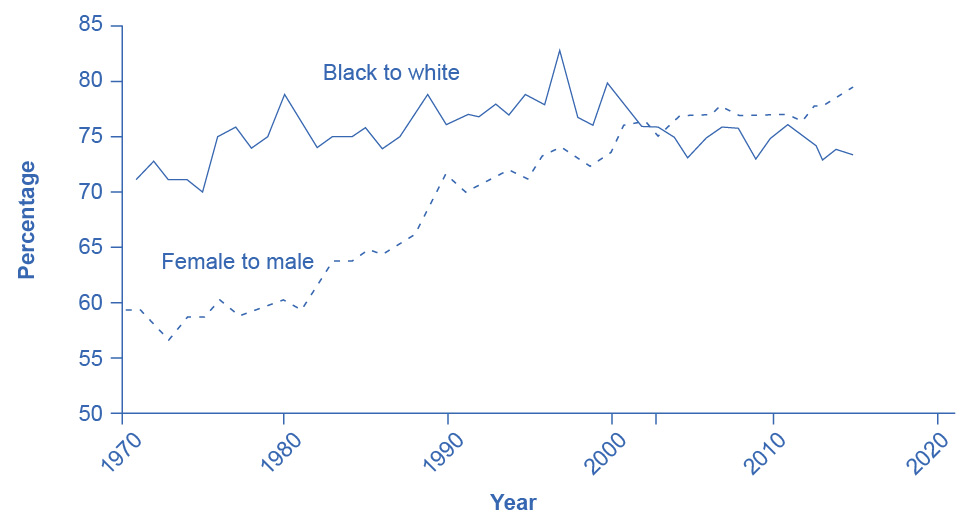

Figure 14.15図 14.15
The ratio of wages for Black workers to White workers rose substantially in the late 1960s and through the 1970s. The 1990s saw a peak above 80% followed by a bumpy decline to the low 70s. The ratio of wages for female to male workers changed little through the 1970s. In both cases, a gap remains between the average wages of Black and White workers and between the average wages of female and male workers. Source: U.S. Department of Labor, Bureau of Labor Statistics.
英語のヒント
黒人労働者の白人労働者に対する賃金比率は、1960年代末から1970年代にかけて大きく上昇した。1990年代には80%超の頂点を迎え、その後は上下しながら70%台前半へ下がった。女性労働者の男性労働者に対する賃金比率は、1970年代を通じてほとんど変わらなかった。いずれの場合も、黒人と白人、女性と男性の平均賃金の間に格差が残る。出典:米国労働省労働統計局。
An earnings gap between average wages, in and of itself, does not prove that discrimination is occurring in the labor market. We need to apply the same productivity characteristics to all parties (employees) involved. Gender discrimination in the labor market occurs when employers pay people of a specific gender less despite those people having comparable levels of education, experience, and expertise. (Read the Clear It Up about the sex-discrimination suit brought against Walmart.) Similarly, racial discrimination in the labor market exists when employers pay racially diverse employees less than their coworkers of the majority race despite having comparable levels of education, experience, and expertise. To bring a successful gender discrimination lawsuit, an employee must prove the employer is paying them less than an employee of a different gender who holds a similar job, with similar educational attainment, and with similar expertise. Likewise, someone who wants to sue on the grounds of racial discrimination must prove that the employer pays them less than an employee of another race who holds a similar job, with similar educational attainment, and with similar expertise.
英語のヒント
平均賃金の間に所得格差があること自体は、労働市場で差別が起きている証拠にはならない。関係するすべての当事者、すなわち従業員に、同じ生産性の特性を適用する必要がある。労働市場の性差別は、同等の教育、経験、専門性を持つにもかかわらず、雇用者が特定の性別の人々に少ない給与を払うときに生じる。(ウォルマートに対する性差別訴訟についての「疑問を解こう」を読もう。)同様に、人種的に多様な従業員が、同等の教育、経験、専門性を持つにもかかわらず、多数派人種の同僚より少ない給与を雇用者から受け取るとき、労働市場の人種差別が存在する。性差別訴訟で勝つためには、従業員は、同様の仕事に就き、同様の教育達成度と専門性を持つ別の性別の従業員より、自分への給与が低いことを証明しなければならない。同様に、人種差別を理由に訴えたい人は、同様の仕事、教育達成度、専門性を持つ別の人種の従業員より、自分への給与が低いことを証明しなければならない。
The FRED database includes earnings data at earnings by age, gender and race/ethnicity.
英語のヒント
FREDデータベースには、「年齢・性別・人種/民族別の所得」に所得データがある。
As stated previously and as we will see below, not every instance of a wage gap or employment inequity is a product of overt discrimination on the part of individual employers. Significant overall issues in societies, such as inequitable education or housing segregation, can lead to earning gaps and limitations on economic mobility. However, these wider issues usually affect people from minority populations and/or those who have been historically underrepresented in positions of power. Economist William A. Darity Jr., whose work is discussed in more detail below, indicates that individualized employer racism still exists, but it is largely practiced in "covert and subtle forms."
英語のヒント
すでに述べ、以下でも見るように、賃金格差や雇用の不公平のすべてが、個々の雇用者による露骨な差別の結果ではない。不公平な教育や居住の分離など、社会全体の重大な問題が、所得格差や経済的地位の移動の制約を生むこともある。しかし、これらの広い問題は通常、少数者集団の人々や、歴史的に権力のある地位に十分代表されてこなかった人々に影響する。以下で詳しく取り上げる経済学者ウィリアム・A・ダリティ・ジュニアは、個々の雇用者による人種差別は今も存在するが、主として「隠れた微妙な形」で行われると指摘する。