第14章労働市場と所得
The Decline in U.S. Union Membership米国の組合加入の減少
The proportion of U.S. workers belonging to unions has declined dramatically since the early 1950s. Economists have offered a number of possible explanations:
英語のヒント
米国の労働者に占める組合員の割合は、1950年代初めから大きく減少してきた。経済学者は、いくつかの説明を提示している。
- The shift from manufacturing to service industries
英語のヒント
製造業からサービス業への移行 - The force of globalization and increased competition from foreign producers
英語のヒント
グローバル化の力と、外国の生産者との競争の激化 - A reduced desire for unions because of the workplace protection laws now in place
英語のヒント
現在整っている職場保護法により、組合を求める気持ちが弱まったこと - U.S. legal environment that makes it relatively more difficult for unions to organize workers and expand their membership
英語のヒント
組合が労働者を組織し、組合員を増やすことを比較的難しくする米国の法的環境
Let’s discuss each of these four explanations in more detail.
英語のヒント
これら4つの説明を、それぞれ詳しく論じよう。
A first possible explanation for the decline in the share of U.S. workers belonging to unions involves the patterns of job growth in the manufacturing and service sectors of the economy as Figure 14.13 shows. The U.S. economy had about 15 million manufacturing jobs in 1960. This total rose to 19 million by the late 1970s and then declined to 17 million in 2013. Meanwhile, the number of jobs in service industries (including government employment) rose from 35 million in 1960 to over 118 million by 2013, according to the Bureau of Labor Statistics. Because over time unions were stronger in manufacturing than in service industries, the growth in jobs was not happening where the unions were. It is interesting to note that government workers comprise several of the biggest unions in the country, including the American Federation of State, County and Municipal Employees (AFSCME); the Service Employees International Union; and the National Education Association. Table 14.11 lists the membership of each of these unions. Outside of government employees, however, unions have not had great success in organizing the service sector.
英語のヒント
米国の労働者に占める組合員の割合が下がったことについての第1の説明は、図14.13が示す、経済の製造業部門とサービス部門における雇用増加の傾向に関係する。1960年、米国経済には約1,500万の製造業の仕事があった。この総数は1970年代末までに1,900万へ増え、その後2013年には1,700万へ減った。一方、労働統計局によると、政府の雇用を含むサービス業の仕事は、1960年の3,500万から、2013年には1億1,800万超へ増えた。長らく組合はサービス業より製造業で強かったため、雇用が増えた場所は、組合が存在する場所ではなかった。米国州・郡・市職員連盟(AFSCME)、サービス従業員国際労働組合、全米教育協会など、国内最大級のいくつかの組合が政府職員で構成される点は興味深い。表14.11は、これらの組合の組合員数を示す。しかし、政府職員を除くと、組合はサービス部門の組織化に大きな成功を収めていない。
The Growth of Service Jobsサービス業の仕事の増加
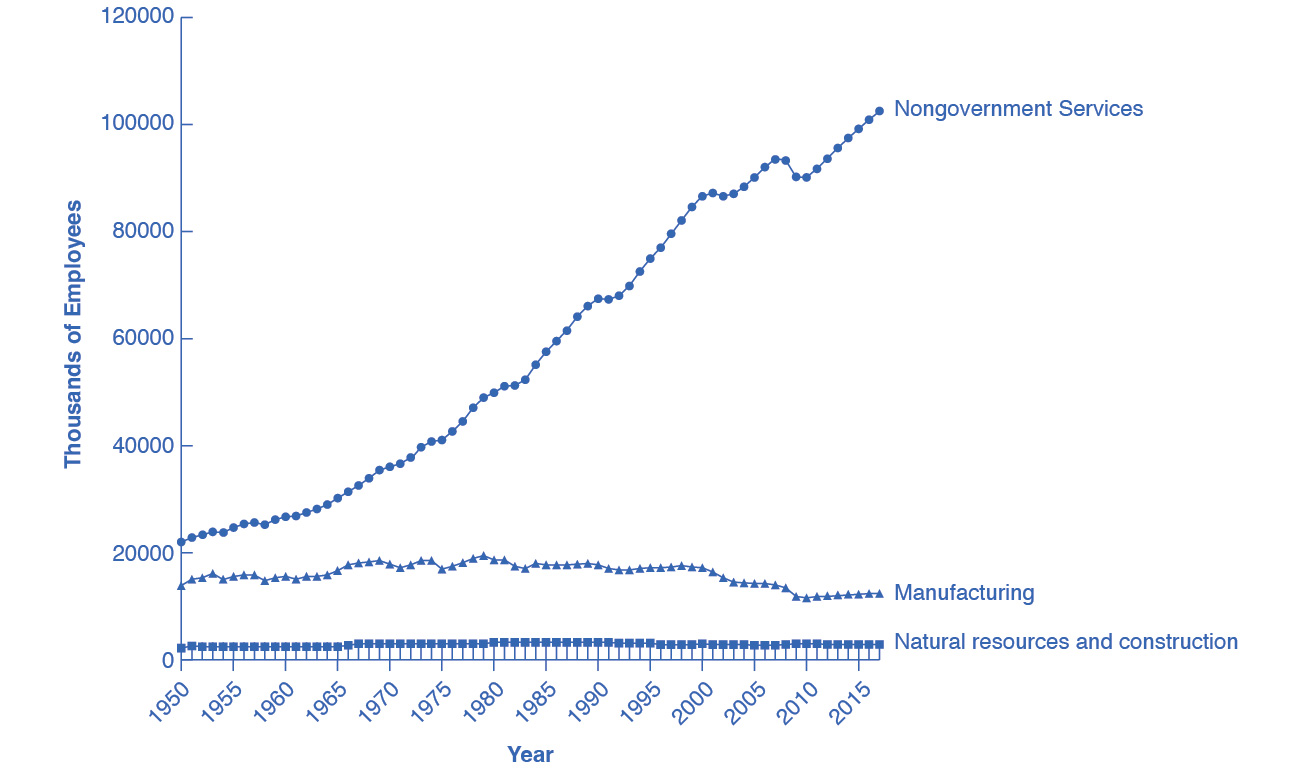

Figure 14.13図 14.13
Jobs in services have increased dramatically for more than the past 50 years. Jobs in government have increased modestly until 1990 and then declined slightly since then. Jobs in manufacturing peaked in the late 1970s and have declined more than a third since then.
英語のヒント
サービス業の仕事は、過去50年以上にわたり急増してきた。政府の仕事は1990年まで緩やかに増え、その後は少し減った。製造業の仕事は1970年代末に頂点に達し、その後3分の1以上減った。
A second explanation for the decline in the share of unionized workers looks at import competition. Starting in the 1960s, U.S. carmakers and steelmakers faced increasing competition from Japanese and European manufacturers. As sales of imported cars and steel rose, the number of jobs in U.S. auto manufacturing fell. This industry is heavily unionized. Not surprisingly, membership in the United Auto Workers, which was 975,000 in 1985, had fallen to roughly 390,000 by 2015. Import competition not only decreases the employment in sectors where unions were once strong, but also decreases the bargaining power of unions in those sectors. However, as we have seen, unions that organize public-sector workers, who are not threatened by import competition, have continued to see growth.
英語のヒント
組合員の割合が低下した第2の説明は、輸入品との競争に注目する。1960年代から、米国の自動車メーカーと鉄鋼メーカーは、日本や欧州のメーカーとの競争の激化に直面した。輸入自動車や鉄鋼の販売が増えると、米国の自動車製造業の仕事は減った。この産業は組合化が進んでいる。全米自動車労働組合の組合員が、1985年の975,000人から2015年の約390,000人へ減ったことは、驚きではない。輸入競争は、組合がかつて強かった部門の雇用を減らすだけでなく、その部門の組合の交渉力も弱める。しかし、すでに見たように、輸入競争の脅威を受けない公共部門の労働者を組織する組合は、増加を続けてきた。
A third possible reason for the decline in the number of union workers is that citizens often call on their elected representatives to pass laws concerning work conditions, overtime, parental leave, regulation of pensions, and other issues. Unions offered strong political support for these laws aimed at protecting workers but, in an ironic twist, the passage of those laws then made many workers feel less need for unions.
英語のヒント
組合員数が減った第3の理由として、市民が選挙で選んだ代表者に、労働条件、残業、育児休暇、年金規制、その他の問題についての法律を成立させるよう求めることが多い点がある。組合は労働者を保護するこれらの法律を政治的に強く支持したが、皮肉にも、その法律が成立すると、多くの労働者は組合の必要性をあまり感じなくなった。
These first three possible reasons for the decline of unions are all somewhat plausible, but they have a common problem. Most other developed economies have experienced similar economic and political trends, such as the shift from manufacturing to services, globalization, and increasing government social benefits and regulation of the workplace. Clearly there are cultural differences between countries as to their acceptance of unions in the workplace. The share of the population belonging to unions in other countries is very high compared with the share in the United States. Table 14.11 shows the proportion of workers in a number of the world’s high-income economies who belong to unions. The United States is near the bottom, along with France and Spain. The last column shows union coverage, defined as including those workers whose wages are determined by a union negotiation even if the workers do not officially belong to the union. In the United States, union membership is almost identical to union coverage. However, in many countries, the wages of many workers who do not officially belong to a union are still determined by collective bargaining between unions and firms.
英語のヒント
組合衰退についての最初の3つの理由は、どれもある程度もっともらしいが、共通の問題がある。ほかの大半の先進経済でも、製造業からサービス業への移行、グローバル化、政府の社会給付と職場規制の拡大といった、似た経済的・政治的傾向を経験してきた。職場に組合を受け入れるかどうかについて、国ごとに文化の違いがあることは明らかである。他国の人口に占める組合員の割合は、米国に比べて非常に高い。表14.11は、世界のいくつかの高所得経済で、労働者のうち組合に所属する人の割合を示す。米国はフランス、スペインとともに最下位に近い。最後の列は、組合協約の適用範囲を示す。これは、正式には組合に所属していなくても、組合の交渉で賃金が決まる労働者を含むと定義される。米国では、組合加入と協約適用の範囲はほぼ同じである。しかし多くの国では、正式には組合に所属しない多くの労働者の賃金も、組合と企業の団体交渉によって決まる。
Country 国 |
Union Density: Percentage of Workers Belonging to a Union 組合組織率:労働者のうち組合に所属する人の割合 |
Union Coverage: Percentage of Workers Whose Wages Are Determined by Union Bargaining 組合協約適用率:労働者のうち組合交渉で賃金が決まる人の割合 |
|---|---|---|
Austria オーストリア |
37% |
99% |
France フランス |
9% |
95% |
Germany ドイツ |
26% |
63% |
Japan 日本 |
22% |
23% |
Netherlands オランダ |
25% |
82% |
Spain スペイン |
11.3% |
81% |
Sweden スウェーデン |
82% |
92% |
United Kingdom 英国 |
29% |
35% |
United States 米国 |
11.1% |
12.5% |
These international differences in union membership suggest a fourth reason for the decline of union membership in the United States: perhaps U.S. laws are less friendly to the formation of unions than such laws in other countries. The close connection between union membership and a friendly legal environment is apparent in the history of U.S. unions. The great rise in union membership in the 1930s followed the passage of the National Labor Relations Act of 1935, which specified that workers had a right to organize unions and that management had to give them a fair chance to do so. The U.S. government strongly encouraged forming unions during the early 1940s in the belief that unions would help to coordinate the all-out production efforts needed during World War II. However, after World War II came the passage of the Taft-Hartley Act of 1947, which gave states the power to allow workers to opt out of the union in their workplace if they so desired. This law made the legal climate less encouraging to those seeking to form unions, and union membership levels soon started declining.
英語のヒント
組合加入のこうした国際的な違いは、米国の組合加入が減少した第4の理由を示唆する。米国の法律は、ほかの国の法律より、組合の結成に好意的でないのかもしれない。組合加入と、それを支える法的環境の密接なつながりは、米国の組合の歴史に明らかである。1930年代の組合加入の大幅な増加は、1935年全国労働関係法の成立に続いて起きた。同法は、労働者には組合を組織する権利があり、経営側はそのための公正な機会を与えなければならないと定めた。米国政府は1940年代初め、第二次世界大戦中に必要な総力的な生産努力の調整に組合が役立つと考え、組合結成を強く奨励した。しかし戦後、1947年タフト=ハートレー法が成立し、労働者が望めば職場の組合に加入しないことを認める権限を州に与えた。この法律により、組合結成を求める人にとって法的環境の後押しが弱まり、ほどなく組合加入は減少し始めた。
The procedures for forming a union differ substantially from country to country. For example, the procedures in the United States and those in Canada are strikingly different. When a group of workers wishes to form a union in the United States, they announce this fact and set an election date when the firm's employees will vote in a secret ballot on whether to form a union. Supporters of the union lobby for a “yes” vote, and the firm's management lobbies for a “no” vote—often even hiring outside consultants for assistance in swaying workers to vote “no.” In Canada, by contrast, a union is formed when a sufficient proportion of workers (usually about 60%) signs an official card saying that they want a union. There is no separate “election date.” The management of Canadian firms is limited by law in its ability to lobby against the union. In addition, although it is illegal to discriminate and fire workers based on their union activity in the United States, the penalties are slight, making this a not so costly way of deterring union activity. In short, forming unions is easier in Canada—and in many other countries—than in the United States.
英語のヒント
組合結成の手続は国ごとに大きく異なる。例えば、米国とカナダの手続は著しく違う。米国で労働者の集団が組合を作ろうとすると、その事実を公表し、組合を結成するかどうかを企業の従業員が秘密投票で決める選挙日を設定する。組合支持者は「賛成」への投票を働きかけ、企業の経営側は「反対」への投票を働きかける。労働者を「反対」に誘導する助けとして、外部のコンサルタントを雇うことさえ多い。対してカナダでは、十分な割合の労働者、通常約60%が、組合を望むという正式なカードに署名すると、組合が成立する。別の「選挙日」はない。カナダ企業の経営側が組合に反対する働きかけを行う能力は、法律によって制限される。さらに米国では、組合活動を理由に労働者を差別し解雇することは違法だが、罰則が軽いため、組合活動を抑えるそれほど高くつかない方法となっている。要するに、カナダやほかの多くの国では、米国より組合を結成しやすい。
In summary, union membership in the United States is lower than in many other high-income countries, a difference that may be due to different legal environments and cultural attitudes toward unions.
英語のヒント
要約すると、米国の組合加入は、ほかの多くの高所得国より少ない。この違いは、法的環境と、組合に対する文化的態度の違いによるのかもしれない。