第14章労働市場と所得
14.1 The Theory of Labor Markets14.1 労働市場の理論
Learning Objectives学習目標
Learning Objectives学習目標
By the end of this section, you will be able to:
英語のヒント
この節を学ぶと、次のことができるようになる。
- Describe the demand for labor in perfectly competitive output markets
英語のヒント
完全競争的な生産物市場における労働需要を説明する。 - Describe the demand for labor in imperfectly competitive output markets
英語のヒント
不完全競争的な生産物市場における労働需要を説明する。 - Identify what determines the going market rate for labor
英語のヒント
何が労働の現行市場賃金率を決めるかを特定する。
The labor market, like all markets, has a demand and a supply. Why do firms demand labor? Why is an employer willing to pay you for your labor? It’s not because the employer likes you or is socially conscious. Rather, it’s because your labor is worth something to the employer--your work brings in revenues to the firm. How much is an employer willing to pay? That depends on the skills and experience you bring to the firm.
英語のヒント
すべての市場と同様に、労働市場にも需要と供給がある。企業はなぜ労働を需要するのだろうか。雇用者はなぜ、あなたの労働に対して賃金を払おうとするのだろうか。それは雇用者があなたを好きだからでも、社会的意識が高いからでもない。むしろ、あなたの労働が雇用者にとって価値を持つからである。あなたの仕事は、企業に収入をもたらす。雇用者はいくら払おうとするだろうか。それは、あなたが企業にもたらす技能と経験に依存する。
If a firm wants to maximize profits, it will never pay more (in terms of wages and benefits) for a worker than the value of their marginal productivity to the firm. We call this the first rule of labor markets.
英語のヒント
企業が利潤の最大化を望むなら、労働者1人に対して、その企業にとっての限界生産性の価値を超える賃金や福利厚生を払うことは決してない。これを労働市場の第1法則と呼ぶ。
Suppose a worker can produce two widgets per hour and the firm can sell each widget for $4 each. Then the worker is generating $8 per hour in revenues to the firm, and a profit-maximizing employer will pay the worker up to, but no more than, $8 per hour, because that is what the worker is worth to the firm.
英語のヒント
ある労働者が1時間に小型製品を2個生産でき、企業は1個4ドルで売れるとする。その労働者は企業に1時間当たり8ドルの収入を生み、利潤を最大化する雇用者は、1時間当たり8ドルまでは払うが、それを超えては払わない。企業にとって、その労働者が持つ価値はそれだけだからである。
Recall the definition of marginal product. Marginal product is the additional output a firm can produce by adding one more worker to the production process. Since employers often hire labor by the hour, we’ll define marginal product as the additional output the firm produces by adding one more worker hour to the production process. In this chapter, we assume that workers in a particular labor market are homogeneous—they have the same background, experience and skills and they put in the same amount of effort. Thus, marginal product depends on the capital and technology with which workers have to work.
英語のヒント
限界生産物の定義を思い出そう。限界生産物とは、生産過程に労働者をもう1人加えることで、企業が生産できる追加的な産出量である。雇用者は時間単位で労働を雇うことが多いため、ここでは限界生産物を、生産過程に労働をもう1人時加えることで企業が生産する追加的な産出量と定義する。この章では、特定の労働市場にいる労働者は同質だと仮定する。すなわち、同じ背景、経験、技能を持ち、同じ量の努力をする。したがって限界生産物は、労働者が働く際に利用する資本と技術に依存する。
A typist can type more pages per hour with an electric typewriter than a manual typewriter, and the typist can type even more pages per hour with a personal computer and word processing software. A ditch digger can dig more cubic feet of dirt in an hour with a backhoe than with a shovel.
英語のヒント
タイピストは、手動タイプライターより電動タイプライターを使うほうが、1時間に多くのページを打て、パソコンとワープロソフトを使えばさらに多く打てる。溝を掘る人は、シャベルよりバックホーを使うほうが、1時間により多くの立方フィートの土を掘れる。
Thus, we can define the demand for labor as the marginal product of labor times the value of that output to the firm.
英語のヒント
したがって労働需要は、労働の限界生産物に、その産出物の企業にとっての価値を掛けたものと定義できる。
# Workers (L) 労働者数(L) |
1 |
2 |
3 |
4 |
MPL |
4 |
3 |
2 |
1 |
Marginal Product of Labor労働の限界生産物
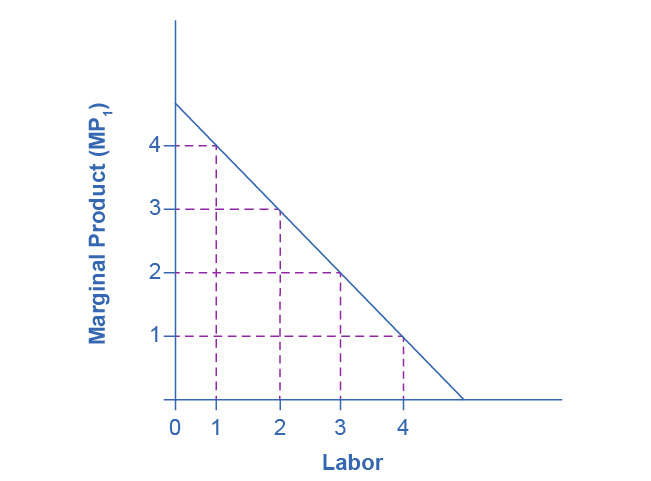
Figure 14.2図 14.2
Because of fixed capital, the marginal product of labor declines as the employer hires additional workers.
英語のヒント
資本が固定されているため、雇用者が労働者を追加で雇うにつれ、労働の限界生産物は減少する。
On what does the value of each worker’s marginal product depend? If we assume that the employer sells its output in a perfectly competitive market, the value of each worker’s output will be the market price of the product. Thus,
英語のヒント
各労働者の限界生産物の価値は、何に依存するだろうか。雇用者が産出物を完全競争市場で売ると仮定すると、各労働者の産出物の価値は、その製品の市場価格となる。したがって、
Demand for Labor = MPL x P = Value of the Marginal Product of Labor
英語のヒント
労働需要 = MPL × P = 労働の限界生産物価値
# Workers (L) 労働者数(L) |
1 |
2 |
3 |
4 |
MPL |
4 |
3 |
2 |
1 |
Price of Output 産出物の価格 |
$4 |
$4 |
$4 |
$4 |
VMPL |
$16 |
$12 |
$8 |
$4 |
Note that the value of each additional worker is less than the value of the ones who came before.
英語のヒント
追加される各労働者の価値は、それより先に雇った労働者の価値より小さいことに注意しよう。
Value of the Marginal Product of Labor労働の限界生産物価値
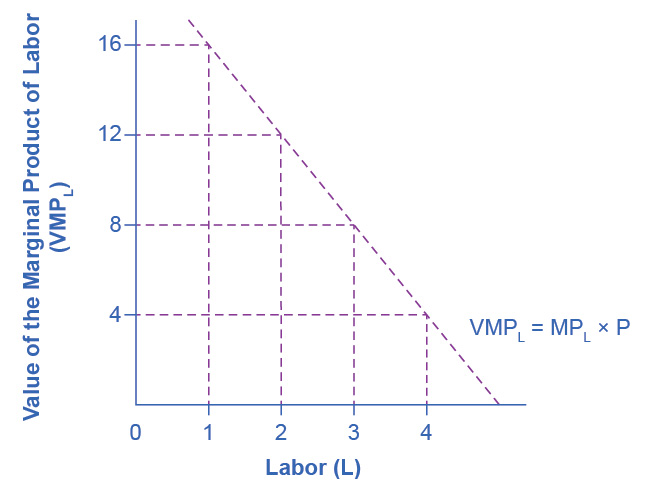


Figure 14.3図 14.3
For firms operating in a competitive output market, the value of additional output sold is the price the firms receive for the output. Since MPL declines with additional labor employed, while that marginal product is worth the market price, the value of the marginal product declines as employment increases.
英語のヒント
競争的な生産物市場で活動する企業では、追加で売る産出物の価値は、その産出物に対して受け取る価格である。雇用する労働が増えるとMPLが減少し、その限界生産物は市場価格に等しい価値を持つため、雇用が増えるにつれ限界生産物価値は減少する。