第15章貧困と経済的不平等
15.3 The Safety Net15.3 安全網
Learning Objectives学習目標
Learning Objectives学習目標
By the end of this section, you will be able to:
英語のヒント
この節を学ぶと、次のことができるようになる。
- Identify the antipoverty government programs that comprise the safety net
英語のヒント
安全網を構成する政府の貧困対策事業を挙げる。 - Explain the safety net programs' primary goals and how these programs have changed over time
英語のヒント
安全網事業の主な目標と、その歴史的な変化を説明する。 - Discuss the complexities of these safety net programs and why they can be controversial
英語のヒント
これらの安全網事業の複雑さと、論争を招く理由を論じる。
The U.S. government has implemented a number of programs to assist those below the poverty line and those who have incomes just above the poverty line. Such programs are called the safety net, to recognize that they offer some protection for those who find themselves without jobs or income.
英語のヒント
米国政府は、貧困線以下の人々と、貧困線を少し上回る所得の人々を助けるため、多くの事業を実施してきた。これらは、仕事や所得を失った人々にある程度の保護を提供することから、安全網と呼ばれる。
Temporary Assistance for Needy Families困窮家庭一時扶助
From the Great Depression until 1996, the United States’ most visible antipoverty program was Aid to Families with Dependent Children (AFDC), which provided cash payments to mothers with children who were below the poverty line. Many just called this program “welfare.” In 1996, Congress passed and President Bill Clinton signed into law the Personal Responsibility and Work Opportunity Reconciliation Act, more commonly called the “welfare reform act.” The new law replaced AFDC with Temporary Assistance for Needy Families (TANF).
英語のヒント
大恐慌から1996年まで、米国で最も目立つ貧困対策事業は、要扶養児童家庭扶助(AFDC)だった。これは、貧困線以下にいる子どもを持つ母親へ現金を給付した。多くの人は、この事業を単に「福祉」と呼んだ。1996年、議会が可決し、ビル・クリントン大統領が署名して成立させた個人責任・就労機会調整法は、より一般には「福祉改革法」と呼ばれる。新法はAFDCを、困窮家庭一時扶助(TANF)に置き換えた。
Additional Resources追加教材
TANF brought several dramatic changes in how welfare operated. Under the old AFDC program, states set the level of welfare benefits that they would pay to people experiencing poverty, and the federal government guaranteed it would chip in some of the money as well. The federal government’s welfare spending would rise or fall depending on the number of people in need, and on how each state set its own welfare contribution.
英語のヒント
TANFは、福祉の運営にいくつかの大きな変化をもたらした。旧AFDCでは、州が貧困を経験する人々への福祉給付水準を決め、連邦政府もその一部を負担すると保証した。連邦政府の福祉支出は、困窮者の数と、各州が福祉負担をどう定めるかによって、増減した。
Under TANF, however, the federal government gives a fixed amount of money to each state. The state can then use the money for almost any program with an antipoverty component: for example, the state might use the money to give funds to families with low income, or to reduce teenage pregnancy, or even to raise the high school graduation rate. However, the federal government imposed two key requirements. First, if states are to keep receiving the TANF grants, they must impose work requirements so that most of those receiving TANF benefits are working (or attending school). Second, no one can receive TANF benefits with federal money for more than a total of five years over their lifetime. The old AFDC program had no such work requirements or time limits.
英語のヒント
しかしTANFでは、連邦政府は各州に定額を渡す。その後、州は貧困対策の要素を持つほぼどのような事業にも、その資金を使える。例えば低所得世帯に資金を渡す、10代の妊娠を減らす、さらには高校卒業率を上げるためにも使える。ただし連邦政府は、2つの重要な条件を課した。第1に、州がTANFの補助金を受け取り続けるには、給付を受ける人の大半が働くか通学するよう、就労条件を課さなければならない。第2に、連邦資金によるTANF給付は、生涯を通じて合計5年を超えては受けられない。旧AFDCには、このような就労条件や期間制限はなかった。
TANF attempts to avoid the poverty trap by requiring that welfare recipients work and by limiting the length of time they can receive benefits. In its first few years, the program was quite successful. The number of families receiving payments in 1995, the last year of AFDC, was 4.8 million. November 2020, according to the Congressional Research Service, the number of families receiving payments under TANF was 1.0 million—a decline of nearly 80%.
英語のヒント
TANFは、福祉受給者に働くよう義務づけ、給付を受けられる期間を制限することで、貧困の罠を避けようとする。最初の数年間、この事業はかなり成功した。AFDCの最後の年である1995年に給付を受けていた家族は480万だった。議会調査局によると、2020年11月にTANFの給付を受ける家族は100万で、ほぼ80%減少した。
TANF benefits to poor families vary considerably across states. For example, again according to the Congressional Research Service, in July 2020 the highest monthly payment in New Hampshire to a single mother with one child was $862, while in Mississippi the highest monthly payment to that family was $146. In part, these payments reflect differences in states’ cost of living. As reported by the Department of Health and Human Services, in 1995 total spending on TANF was approximately $19 billion. Spending increased yearly through 2001, then it was roughly flat at approximately $26 billion until 2005, then it increased again through 2010, where it peaked at nearly $35 billion. It then decreased again to around $30 billion in 2020. When you take into account the effects of inflation, the decline is even greater. Moreover, there seemed little evidence that families were suffering a reduced standard of living as a result of TANF—although, on the other side, there was not much evidence that families had greatly improved their total levels of income, either.
英語のヒント
貧しい家族へのTANF給付は、州によってかなり違う。例えば同じく議会調査局によると、2020年7月、子ども1人を持つひとり親の母親への月額最高給付は、ニューハンプシャー州で862ドル、ミシシッピ州では146ドルだった。これらの額は、一部には州ごとの生活費の違いを反映する。保健福祉省の報告によると、1995年のTANF総支出は約190億ドルだった。2001年までは毎年増え、その後2005年までは約260億ドルでほぼ横ばい、さらに2010年まで増え、約350億ドルで頂点に達した。その後再び減り、2020年には約300億ドルとなった。インフレの影響を考慮すると、減少はさらに大きい。またTANFの結果として、家族の生活水準が下がったという証拠はほとんどないように見えた。ただし、家族の総所得水準が大きく改善したという証拠も、あまりなかった。
The Earned Income Tax Credit (EITC)勤労所得税額控除(EITC)
The earned income tax credit (EITC), first passed in 1975, is a method of assisting the working poor through the tax system. The EITC is one of the largest assistance program for low-income groups, and as of December 2021, about 25 million eligible workers and families received about $60 billion in EITC. For the 2021 tax year, the earned income credit ranges from $1,502 to $6,728 depending on tax-filing status, income, and number of children. The average amount of EITC received nationwide was about $2,411. In 2021, for example, a single parent with two children would have received a tax credit of $5,980 up to a modest income level. The amount of the tax break increases with the amount of income earned, up to a point. The earned income tax credit has often been popular with both economists and the general public because of the way it effectively increases the payment received for work.
英語のヒント
1975年に初めて成立した勤労所得税額控除(EITC)は、税制を通じて働く貧困層を助ける方法である。EITCは低所得層への最大級の援助事業の1つで、2021年12月時点で、約2,500万の対象労働者・家族が、約600億ドルを受け取った。2021課税年度の控除額は、申告区分、所得、子どもの人数に応じ、1,502~6,728ドルとなる。全国の平均受給額は約2,411ドルだった。例えば2021年、子ども2人を持つひとり親は、ある低めの所得水準までは、5,980ドルの税額控除を受け取ったはずである。税の軽減額は、ある点までは稼いだ所得に応じて増える。勤労所得税額控除は、働いて受け取る支払を実質的に増やす方法のため、経済学者と一般市民の両方から支持されることが多い。
What about the danger of the poverty trap that every additional $1 earned will reduce government support payments by close to $1? To minimize this problem, the earned income tax credit is phased out slowly. For example, according to the Tax Policy Center, for a single-parent family with two children in 2013, the credit is not reduced at all (but neither is it increased) as earnings rise from $13,430 to $17,530. Then, for every $1 earned above $17,530, the amount received from the credit is reduced by 21.06 cents, until the credit phases out completely at an income level of $46,227.
英語のヒント
追加で1ドル稼ぐごとに政府の支援給付がほぼ1ドル減る、貧困の罠の危険はどうだろうか。この問題を最小限にするため、勤労所得税額控除は緩やかに縮小される。例えば税制政策センターによると、2013年の子ども2人のひとり親世帯では、所得が13,430ドルから17,530ドルへ上がっても、控除はまったく減らないが、増えもしない。その後、17,530ドルを超えて1ドル稼ぐごとに、受け取る控除額は21.06セント減り、所得46,227ドルで完全になくなる。
Figure 15.5 illustrates that the earned income tax credits, child tax credits, and the TANF program all cost the federal government money—either in direct outlays or in loss of tax revenues. CTC stands for the government tax cuts for the child tax credit.
英語のヒント
図15.5は、勤労所得税額控除、児童税額控除、TANFのすべてが、直接支出または税収喪失として、連邦政府に費用を発生させることを示す。CTCは、児童税額控除による政府の減税を表す。
Real Federal Spending on CTC, EITC, and TANF, 1975–2016CTC、EITC、TANFへの連邦実質支出、1975~2016年
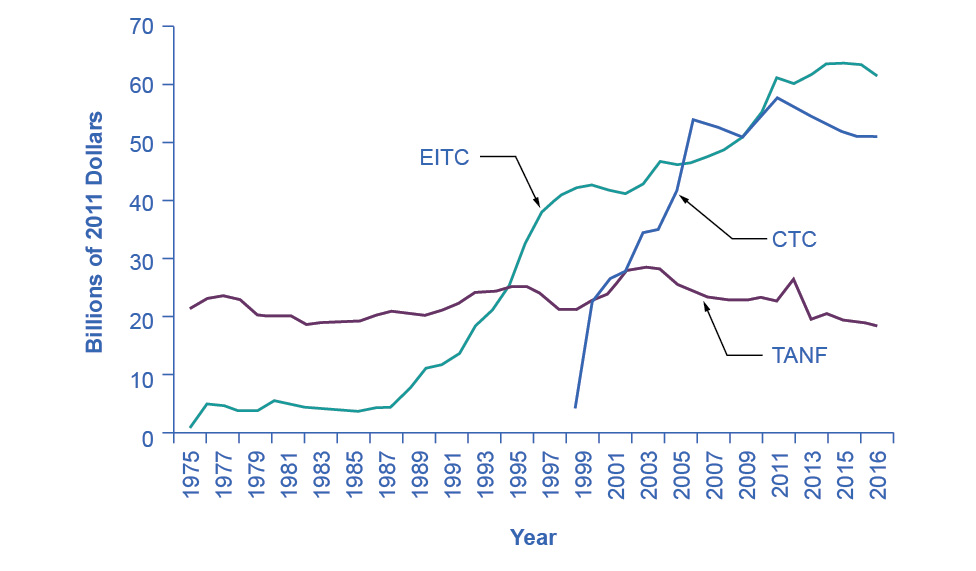

Figure 15.5図 15.5
EITC increased from under $10 billion in the late 1980s to almost $42 billion in 2000 and to over $61 billion in 2016, far exceeding estimated 2016 outlays in the CTC (Child Tax Credits) and TANF of over $25 billion and $18 billion, respectively. (Source: Office of Management and Budget)
英語のヒント
EITCは、1980年代末の100億ドル未満から、2000年の約420億ドル、2016年の610億ドル超へ増えた。2016年のCTC(児童税額控除)とTANFの推計支出である、それぞれ250億ドル超、180億ドルを大きく上回った。(出典:行政管理予算局)
In recent years, the EITC has become a hugely expensive government program for providing income assistance to people below or near the poverty line, costing about $60 billion in 2021. In that year, the EITC provided benefits to about 25 million families and individuals and, on average, is worth about $2,411 per family (with children), according to the Tax Policy Center. One reason that the TANF law worked as well as it did is that the government greatly expanded EITC in the late 1980s and again in the early 1990s, which increased the returns to work for low-income Americans.
英語のヒント
近年、EITCは貧困線以下やその近くの人々へ所得援助を行う、非常に費用の大きな政府事業となり、2021年には約600億ドルかかった。税制政策センターによると、同年には約2,500万の家族と個人へ給付し、子どものいる家族1世帯当たり平均約2,411ドルの価値があった。TANF法がかなりうまく機能した理由の1つは、政府が1980年代末、さらに1990年代初めにもEITCを大きく拡充し、低所得の米国人にとって働く見返りを増やしたことである。