第15章貧困と経済的不平等
The Ladder of Opportunity機会のはしご
Economic inequality is perhaps most troubling when it is not the result of effort or talent, but instead is determined by the circumstances under which a child grows up. One child attends a well-run grade school and high school and heads on to college, while parents help out by supporting education and other interests, paying for college, a first car, and a first house, and offering work connections that lead to internships and jobs. Another child attends a poorly run grade school, barely makes it through a low-quality high school, does not go to college, and lacks family and peer support. These two children may be similar in their underlying talents and in the effort they put forth, but their economic outcomes are likely to be quite different.
英語のヒント
経済的不平等が最も問題となるのは、おそらく努力や才能の結果ではなく、子どもが育つ環境によって決まるときである。ある子どもは、運営のよい小学校と高校へ通い、大学へ進む。その間、親は教育やほかの関心を支え、大学、最初の車、最初の家の費用を出し、インターンシップや仕事につながる人脈を提供する。別の子どもは、運営の悪い小学校へ通い、質の低い高校をかろうじて修了し、大学へ行かず、家族や仲間の支援もない。2人は生まれ持った才能や注ぐ努力が似ているかもしれないが、経済的な結果は大きく違う可能性が高い。
Public policy can attempt to build a ladder of opportunities so that, even though all children will never come from identical families and attend identical schools, each child has a reasonable opportunity to attain an economic niche in society based on their interests, desires, talents, and efforts. Table 15.9 shows some of those initiatives.
英語のヒント
公共政策は、すべての子どもが同じ家族に生まれ、同じ学校へ通うことは決してなくても、それぞれが関心、望み、才能、努力に基づき、社会の中で経済的な居場所を得る妥当な機会を持てるよう、機会のはしごを築こうとすることができる。表15.9は、そのような取組の一部を示す。
Children 子ども |
College Level 大学段階 |
Adults 成人 |
|---|---|---|
• Improved day care • 保育の改善 |
• Widespread loans and grants for those in financial need • 経済的に困窮する人々への広範な融資と給付 |
• Opportunities for retraining and acquiring new skills • 再訓練と新しい技能の習得の機会 |
• Enrichment programs for preschoolers 英語のヒント• 就学前の子どもの発達を豊かにする事業 |
• Public support for a range of institutions from two-year community colleges to large research universities • 2年制コミュニティカレッジから大規模な研究大学まで、多様な機関への公的支援 |
• Prohibiting discrimination in job markets and housing on the basis of race, gender, age, and disability • 人種、性別、年齢、障害に基づく、労働市場と住宅における差別の禁止 |
• Improved public schools • 公立学校の改善 |
- |
- |
• After school and community activities • 放課後・地域の活動 |
- |
- |
• Internships and apprenticeships • インターンシップと徒弟制度 |
- |
- |
Some have called the United States a land of opportunity. Although the general idea of a ladder of opportunity for all citizens continues to exert a powerful attraction, specifics are often quite controversial. Society can experiment with a wide variety of proposals for building a ladder of opportunity, especially for those who otherwise seem likely to start their lives in a disadvantaged position. The government needs to carry out such policy experiments in a spirit of open-mindedness, because some will succeed while others will not show positive results or will cost too much to enact on a widespread basis.
英語のヒント
米国を機会の国と呼ぶ人々がいる。すべての市民のための機会のはしごという一般的な考えは、今も強い魅力を持つが、具体策には大きな論争が伴うことが多い。社会は、とくに何もしなければ不利な立場から人生を始めそうな人々のために、機会のはしごを築く多様な提案を試せる。政府は、開かれた態度でこうした政策実験を行う必要がある。成功するものもあれば、よい結果を示さないものや、広く実施するには費用が高すぎるものもあるためである。
Inheritance Taxes相続税
There is always a debate about inheritance taxes. It goes like this: Why should people who have worked hard all their lives and saved up a substantial nest egg not be able to give their money and possessions to their children and grandchildren? In particular, it would seem un-American if children were unable to inherit a family business or a family home. Alternatively, many Americans are far more comfortable with inequality resulting from high-income people who earned their money by starting innovative new companies than they are with inequality resulting from high-income people who have inherited money from rich parents.
英語のヒント
相続税については常に論争がある。例えば、次のような議論である。一生懸命働いて相当の蓄えを作った人が、なぜ子や孫に金銭や財産を渡せないのか。とくに、子どもが家業や実家を相続できなければ、米国らしくないように思えるだろう。別の見方として、多くの米国人は、裕福な親から金銭を相続した高所得者による不平等より、革新的な新企業を始めて自分で稼いだ高所得者による不平等を、はるかに受け入れやすい。
The United States does have an estate tax—that is, a tax imposed on the value of an inheritance—which suggests a willingness to limit how much wealth one can pass on as an inheritance. However, in 2022 the estate tax applied only to those leaving inheritances of more than $12.06 million and thus applies to only a tiny percentage of those with high levels of wealth.
英語のヒント
米国には実際に遺産税、すなわち相続財産の価値に課す税があり、相続として受け渡せる富の量を制限しようとする姿勢を示す。しかし2022年、遺産税は1,206万ドルを超える遺産を残す人だけに適用され、したがって多額の富を持つ人のうち、ごくわずかな割合にしか適用されない。
The Tradeoff between Incentives and Income Equality誘因と所得平等のトレードオフ
Government policies to reduce poverty or to encourage economic equality, if carried to extremes, can injure incentives for economic output. The poverty trap, for example, defines a situation where guaranteeing a certain level of income can eliminate or reduce the incentive to work. An extremely high degree of redistribution, with very high taxes on the rich, would be likely to discourage work and entrepreneurship. Thus, it is common to draw the tradeoff between economic output and equality, as Figure 15.10 (a) shows. In this formulation, if society wishes a high level of economic output, like point A, it must also accept a high degree of inequality. Conversely, if society wants a high level of equality, like point B, it must accept a lower level of economic output because of reduced incentives for production.
英語のヒント
貧困を減らしたり、経済的平等を促したりする政府政策は、極端に進めると、経済的産出への誘因を損ないうる。例えば貧困の罠は、一定水準の所得保証が、働く誘因をなくしたり減らしたりする状況を指す。富裕者への非常に高い税による、極端に強い再分配は、労働や起業を妨げる可能性が高い。したがって図15.10(a)のように、経済的産出と平等のトレードオフを描くことが一般的である。この表現では、社会が点Aのような高い経済的産出を望むなら、大きな不平等も受け入れなければならない。逆に点Bのような高い平等を望むなら、生産の誘因が弱まるため、低い経済的産出を受け入れなければならない。
This view of the tradeoff between economic output and equality may be too pessimistic, and Figure 15.10 (b) presents an alternate vision. Here, the tradeoff between economic output and equality first slopes up, in the vicinity of choice C, suggesting that certain programs might increase both output and economic equality. For example, the policy of providing free public education has an element of redistribution, since the value of the public schooling received by children of low-income families is clearly higher than what low-income families pay in taxes. A well-educated population, however, is also an enormously powerful factor in providing the skilled workers of tomorrow and helping the economy to grow and expand. In this case, equality and economic growth may complement each other.
英語のヒント
経済的産出と平等のトレードオフについてのこの見方は、悲観的すぎるかもしれない。図15.10(b)は別の見方を示す。ここでは、選択C付近でトレードオフが最初は右上がりとなり、ある事業は産出と経済的平等の両方を高めうると示唆する。例えば無料の公教育を提供する政策には再分配の要素がある。低所得世帯の子どもが受ける公教育の価値は、その世帯の納税額より明らかに高いためである。しかし、教育を十分に受けた人口は、将来の技能労働者を供給し、経済の成長・拡大を助ける、非常に強力な要因でもある。この場合、平等と経済成長は互いに補完しうる。
Moreover, policies to diminish inequality and soften the hardship of poverty may sustain political support for a market economy. After all, if society does not make some effort toward reducing inequality and poverty, the alternative might be that people would rebel against market forces. Citizens might seek economic security by demanding that their legislators pass laws forbidding employers from ever laying off workers or reducing wages, or laws that would impose price floors and price ceilings and shut off international trade. From this viewpoint, policies to reduce inequality may help economic output by building social support for allowing markets to operate.
英語のヒント
さらに、不平等を減らし、貧困の苦しさを和らげる政策は、市場経済への政治的支持を維持しうる。結局、社会が不平等と貧困の縮小に努力しなければ、人々が市場の力に反発するかもしれない。市民は、雇用者による解雇や賃下げを一切禁じる法律、あるいは価格の下限・上限を課し、国際貿易を遮断する法律を議員に求め、経済的安定を得ようとするかもしれない。この観点からは、不平等を減らす政策は、市場の働きを認める社会的支持を築くことで、経済的産出を助けうる。
The Tradeoff between Incentives and Economic Equality誘因と経済的平等のトレードオフ
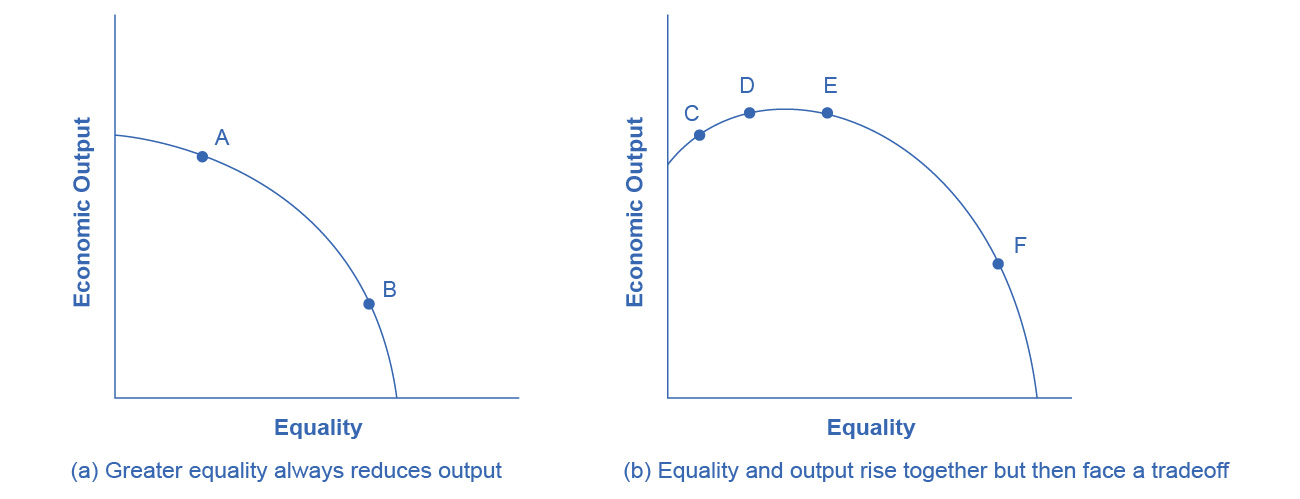

Figure 15.10図 15.10
(a) Society faces a trade-off where any attempt to move toward greater equality, like moving from choice A to B, involves a reduction in economic output. (b) Situations can arise like point C, where it is possible both to increase equality and also to increase economic output, to a choice like D. It may also be possible to increase equality with little impact on economic output, like the movement from choice D to E. However, at some point, too aggressive a push for equality will tend to reduce economic output, as in the shift from E to F.
英語のヒント
(a)社会は、選択AからBへの移動のように、平等を高めるあらゆる試みが経済的産出の減少を伴うトレードオフに直面する。(b)点CからDのような選択へ、平等と経済的産出の両方を高められる状況も生じうる。DからEのように、産出にほとんど影響せず、平等を高められることもある。しかし、ある点を超えて平等を強く追求しすぎると、EからFへの移動のように、経済的産出が減る傾向がある。
The tradeoff in Figure 15.10 (b) then flattens out in the area between points D and E, which reflects the pattern that a number of countries that provide similar levels of income to their citizens—the United States, Canada, European Union nations, Japan, and Australia—have different levels of inequality. The pattern suggests that countries in this range could choose a greater or a lesser degree of inequality without much impact on economic output. Only if these countries push for a much higher level of equality, like at point F, will they experience the diminished incentives that lead to lower levels of economic output. In this view, while a danger always exists that an agenda to reduce poverty or inequality can be poorly designed or pushed too far, it is also possible to discover and design policies that improve equality and do not injure incentives for economic output by very much—or even improve such incentives.
英語のヒント
図15.10(b)のトレードオフは、その後、点DとEの間で平らになる。これは、米国、カナダ、EU諸国、日本、オーストラリアなど、市民に同程度の所得水準を提供する多くの国で、不平等の水準が異なることを反映する。この形は、その範囲の国が、産出に大きく影響せず、不平等を大きくも小さくも選べることを示唆する。これらの国が点Fのように、はるかに高い平等を求めて初めて、誘因の低下によって産出が低くなる。この見方では、貧困・不平等対策の設計を誤ったり、進めすぎたりする危険は常にあるが、平等を改善しつつ、経済的産出への誘因をあまり損なわない政策、さらには誘因を改善する政策を発見し、設計することも可能である。