第15章貧困と経済的不平等
Key Concepts and Summary重要概念とまとめ
A poverty trap occurs when government-support payments decline as the recipients earn more income. As a result, the recipients do not end up with much more income when they work, because the loss of government support largely or completely offsets any income that one earns by working. Phasing out government benefits more slowly, as well as imposing requirements for work as a condition of receiving benefits and a time limit on benefits can reduce the harshness of the poverty trap.
英語のヒント
貧困の罠は、受給者がより多くの所得を稼ぐにつれ、政府の支援給付が減るときに生じる。その結果、働いても、受給者の所得はあまり増えない。政府支援の喪失が、働いて得る所得を大部分、または完全に相殺するためである。政府給付をより緩やかに縮小し、さらに給付の条件として就労を義務づけ、給付期間に上限を設けることで、貧困の罠の厳しさを和らげられる。
Self-Check Questions理解度確認問題
Exercises 9–10練習問題 9–10
Exercise 9問題 9
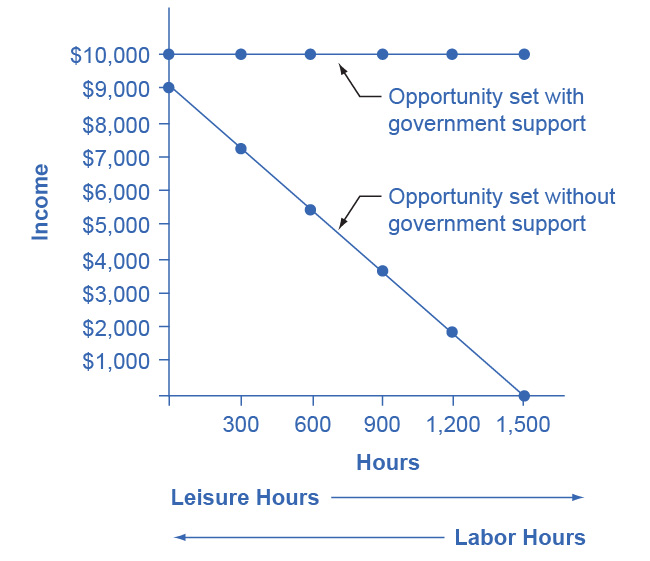
Jonathon is a single father with one child. He can work as a server for $6 per hour for up to 1,500 hours per year. He is eligible for welfare, and so if he does not earn any income, he will receive a total of $10,000 per year. He can work and still receive government benefits, but for every $1 of income, his welfare stipend is $1 less. Create a table similar to Table 15.4 that shows Jonathan’s options. Use four columns, the first showing number of hours to work, the second showing his earnings from work, the third showing the government benefits he will receive, and the fourth column showing his total income (earnings + government support). Sketch a labor-leisure diagram of Jonathan’s opportunity set with and without government support.
英語のヒント
ジョナサンは、子ども1人を持つひとり親の父親である。給仕として時給6ドルで、年間1,500時間まで働ける。福祉給付の資格があり、所得をまったく稼がなければ、年に合計10,000ドルを受け取る。働きながら政府給付を受けることもできるが、所得1ドルごとに福祉手当は1ドル減る。ジョナサンの選択肢を示す、表15.4に似た表を作りなさい。4つの列を使い、第1列は働く時間数、第2列は労働所得、第3列は受け取る政府給付、第4列は総所得(労働所得+政府支援)を示す。政府支援がある場合とない場合のジョナサンの機会集合を、労働・余暇の図に描きなさい。
Solution解き方
Jonathon’s options for working and total income are shown in the following table. His labor-leisure diagram is shown in the figure following the table.
英語のヒント
ジョナサンの労働と総所得の選択肢を、次の表に示す。労働・余暇の図は、表の後の図に示す。
Number of Work Hours 労働時間数 |
Earnings from Work 労働所得 |
Government Benefits 政府給付 |
Total Income 総所得 |
|---|---|---|---|
1,500 |
$9,000 |
$1,000 |
$10,000 |
1,200 |
$7,200 |
$2,800 |
$10,000 |
900 |
$5,400 |
$4,600 |
$10,000 |
600 |
$3,600 |
$6,400 |
$10,000 |
300 |
$1,800 |
$8,200 |
$10,000 |
0 |
$0 |
$10,000 |
$10,000 |
Exercise 10問題 10
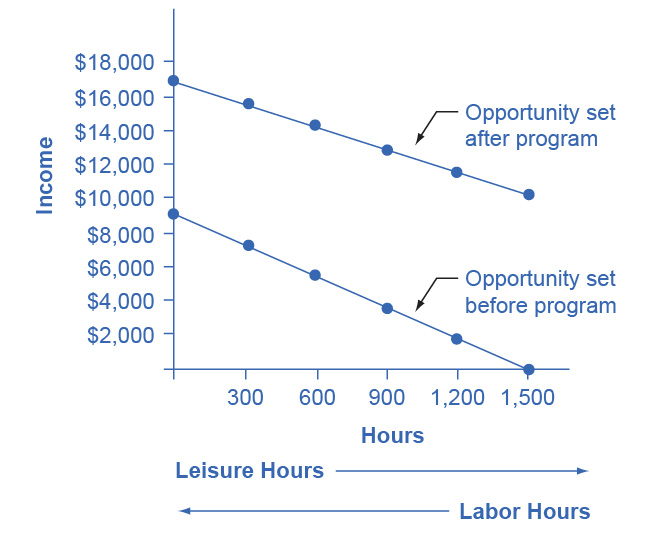
Imagine that the government reworks the welfare policy that was affecting Jonathan in question 2, so that for each dollar someone like Jonathan earns at work, his government benefits diminish by only 30 cents. Reconstruct the table from question 2 to account for this change in policy. Draw Jonathan’s labor-leisure opportunity sets, both for before this welfare program is enacted and after it is enacted.
英語のヒント
政府が、問2でジョナサンに影響していた福祉政策を改め、ジョナサンのような人が仕事で1ドル稼ぐごとに、政府給付が30セントだけ減るようにすると想像しよう。この政策変更を考慮して、問2の表を作り直しなさい。この福祉事業の実施前と実施後の両方について、ジョナサンの労働・余暇の機会集合を描きなさい。
Solution解き方
The following table shows a policy where only 30 cents in government support is pulled right back for every $1 of income earned. Jonathon’s labor-leisure diagram is shown in the figure following the table. “Opportunity set after program” extends from (0, $16,300) to (1,500, $10,000). “Opportunity set before program” slopes downward from (0, $9,000) to (1,500, $0).
英語のヒント
次の表は、1ドルの所得を稼ぐごとに政府支援が30セントだけ差し引かれる政策を示す。ジョナサンの労働・余暇の図は、表の後の図に示す。「事業実施後の機会集合」は(0, 16,300ドル)から(1,500, 10,000ドル)まで延びる。「事業実施前の機会集合」は(0, 9,000ドル)から(1,500, 0ドル)へ右下がりとなる。
Number of Work Hours 労働時間数 |
Earnings from Work 労働所得 |
Government Benefits 政府給付 |
Total Income 総所得 |
|---|---|---|---|
1,500 |
$9,000 |
$7,300 |
$16,300 |
1,200 |
$7,200 |
$7,840 |
$15,040 |
900 |
$5,400 |
$8,380 |
$13,780 |
600 |
$3,600 |
$8,920 |
$12,520 |
300 |
$1,800 |
$9,460 |
$22,260 |
0 |
$0 |
$10,000 |
$10,000 |


Review Questions復習問題
Exercises 11–13練習問題 11–13
Exercise 11問題 11
How does the poverty trap discourage people from working?
英語のヒント
貧困の罠は、どのように人々の労働意欲をそぐか。
Exercise 12問題 12
How can the effect of the poverty trap be reduced?
英語のヒント
貧困の罠の影響を、どうすれば弱められるか。
Exercise 13問題 13
How does the U.S. government specifically support elderly people experiencing poverty?
英語のヒント
米国政府は、貧困を経験する高齢者を具体的にどう支援するか。
Critical Thinking Questions考察問題
Exercises 14–15練習問題 14–15
Exercise 14問題 14
Exercise 9 and Exercise 10 asked you to describe the labor-leisure tradeoff for Jonathon. Since, in the first example, there is no monetary incentive for Jonathon to work, explain why he may choose to work anyway. Explain what the opportunity costs of working and not working might be for Jonathon in each example. Using your tables and graphs from Exercise 9 and Exercise 10, analyze how the government welfare system affects Jonathan’s incentive to work.
英語のヒント
Exercise 15問題 15
Explain how you would create a government program that would give an incentive for labor to increase hours and keep labor from falling into the poverty trap.
英語のヒント
労働者が労働時間を増やす誘因を与え、貧困の罠に陥るのを防ぐ政府事業を、どのように作るかを説明しなさい。
Problems問題
Exercises 16練習問題 16
Exercise 16問題 16
Susan is a single mother with three children. She can earn $8 per hour and works up to 1,800 hours per year. However, if she does not earn any income at all, she will receive government benefits totaling $16,000 per year. For every $1 of income she earns, her level of government support will be reduced by $1. Create a table, patterned after this one. The first column should show Susan’s choices of how many hours to work per year, up to 1,800 hours. The second column should show her earnings from work. The third column should show her level of government support, given her earnings. The final column should show her total income, combining earnings and government support. Based on the table you created, what are the likely impacts of this kind of assistance program on Susan's incentive to work? Are there additional opportunity costs that may reduce her incentive to work?
英語のヒント
スーザンは、子ども3人を持つひとり親の母親である。時給8ドルを稼ぐことができ、年間1,800時間まで働く。しかし所得をまったく稼がなければ、年に合計16,000ドルの政府給付を受け取る。1ドル稼ぐごとに、政府支援は1ドル減る。この表を手本に、表を作りなさい。第1列には、年間1,800時間までの範囲で、スーザンが働く時間数の選択肢を示す。第2列には労働所得、第3列にはその所得を前提とした政府支援の水準、最後の列には、労働所得と政府支援を合わせた総所得を示す。作った表に基づき、この種の援助事業は、スーザンの働く誘因にどのような影響を与えそうか。働く誘因を弱める追加の機会費用はあるか。
poverty trap
貧困の罠
antipoverty programs set up so that government benefits decline substantially as people earn more income—as a result, working provides little financial gain
英語のヒント
人々が多くの所得を稼ぐにつれて政府給付が大きく減るように作られた貧困対策事業。その結果、働いても金銭的利益がほとんどない状態。