第15章貧困と経済的不平等
Causes of Growing Inequality: The Changing Composition of American Households不平等拡大の原因:米国の世帯構成の変化
In 1970, 41% of married women were in the labor force, but by 2019, according to the Bureau of Labor Statistics, 58.6% of married women were in the labor force. One result of this trend is that more households have two earners. Moreover, it has become more common for one high earner to marry another high earner. A few decades ago, the common pattern featured a man with relatively high earnings, such as an executive or a doctor, marrying a woman who did not earn as much, like a secretary or a nurse. Often, the woman would leave paid employment, at least for a few years, to raise a family. However, now doctors are marrying doctors and executives are marrying executives, and mothers with high-powered careers are often returning to work while their children are quite young. This pattern of households with two high earners tends to increase the proportion of high-earning households.
英語のヒント
1970年には既婚女性の41%が労働力に属したが、労働統計局によると、2019年には58.6%となった。この傾向の結果の1つは、稼ぎ手が2人いる世帯が増えたことである。さらに、高所得者が別の高所得者と結婚することも、より一般的になった。数十年前のよくある形は、幹部や医師のような比較的高所得の男性が、秘書や看護師のように、それほど稼がない女性と結婚することだった。女性は家族を育てるため、少なくとも数年間、有給の仕事を離れることが多かった。しかし現在では、医師は医師と、幹部は幹部と結婚し、重要な職業的地位にある母親は、子どもがまだ幼いうちに仕事へ戻ることが多い。高所得の稼ぎ手が2人いる世帯という形は、高所得世帯の割合を増やす傾向がある。
According to data in the National Journal, even as two-earner couples have increased, so have single-parent households. Of all U.S. families, in 2021, about 23% were headed by single mothers. The poverty rate among single-parent households tends to be relatively high.
英語のヒント
『National Journal』のデータによると、共働き夫婦が増えると同時に、ひとり親世帯も増えた。2021年、米国の全家族の約23%は、ひとり親の母親が世帯主だった。ひとり親世帯の貧困率は、比較的高い傾向がある。
These changes in family structure, including the growth of single-parent families who tend to be at the lower end of the income distribution, and the growth of two-career high-earner couples near the top end of the income distribution, account for roughly half of the rise in income inequality across households in recent decades.
英語のヒント
所得分布の下端に位置しやすいひとり親世帯の増加と、上端近くに位置する共働きの高所得夫婦の増加を含む、こうした家族構造の変化は、近年の数十年間における世帯間の所得不平等の拡大の約半分を説明する。
Additional Resources追加教材
Causes of Growing Inequality: A Shift in the Distribution of Wages不平等拡大の原因:賃金分布の変化
Another factor behind the rise in U.S. income inequality is that earnings have become less equal since the late 1970s. In particular, the earnings of high-skilled labor relative to low-skilled labor have increased. Winner-take-all labor markets result from changes in technology, which have increased global demand for “stars,”—whether the best CEO, doctor, basketball player, or actor. This global demand pushes salaries far above productivity differences associated with educational differences. One way to measure this change is to take workers' earnings with at least a four-year college bachelor’s degree (including those who went on and completed an advanced degree) and divide them by workers' earnings with only a high school degree. The result is that those in the 25–34 age bracket with college degrees earned about 1.85 times as much as high school graduates in 2020, up from 1.59 times in 1995, according to U.S. Census data. Winner-take-all labor market theory argues that the salary gap between the median and the top 1 percent is not due to educational differences.
英語のヒント
米国の所得不平等拡大のもう1つの要因は、1970年代末以降、所得がより不平等になったことである。とくに、低技能労働に対する高技能労働の相対所得が増えた。技術の変化によって、最高のCEO、医師、バスケットボール選手、俳優といった「スター」への世界的需要が増え、勝者総取りの労働市場が生まれる。この世界的需要は、教育の違いに伴う生産性の違いをはるかに超えて、給与を押し上げる。この変化を測る方法の1つは、大学院へ進んで高度な学位を修了した人も含め、少なくとも4年制大学の学士号を持つ労働者の所得を、高校卒業資格だけを持つ労働者の所得で割ることである。米国国勢調査のデータによると、25~34歳の大学卒業者は2020年、高校卒業者の約1.85倍を稼ぎ、1995年の1.59倍から増えた。勝者総取りの労働市場理論は、中央値と上位1%の給与格差は教育の違いによるものではないと主張する。
Economists use the demand and supply model to reason through the most likely causes of this shift. According to the National Center for Education Statistics, in recent decades, the supply of U.S. workers with college degrees has increased substantially. For example, 840,000 four-year bachelor’s degrees were conferred on Americans in 1970. In 2018–2019, 2.0 million such degrees were conferred—an increase of over 138%. In Figure 15.9, this shift in supply to the right, from S0 to S1, by itself should result in a lower equilibrium wage for high-skilled labor. Thus, we can explain the increase in the price of high-skilled labor by a greater demand, like the movement from D0 to D1. Evidently, combining both the increase in supply and in demand has resulted in a shift from E0 to E1, and a resulting higher wage.
英語のヒント
経済学者は需要・供給モデルを使い、この変化の最もありそうな原因を考える。国立教育統計センターによると、近年の数十年間、大学の学位を持つ米国労働者の供給は大幅に増えた。例えば1970年には84万人の米国人に4年制の学士号が授与された。2018~2019年には200万件で、138%超増えた。図15.9のS0からS1への供給の右方移動は、それだけなら高技能労働の均衡賃金を下げるはずである。したがって高技能労働の価格上昇は、D0からD1への移動のような、より大きな需要によって説明できる。明らかに、供給増加と需要増加の組合せが、E0からE1への移動と、それによる高い賃金をもたらした。
Why Would Wages Rise for High-Skilled Labor?高技能労働の賃金はなぜ上がるのか
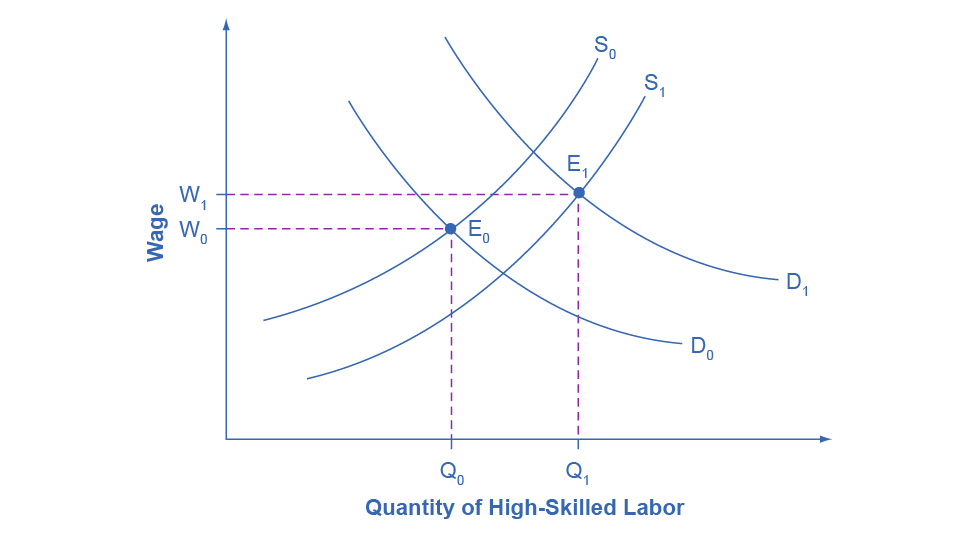

Figure 15.9図 15.9
The proportion of workers attending college has increased in recent decades, so the supply curve for high-skilled labor has shifted to the right, from S0 to S1. If the demand for high-skilled labor had remained at D0, then this shift in supply would have led to lower wages for high-skilled labor. However, the wages for high-skilled labor, especially if there is a large global demand, have increased even with the shift in supply to the right. The explanation must lie in a shift to the right in demand for high-skilled labor, from D0 to D1. The figure shows how a combination of the shift in supply, from S0 to S1, and the shift in demand, from D0 to D1, led to both an increase in the quantity of high-skilled labor hired and also to a rise in the wage for such labor, from W0 to W1.
英語のヒント
近年の数十年間に大学へ通う労働者の割合が増えたため、高技能労働の供給曲線はS0からS1へ右に移動した。高技能労働の需要がD0にとどまっていれば、この供給の移動は賃金を下げたはずである。しかし高技能労働の賃金は、とくに世界的に大きな需要がある場合、供給が右に移動しても上がった。その説明は、高技能労働の需要がD0からD1へ右に移動したことにあるはずである。図は、S0からS1への供給の移動と、D0からD1への需要の移動の組合せが、雇われる高技能労働量の増加と、その賃金のW0からW1への上昇の両方をもたらす仕組みを示す。
What factors would cause the demand for high-skilled labor to rise? The most plausible explanation is that while the explosion in new information and communications technologies over the last several decades has helped many workers to become more productive, the benefits have been especially great for high-skilled workers like top business managers, consultants, and design professionals. The new technologies have also helped to encourage globalization, the remarkable increase in international trade over the last few decades, by making it more possible to learn about and coordinate economic interactions all around the world. In turn, the rising impact of foreign trade in the U.S. economy has opened up greater opportunities for high-skilled workers to sell their services around the world, and lower-skilled workers have to compete with a larger supply of similarly skilled workers around the globe.
英語のヒント
どのような要因が、高技能労働への需要を増やすのだろうか。最ももっともらしい説明は、過去数十年間の情報通信技術の爆発的な発展が、多くの労働者の生産性を高める助けとなったが、とくに経営上層部、コンサルタント、設計専門家のような高技能労働者に大きな便益を与えたことである。新技術はまた、世界中の経済的なやり取りを知り、調整することを容易にし、過去数十年間の国際貿易の目覚ましい増加であるグローバル化を促した。次に、米国経済における対外貿易の影響が高まることで、高技能労働者には世界中へサービスを売る機会が増え、低技能労働者は、世界中の同程度の技能を持つ、より大きな労働供給と競争しなければならなくなった。
We can view the market for high-skilled labor as a race between forces of supply and demand. Additional education and on-the-job training will tend to increase the high-skilled labor supply and to hold down its relative wage. Conversely, new technology and other economic trends like globalization tend to increase the demand for high-skilled labor and push up its relative wage. We can view the greater inequality of wages as a sign that demand for skilled labor is increasing faster than supply. Alternatively, if the supply of lower skilled workers exceeds the demand, then average wages in the lower quintiles of the income distribution will decrease. The combination of forces in the high-skilled and low-skilled labor markets leads to increased income disparity.
英語のヒント
高技能労働の市場は、供給と需要の力の競争と見ることができる。追加の教育と職場内訓練は、高技能労働の供給を増やし、その相対賃金を抑える傾向がある。逆に、新技術やグローバル化のようなほかの経済的傾向は、高技能労働の需要を増やし、その相対賃金を押し上げる傾向がある。賃金不平等の拡大は、技能労働への需要が供給より速く増えている兆候と見ることができる。別の場合として、低技能労働者の供給が需要を超えれば、所得分布の下位五分位の平均賃金は下がる。高技能・低技能労働市場の力の組合せが、所得格差の拡大につながる。