第15章貧困と経済的不平等
Supplemental Nutrition Assistance Program (SNAP)補助的栄養支援制度(SNAP)
Often called “food stamps,” Supplemental Nutrition Assistance Program (SNAP) is a federally funded program, started in 1964, in which each month people receive a card like a debit card that they can use to buy food. The amount of food aid for which a household is eligible varies by income, number of children, and other factors but, in general, households are expected to spend about 30% of their own net income on food, and if 30% of their net income is not enough to purchase a nutritionally adequate diet, then those households are eligible for SNAP.
英語のヒント
しばしば「フードスタンプ」と呼ばれる補助的栄養支援制度(SNAP)は、1964年に始まった連邦資金による事業で、人々は毎月、食料を買えるデビットカードのようなカードを受け取る。世帯が受けられる食料援助の額は、所得、子どもの人数、その他の要因によって異なる。しかし一般に、世帯は自分の純所得の約30%を食費に使うと想定され、その30%で栄養的に十分な食事を買えなければ、SNAPの対象になる。
SNAP can contribute to the poverty trap. For every $100 earned, the government assumes that a family can spend $30 more for food, and thus reduces its eligibility for food aid by $30. This decreased benefit is not a complete disincentive to work—but combined with how other programs reduce benefits as income increases, it adds to the problem. SNAP, however, does try to address the poverty trap with its own set of work requirements and time limits.
英語のヒント
SNAPは貧困の罠の一因になりうる。100ドル稼ぐごとに、政府は家族が食費を30ドル増やせると仮定し、食料援助の受給資格額を30ドル減らす。この給付減少が働く誘因を完全になくすわけではないが、所得が増えるとほかの事業の給付も減ることと重なると、問題を深める。ただしSNAPも、独自の就労条件と期間制限によって、貧困の罠に対処しようとしている。
Why give debit cards and not just cash? Part of the political support for SNAP comes from a belief that since recipients must spend the the cards on food, they cannot “waste” them on other forms of consumption. From an economic point of view, however, the belief that cards must increase spending on food seems wrong-headed. After all, say that a family is spending $2,500 per year on food, and then it starts receiving $1,000 per year in SNAP aid. The family might react by spending $3,500 per year on food (income plus aid), or it might react by continuing to spend $2,500 per year on food, but use the $1,000 in food aid to free up $1,000 that it can now spend on other goods. Thus, it is reasonable to think of SNAP cards as an alternative method, along with TANF and the earned income tax credit, of transferring income to those working but still experiencing poverty.
英語のヒント
なぜ現金をそのまま渡さず、デビットカードを与えるのだろうか。SNAPへの政治的支持の一部は、受給者がカードを食料に使わなければならないため、ほかの消費で「無駄遣い」できないという信念から来る。しかし経済的観点では、カードによって必ず食費が増えるという考えは誤っているように見える。例えば、家族が年2,500ドルを食費に使い、その後、年1,000ドルのSNAP援助を受け始めるとする。家族は、所得に援助を加えて年3,500ドルを食費に使うかもしれない。あるいは、食費を年2,500ドルのままにしながら、1,000ドルの食料援助によって、自分の1,000ドルをほかの財に使えるようにするかもしれない。したがってSNAPカードは、TANFや勤労所得税額控除と並び、働いていても貧困を経験する人々に所得を移転する別の方法と考えるのが妥当である。
Anyone eligible for TANF is also eligible for SNAP, although states can expand eligibility for food aid if they wish to do so. In some states, where TANF welfare spending is relatively low, a poor family may receive more in support from SNAP than from TANF. In 2021, about 41.5 million people received food aid with total benefits of just over $108 billion, which is an average monthly benefit of about $287 per person per month. SNAP participation increased by 70% between 2007 and 2011, from 26.6 million participants to 45 million. According to the Congressional Budget Office, the 2008-2009 Great Recession and rising food prices caused this dramatic rise in participation. Likewise, between 2019 and 2021, the number of participants in SNAP increased by 5.8 million, the amount per person increased by 67%, and total benefits nearly doubled as a consequence of the sharp recession due to the onset of the COVID-19 pandemic in early 2020.
英語のヒント
TANFの資格がある人は、すべてSNAPの資格も持つが、州は望めば食料援助の資格を広げられる。TANFの福祉支出が比較的低い一部の州では、貧しい家族はTANFよりSNAPから多くの支援を受けることがある。2021年には約4,150万人が、総額1,080億ドルを少し超える食料援助を受け、1人当たり月額給付の平均は約287ドルだった。SNAPの参加者は、2007年の2,660万人から2011年の4,500万人へ、70%増えた。議会予算局によると、2008~2009年の大不況と食料価格の上昇が、この大幅な増加を引き起こした。同様に2019~2021年には、2020年初めの新型コロナウイルス感染症の世界的流行による急激な景気後退の結果、参加者が580万人増え、1人当たり金額は67%増え、給付総額はほぼ倍増した。
The federal government deploys a range of income security programs that it funds through departments such as Health and Human Services, Agriculture, and Housing and Urban Development (HUD) (see Figure 15.6). According to the Office of Management and Budget, collectively, these three departments provided an estimated $62 billion of aid through programs such as supplemental feeding programs for women and children, subsidized housing, and energy assistance. The federal government also transfers funds to individual states through special grant programs.
英語のヒント
連邦政府は、保健福祉省、農務省、住宅都市開発省(HUD)などを通じて資金を出す、さまざまな所得保障事業を実施する(図15.6参照)。行政管理予算局によると、これら3省は合わせて、女性・子どもへの補足的な給食事業、住宅補助、エネルギー援助などの事業を通じ、推計620億ドルの援助を提供した。連邦政府は、特別な補助金事業を通じ、各州にも資金を移転する。
Expenditure Comparison of TANF, SNAP, HUD, and Other Income Security Programs, 1988–2013 (est.)TANF、SNAP、HUD、その他の所得保障事業の支出比較、1988~2013年(推計)
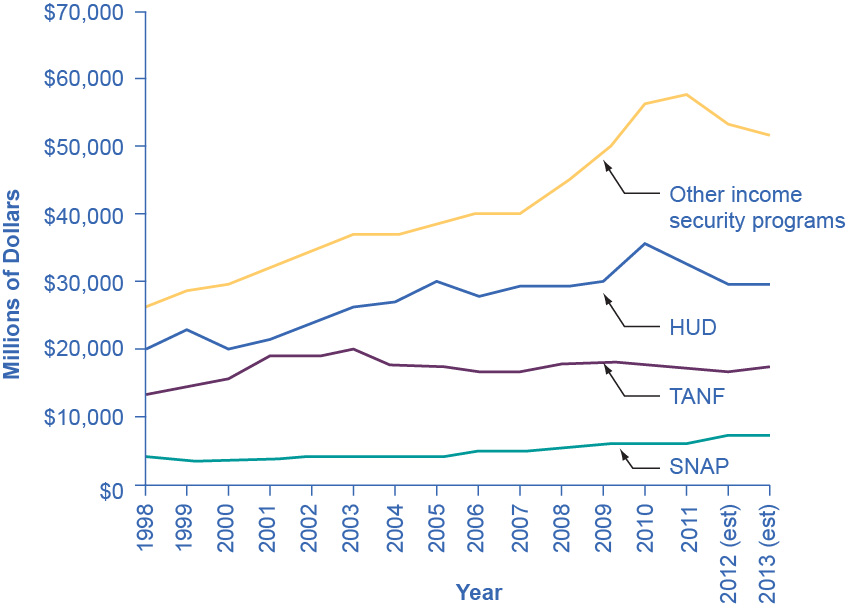

Figure 15.6図 15.6
Total expenditures on income security continued to rise between 1988 and 2010, while payments for TANF have increased from $13 billion in 1998 to an estimated $17.3 billion in 2013. SNAP has seen relatively small increments. These two programs comprise a relatively small portion of the estimated $106 billion dedicated to income security in 2013. Note that other programs and housing programs increased dramatically during the 2008 and 2010 time periods. (Source: Table 12.3 Section 600 Income Security, https://www.whitehouse.gov/sites/default/files/omb/budget/fy2013/assets/hist.pdf)
英語のヒント
所得保障の総支出は1988~2010年に増え続け、TANF給付は1998年の130億ドルから、2013年の推計173億ドルへ増えた。SNAPの増加は比較的小さい。これら2事業は、2013年に所得保障へ充てられた推計1,060億ドルの、比較的小さい部分を占める。その他の事業と住宅事業が、2008年と2010年の時期に大きく増えた点に注意しよう。(出典:表12.3、第600項「所得保障」、https://www.whitehouse.gov/sites/default/files/omb/budget/fy2013/assets/hist.pdf)
The safety net includes a number of other programs: government-subsidized school lunches and breakfasts for children from low-income families; the Special Supplemental Food Program for Women, Infants and Children (WIC), which provides food assistance for pregnant women and newborns; the Low Income Home Energy Assistance Program, which provides help with home heating bills; housing assistance, which helps pay the rent; and Supplemental Security Income, which provides cash support for people with disabilities and elderly people experiencing poverty.
英語のヒント
安全網には、ほかにも多くの事業がある。低所得世帯の子どもへの政府補助付きの学校昼食・朝食、妊婦と新生児に食料援助を行う女性・乳幼児特別補助食料制度(WIC)、家庭の暖房費を支援する低所得世帯エネルギー援助事業、家賃の支払を助ける住宅援助、障害者や貧困を経験する高齢者に現金支援を行う補足的保障所得である。