第3章需要と供給
Inefficiency of Price Floors and Price Ceilings価格下限と価格上限の非効率性
The imposition of a price floor or a price ceiling will prevent a market from adjusting to its equilibrium price and quantity, and thus will create an inefficient outcome. However, there is an additional twist here. Along with creating inefficiency, price floors and ceilings will also transfer some consumer surplus to producers, or some producer surplus to consumers.
英語のヒント
価格下限や価格上限を設けると、市場が均衡価格と均衡数量へ調整することを妨げ、非効率な結果を生む。しかし、それに加えてもう一つの作用がある。非効率性を生むと同時に、消費者余剰の一部を生産者へ、あるいは生産者余剰の一部を消費者へ移転するのである。
Imagine that several firms develop a promising but expensive new drug for treating back pain. If this therapy is left to the market, the equilibrium price will be $600 per month and 20,000 people will use the drug, as shown in Figure 3.24 (a). The original level of consumer surplus is T + U and producer surplus is V + W + X. However, the government decides to impose a price ceiling of $400 to make the drug more affordable. At this price ceiling, firms in the market now produce only 15,000.
英語のヒント
いくつかの企業が、腰痛を治療する有望だが高価な新薬を開発したとしよう。市場に任せれば、図3.24(a)のように、均衡価格は月600ドルで、2万人が薬を使う。元の消費者余剰はT+U、生産者余剰はV+W+Xである。しかし政府は、薬を買いやすくするため、400ドルの価格上限を設けることにした。この上限価格では、企業は15,000の数量しか生産しなくなる。
As a result, two changes occur. First, an inefficient outcome occurs and the total surplus of society is reduced. The loss in social surplus that occurs when the economy produces at an inefficient quantity is called deadweight loss. In a very real sense, it is like money thrown away that benefits no one. In Figure 3.24 (a), the deadweight loss is the area U + W. When deadweight loss exists, it is possible for both consumer and producer surplus to be higher, in this case because the price control is blocking some suppliers and demanders from transactions they would both be willing to make.
英語のヒント
その結果、二つの変化が起こる。第一に、非効率な結果となり、社会の総余剰が減る。経済が非効率な数量を生産するときに生じる社会的余剰の損失を、死荷重という。誰の利益にもならず、お金を捨てるようなものである。図3.24(a)では、U+Wが死荷重である。死荷重があるときは、消費者余剰と生産者余剰の両方を、より大きくすることが可能である。この例では、価格統制が、一部の供給者と需要者の双方が望む取引を妨げているためである。
A second change from the price ceiling is that some of the producer surplus is transferred to consumers. After the price ceiling is imposed, the new consumer surplus is T + V, while the new producer surplus is X. In other words, the price ceiling transfers the area of surplus (V) from producers to consumers. Note that the gain to consumers is less than the loss to producers, which is just another way of seeing the deadweight loss.
英語のヒント
価格上限による第二の変化は、生産者余剰の一部が消費者へ移転することである。上限設定後の新しい消費者余剰はT+V、生産者余剰はXとなる。つまり、余剰の領域Vが、生産者から消費者へ移る。消費者の利得は生産者の損失より小さいことに注意しよう。これも死荷重を見る別の方法である。
Efficiency and Price Floors and Ceilings効率性と価格下限・価格上限
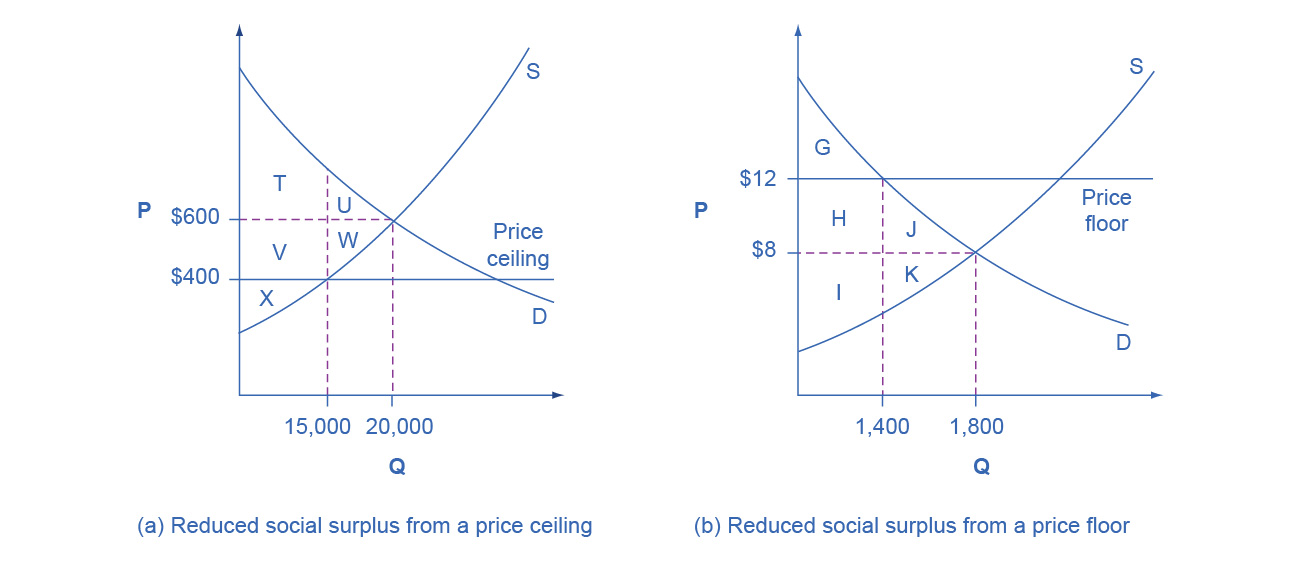

Figure 3.24図 3.24
(a) The original equilibrium price is $600 with a quantity of 20,000. Consumer surplus is T + U, and producer surplus is V + W + X. A price ceiling is imposed at $400, so firms in the market now produce only a quantity of 15,000. As a result, the new consumer surplus is T + V, while the new producer surplus is X. (b) The original equilibrium is $8 at a quantity of 1,800. Consumer surplus is G + H + J, and producer surplus is I + K. A price floor is imposed at $12, which means that quantity demanded falls to 1,400. As a result, the new consumer surplus is G, and the new producer surplus is H + I.
英語のヒント
(a)元の均衡価格は600ドル、数量は20,000である。消費者余剰はT+U、生産者余剰はV+W+X。400ドルの価格上限を設けると、企業は15,000しか生産しなくなる。その結果、新しい消費者余剰はT+V、生産者余剰はXとなる。(b)元の均衡は価格8ドル、数量1,800である。消費者余剰はG+H+J、生産者余剰はI+K。12ドルの価格下限を設けると、需要量は1,400へ減る。その結果、新しい消費者余剰はG、生産者余剰はH+Iとなる。
Figure 3.24 (b) shows a price floor example using a string of struggling movie theaters, all in the same city. The current equilibrium is $8 per movie ticket, with 1,800 people attending movies. The original consumer surplus is G + H + J, and producer surplus is I + K. The city government is worried that movie theaters will go out of business, reducing the entertainment options available to citizens, so it decides to impose a price floor of $12 per ticket. As a result, the quantity demanded of movie tickets falls to 1,400. The new consumer surplus is G, and the new producer surplus is H + I. In effect, the price floor causes the area H to be transferred from consumer to producer surplus, but also causes a deadweight loss of J + K.
英語のヒント
図3.24(b)は、同じ都市内の経営難の映画館群を例に、価格下限を示す。現在の均衡はチケット1枚8ドルで、1,800人が映画を見る。元の消費者余剰はG+H+J、生産者余剰はI+Kである。市政府は、映画館が廃業して市民の娯楽の選択肢が減ることを心配し、1枚12ドルの価格下限を設ける。その結果、チケットの需要量は1,400へ減る。新しい消費者余剰はG、生産者余剰はH+Iとなる。価格下限は、領域Hを消費者余剰から生産者余剰へ移す一方、J+Kの死荷重も生む。
This analysis shows that a price ceiling, like a law establishing rent controls, will transfer some producer surplus to consumers—which helps to explain why consumers often favor them. Conversely, a price floor like a guarantee that farmers will receive a certain price for their crops will transfer some consumer surplus to producers, which explains why producers often favor them. However, both price floors and price ceilings block some transactions that buyers and sellers would have been willing to make, and creates deadweight loss. Removing such barriers, so that prices and quantities can adjust to their equilibrium level, will increase the economy’s social surplus.
英語のヒント
この分析から、家賃統制のような価格上限は、生産者余剰の一部を消費者へ移すことがわかる。消費者が支持することが多い理由を説明できる。逆に、農産物の一定価格を保証するような価格下限は、消費者余剰の一部を生産者へ移す。生産者が支持することが多い理由である。しかし、どちらも買い手と売り手の双方が望む一部の取引を妨げ、死荷重を生む。その障壁を取り除き、価格と数量が均衡へ調整できるようにすれば、経済の社会的余剰は増える。