第3章需要と供給
3.4 Price Ceilings and Price Floors3.4 価格上限と価格下限
Learning Objectives学習目標
Learning Objectives学習目標
By the end of this section, you will be able to:
英語のヒント
この節を学ぶと、次のことができるようになる。
- Explain price controls, price ceilings, and price floors
英語のヒント
価格統制、価格上限、価格下限を説明する。
To this point in the chapter, we have been assuming that markets are free, that is, they operate with no government intervention. In this section, we will explore the outcomes, both anticipated and otherwise, when government does intervene in a market either to prevent the price of some good or service from rising “too high” or to prevent the price of some good or service from falling “too low”.
英語のヒント
ここまでは、市場が自由であり、政府の介入なしに機能すると仮定してきた。この節では、ある財・サービスの価格が「高くなりすぎる」のを防ぐため、あるいは「低くなりすぎる」のを防ぐために政府が市場へ介入したとき、予想された結果と、それ以外の結果を検討する。
Economists believe there are a small number of fundamental principles that explain how economic agents respond in different situations. Two of these principles, which we have already introduced, are the laws of demand and supply.
英語のヒント
経済学者は、経済主体がさまざまな状況でどう反応するかを説明する、少数の基本原理があると考える。そのうち、すでに紹介した二つが需要の法則と供給の法則である。
Governments can pass laws affecting market outcomes, but no law can negate these economic principles. Rather, the principles will become apparent in sometimes unexpected ways, which may undermine the intent of the government policy. This is one of the major conclusions of this section.
英語のヒント
政府は市場の結果に影響する法律を制定できるが、経済原理そのものを無効にはできない。むしろ、その原理が時に予想外の形で現れ、政策の意図を損なうことがある。これが、この節の主な結論の一つである。
Controversy sometimes surrounds the prices and quantities established by demand and supply, especially for products that are considered necessities. In some cases, discontent over prices turns into public pressure on politicians, who may then pass legislation to prevent a certain price from climbing “too high” or falling “too low.”
英語のヒント
需要と供給が決める価格や数量は、特に必需品とされる製品では、論争を呼ぶことがある。価格への不満が政治家への圧力となり、価格が「高くなりすぎる」、あるいは「低くなりすぎる」のを防ぐ法律が成立する場合もある。
The demand and supply model shows how people and firms will react to the incentives that these laws provide to control prices, in ways that will often lead to undesirable consequences. Alternative policy tools can often achieve the desired goals of price control laws, while avoiding at least some of their costs and tradeoffs.
英語のヒント
需要と供給のモデルは、価格を統制する法律が与える誘因に、人々や企業がどう反応するかを示す。その反応は、しばしば望ましくない結果につながる。別の政策手段を使えば、価格統制法が目指す目的を達成しつつ、その費用やトレードオフの少なくとも一部を避けられる場合が多い。
Price Ceilings価格上限
Laws that governments enact to regulate prices are called price controls. Price controls come in two flavors. A price ceiling keeps a price from rising above a certain level (the “ceiling”), while a price floor keeps a price from falling below a given level (the “floor”). This section uses the demand and supply framework to analyze price ceilings. The next section discusses price floors.
英語のヒント
政府が価格を規制するために制定する法律を、価格統制という。価格統制には二つの種類がある。価格上限は価格が一定水準、つまり「天井」を超えて上がるのを防ぎ、価格下限は価格が一定水準、つまり「床」より下がるのを防ぐ。この部分では、需要と供給の枠組みで価格上限を分析し、次に価格下限を論じる。
A price ceiling is a legal maximum price that one pays for some good or service. A government imposes price ceilings in order to keep the price of some necessary good or service affordable. For example, in 2005 during Hurricane Katrina, the price of bottled water increased above $5 per gallon. As a result, many people called for price controls on bottled water to prevent the price from rising so high. In this particular case, the government did not impose a price ceiling, but there are other examples of where price ceilings did occur.
英語のヒント
価格上限とは、財・サービスに対して支払う価格の法定上限である。政府は、必要な財・サービスを手の届く価格に保つために上限を設ける。例えば、2005年のハリケーン・カトリーナの際、飲料水の価格は1ガロン5ドルを超えた。そのため多くの人が、そこまで値上がりしないよう価格統制を求めた。このとき政府は価格上限を設けなかったが、実際に上限が設けられた例はほかにある。
In many markets for goods and services, demanders outnumber suppliers. Consumers, who are also potential voters, sometimes unite behind a political proposal to hold down a certain price. In some cities, such as Albany, renters have pressed political leaders to pass rent control laws, a price ceiling that usually works by stating that landlords can raise rents by only a certain maximum percentage each year. Some of the best examples of rent control occur in urban areas such as New York, Washington D.C., or San Francisco.
英語のヒント
多くの財・サービス市場では、需要者の数が供給者を上回る。投票者にもなりうる消費者は、特定の価格を抑える政治的な提案を支持して団結することがある。オールバニなど一部の都市では、借り手が政治指導者に家賃統制法の制定を求めてきた。これは通常、家主が毎年家賃を上げられる割合に上限を設ける価格統制である。代表的な例は、ニューヨーク、ワシントンD.C.、サンフランシスコなどの都市部に見られる。
Rent control becomes a politically hot topic when rents begin to rise rapidly. Everyone needs an affordable place to live. Perhaps a change in tastes makes a certain suburb or town a more popular place to live. Perhaps locally-based businesses expand, bringing higher incomes and more people into the area. Such changes can cause a change in the demand for rental housing, as Figure 3.21 illustrates. The original equilibrium (E0) lies at the intersection of supply curve S0 and demand curve D0, corresponding to an equilibrium price of $500 and an equilibrium quantity of 15,000 units of rental housing. The effect of greater income or a change in tastes is to shift the demand curve for rental housing to the right, as the data in Table 3.10 shows and the shift from D0 to D1 on the graph. In this market, at the new equilibrium E1, the price of a rental unit would rise to $600 and the equilibrium quantity would increase to 17,000 units.
英語のヒント
A Price Ceiling Example—Rent Control価格上限の例――家賃統制
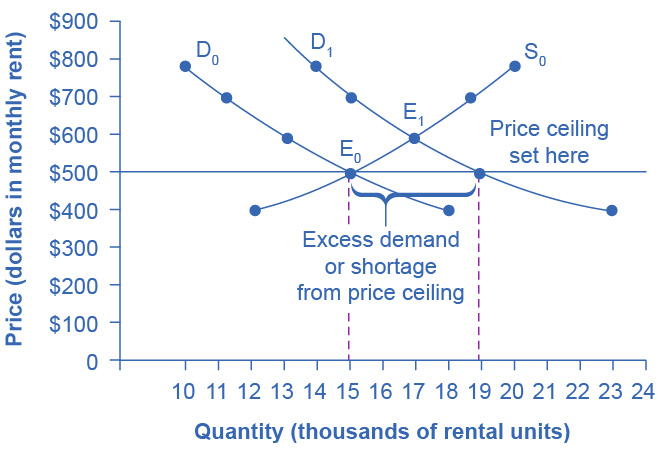

Figure 3.21図 3.21
The original intersection of demand and supply occurs at E0. If demand shifts from D0 to D1, the new equilibrium would be at E1—unless a price ceiling prevents the price from rising. If the price is not permitted to rise, the quantity supplied remains at 15,000. However, after the change in demand, the quantity demanded rises to 19,000, resulting in a shortage.
英語のヒント
元の需要と供給の交点はE0である。需要がD0からD1へシフトすると、価格上限が値上がりを妨げない限り、新しい均衡はE1になる。値上がりが認められなければ供給量は15,000戸のままだが、需要変化後の需要量は19,000戸へ増え、不足が生じる。
Price 価格 |
Original Quantity Supplied 元の供給量 |
Original Quantity Demanded 元の需要量 |
New Quantity Demanded 新しい需要量 |
|---|---|---|---|
$400 |
12,000 |
18,000 |
23,000 |
$500 |
15,000 |
15,000 |
19,000 |
$600 |
17,000 |
13,000 |
17,000 |
$700 |
19,000 |
11,000 |
15,000 |
$800 |
20,000 |
10,000 |
14,000 |
Suppose that a city government passes a rent control law to keep the price at the original equilibrium of $500 for a typical apartment. In Figure 3.21, the horizontal line at the price of $500 shows the legally fixed maximum price set by the rent control law. However, the underlying forces that shifted the demand curve to the right are still there. At that price ($500), the quantity supplied remains at the same 15,000 rental units, but the quantity demanded is 19,000 rental units. In other words, the quantity demanded exceeds the quantity supplied, so there is a shortage of rental housing. One of the ironies of price ceilings is that while the price ceiling was intended to help renters, there are actually fewer apartments rented out under the price ceiling (15,000 rental units) than would be the case at the market rent of $600 (17,000 rental units).
英語のヒント
市政府が家賃統制法を制定し、標準的なアパートの家賃を元の均衡である500ドルに保つとしよう。図3.21の500ドルの水平線が、法定の上限価格を示す。しかし、需要曲線を右へシフトさせた力は依然として存在する。500ドルでは、供給量は15,000戸のままだが、需要量は19,000戸である。つまり、需要量が供給量を上回り、賃貸住宅が不足する。価格上限の皮肉な点の一つは、借り手を助ける目的だったのに、実際に貸し出される住宅が、家賃600ドルの市場均衡なら17,000戸であるのに対し、上限の下では15,000戸と少なくなることである。
Price ceilings do not simply benefit renters at the expense of landlords. Rather, some renters (or potential renters) lose their housing as landlords convert apartments to co-ops and condos. Even when the housing remains in the rental market, landlords tend to spend less on maintenance and on essentials like heating, cooling, hot water, and lighting. The first rule of economics is you do not get something for nothing—everything has an opportunity cost. Thus, if renters obtain “cheaper” housing than the market requires, they tend to also end up with lower quality housing.
英語のヒント
価格上限は、家主を犠牲にして借り手を得させるだけではない。家主が賃貸住宅を共同所有住宅や分譲マンションへ転換すると、一部の借り手や借り手になろうとする人は、住まいを失う。賃貸市場に残る住宅でも、家主は保守管理や、冷暖房、給湯、照明などの基本設備への支出を減らしがちになる。経済学の第一の規則は、何も犠牲にせず何かを得ることはできず、すべてに機会費用があるということである。したがって、借り手が市場で必要とされる価格より「安い」住宅を得ると、質も低くなりがちである。
Price ceilings are enacted in an attempt to keep prices low for those who need the product. However, when the market price is not allowed to rise to the equilibrium level, quantity demanded exceeds quantity supplied, and thus a shortage occurs. Those who manage to purchase the product at the lower price given by the price ceiling will benefit, but sellers of the product will suffer, along with those who are not able to purchase the product at all. Quality is also likely to deteriorate.
英語のヒント
価格上限は、製品を必要とする人のために、価格を低く保とうとして設けられる。しかし、市場価格が均衡水準まで上がることを認めなければ、需要量が供給量を上回り、不足が起きる。上限による低価格で購入できた人は利益を得るが、売り手と、まったく購入できなかった人は損失を被る。品質も低下する可能性が高い。