第3章需要と供給
Newspapers and the Internet新聞とインターネット
According to the Pew Research Center for People and the Press, increasingly more people, especially younger people, are obtaining their news from online and digital sources. The majority of U.S. adults now own smartphones or tablets, and most of those Americans say they use them in part to access the news. From 2004 to 2012, the share of Americans who reported obtaining their news from digital sources increased from 24% to 39%. How has this affected consumption of print news media, and radio and television news? Figure 3.17 and the text below illustrates using the four-step analysis to answer this question.
英語のヒント
ピュー・リサーチ・センターの「人々と報道」部門によれば、特に若者を中心に、オンラインやデジタル媒体からニュースを得る人が増えている。米国の成人の過半数は今やスマートフォンやタブレットを持ち、その多くがニュースの閲覧にも使うと答えている。2004年から2012年にかけて、デジタル媒体からニュースを得ると答えた米国人の割合は、24%から39%に増えた。これは、紙のニュース媒体や、ラジオ・テレビのニュースの消費にどう影響しただろうか。図3.17と以下の説明で、四つの手順を使って答える。
The Print News Market: A Four-Step Analysis紙のニュース市場――四つの手順による分析
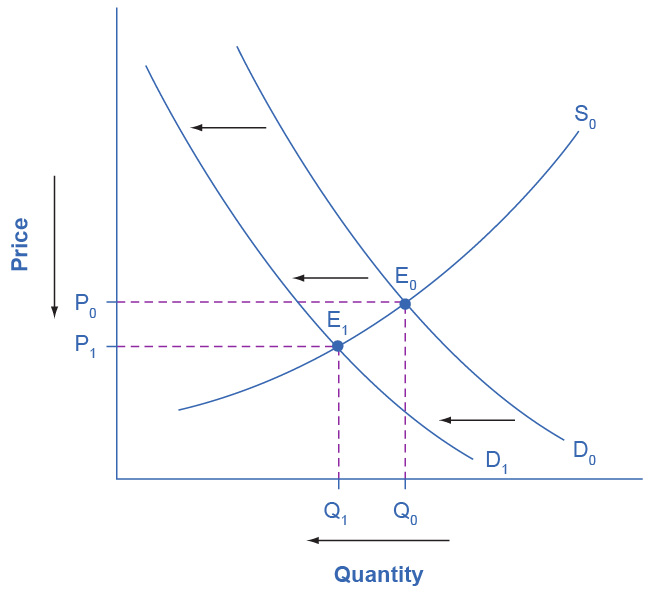
Figure 3.17図 3.17
A change in tastes from print news sources to digital sources results in a leftward shift in demand for the former. The result is a decrease in both equilibrium price and quantity.
英語のヒント
嗜好が紙のニュースからデジタル媒体へ移ると、紙のニュースへの需要は左へシフトする。その結果、均衡価格と均衡数量はともに低下する。
Step 1. Develop a demand and supply model to think about what the market looked like before the event. The demand curve D0 and the supply curve S0 show the original relationships. In this case, we perform the analysis without specific numbers on the price and quantity axis.
英語のヒント
手順1:出来事が起きる前の市場を考えるため、需要・供給モデルを作る。需要曲線D0と供給曲線S0が元の関係を示す。この例では、価格軸と数量軸に具体的な数値を置かずに分析する。
Step 2. Did the described change affect supply or demand? A change in tastes, from traditional news sources (print, radio, and television) to digital sources, caused a change in demand for the former.
英語のヒント
手順2:この変化は需要と供給のどちらに影響したか。嗜好が紙・ラジオ・テレビという従来のニュース源からデジタル媒体へ移り、前者への需要が変わった。
Step 3. Was the effect on demand positive or negative? A shift to digital news sources will tend to mean a lower quantity demanded of traditional news sources at every given price, causing the demand curve for print and other traditional news sources to shift to the left, from D0 to D1.
英語のヒント
手順3:需要への影響は正か、負か。デジタルのニュース源への移行は、各価格での従来のニュース源の需要量を減らす傾向がある。そのため、紙など従来のニュース源の需要曲線は、D0からD1へ左にシフトする。
Step 4. Compare the new equilibrium price and quantity to the original equilibrium price. The new equilibrium (E1) occurs at a lower quantity and a lower price than the original equilibrium (E0).
英語のヒント
手順4:新しい均衡価格と均衡数量を、元の均衡価格と比べる。新しい均衡E1では、元の均衡E0より数量が少なく、価格も低い。
The decline in print news reading predates 2004. Print newspaper circulation peaked in 1973 and has declined since then due to competition from television and radio news. In 1991, 55% of Americans indicated they received their news from print sources, while only 29% did so in 2012. Radio news has followed a similar path in recent decades, with the share of Americans obtaining their news from radio declining from 54% in 1991 to 33% in 2012. Television news has held its own in recent years, with a market share staying in the mid to upper fifties. What does this suggest for the future, given that two-thirds of Americans under 30 years old say they do not obtain their news from television at all?
英語のヒント
紙のニュースを読む人の減少は、2004年より前から始まっていた。紙の新聞の発行部数は1973年をピークに、テレビやラジオのニュースとの競争によって減ってきた。1991年には米国人の55%が紙媒体からニュースを得ると答えたが、2012年には29%だけだった。ラジオのニュースも近年、同じような道をたどり、利用者の割合は1991年の54%から2012年の33%に下がった。テレビのニュースは近年、市場シェア50%台半ばから後半を保っている。しかし、30歳未満の米国人の3分の2が、テレビからはまったくニュースを得ないと答えていることを踏まえると、将来について何が示唆されるだろうか。
The Interconnections and Speed of Adjustment in Real Markets現実の市場における相互関係と調整の速さ
In the real world, many factors that affect demand and supply can change all at once. For example, the demand for cars might increase because of rising incomes and population, and it might decrease because of rising gasoline prices (a complementary good). Likewise, the supply of cars might increase because of innovative new technologies that reduce the cost of car production, and it might decrease as a result of new government regulations requiring the installation of costly pollution-control technology.
英語のヒント
現実には、需要と供給に影響する多くの要因が一度に変わりうる。例えば、自動車需要は所得や人口の増加で増えるかもしれないが、補完財であるガソリンの値上がりで減るかもしれない。同様に、自動車の供給は、生産費用を下げる革新的な技術で増えるかもしれないが、高価な公害防止技術の導入を義務付ける新しい政府規制で減るかもしれない。
Moreover, rising incomes and population or changes in gasoline prices will affect many markets, not just cars. How can an economist sort out all these interconnected events? The answer lies in the ceteris paribus assumption. Look at how each economic event affects each market, one event at a time, holding all else constant. Then combine the analyses to see the net effect.
英語のヒント
さらに、所得や人口の増加、ガソリン価格の変化は、自動車だけでなく多くの市場に影響する。経済学者は、こうした相互につながる出来事をどう整理できるだろうか。答えはセテリス・パリブスの仮定にある。ほかの条件をすべて一定にして、一つの出来事が各市場に与える影響を一つずつ調べる。その後、分析を組み合わせて全体としての効果を見る。
A Combined Example二つの変化を組み合わせた例
The U.S. Postal Service is facing difficult challenges. Compensation for postal workers tends to increase most years due to cost-of-living increases. At the same time, increasingly more people are using email, text, and other digital message forms such as Facebook and Twitter to communicate with friends and others. What does this suggest about the continued viability of the Postal Service? Figure 3.18 and the text below illustrate this using the four-step analysis to answer this question.
英語のヒント
米国郵便公社は厳しい課題に直面している。生活費の上昇により、郵便職員への報酬は、ほとんど毎年増える傾向にある。同時に、友人などとの連絡に、電子メール、テキストメッセージ、FacebookやTwitterなどのデジタルな通信手段を使う人が増えている。これは、郵便公社の事業継続の可能性について何を意味するだろうか。図3.18と以下の説明では、四つの手順でこの問いに答える。
Higher Compensation for Postal Workers: A Four-Step Analysis郵便職員の報酬増加――四つの手順による分析
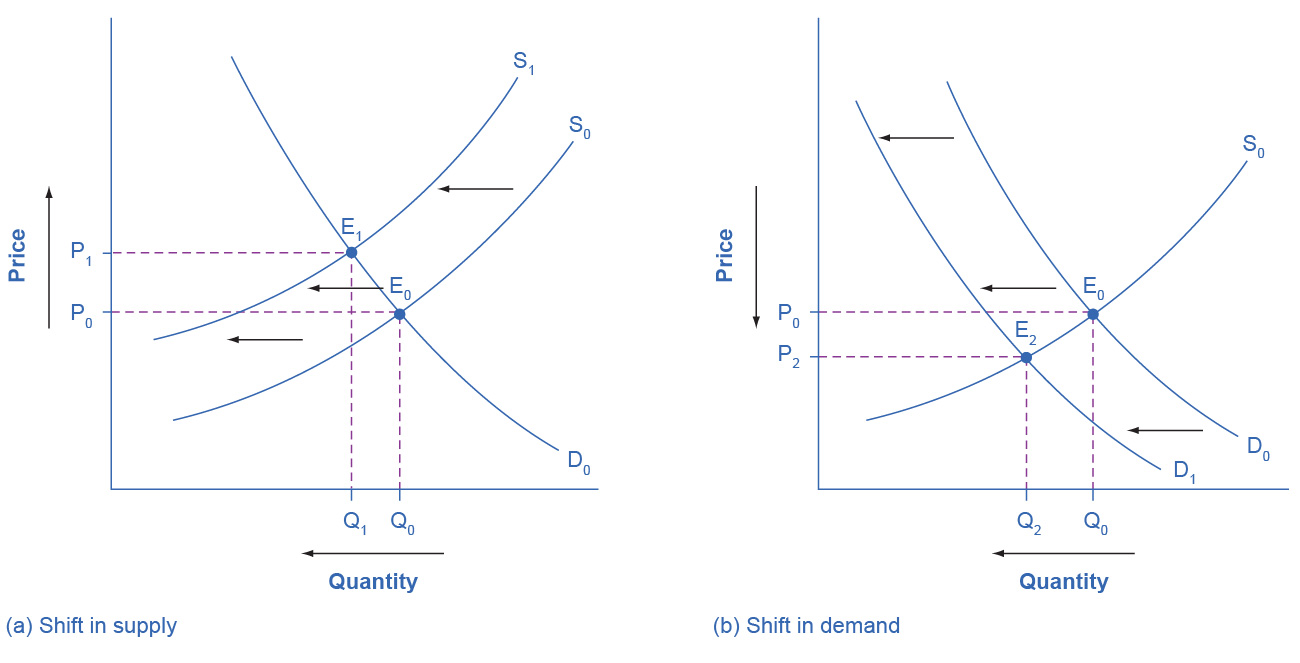
Figure 3.18図 3.18
(a) Higher labor compensation causes a leftward shift in the supply curve, a decrease in the equilibrium quantity, and an increase in the equilibrium price. (b) A change in tastes away from Postal Services causes a leftward shift in the demand curve, a decrease in the equilibrium quantity, and a decrease in the equilibrium price.
英語のヒント
(a)労働への報酬が増えると、供給曲線が左へシフトし、均衡数量は減り、均衡価格は上がる。(b)郵便サービスから離れる嗜好の変化は、需要曲線を左へシフトさせ、均衡数量と均衡価格をともに下げる。
Since this problem involves two disturbances, we need two four-step analyses, the first to analyze the effects of higher compensation for postal workers, the second to analyze the effects of many people switching from “snail mail” to email and other digital messages.
英語のヒント
この問題には二つの変化があるので、四つの手順による分析を二回行う必要がある。第一は郵便職員の報酬増加の影響、第二は多くの人が「カタツムリの郵便」、つまり従来の郵便から電子メールなどのデジタル通信へ切り替える影響を分析する。
Figure 3.18 (a) shows the shift in supply discussed in the following steps.
英語のヒント
図3.18(a)は、以下の手順で説明する供給のシフトを示す。
Step 1. Draw a demand and supply model to illustrate what the market for the U.S. Postal Service looked like before this scenario starts. The demand curve D0 and the supply curve S0 show the original relationships.
英語のヒント
手順1:この状況が起きる前の米国郵便公社の市場を、需要・供給モデルで描く。需要曲線D0と供給曲線S0が元の関係を示す。
Step 2. Did the described change affect supply or demand? Labor compensation is a cost of production. A change in production costs caused a change in supply for the Postal Service.
英語のヒント
手順2:この変化は需要と供給のどちらに影響したか。労働への報酬は生産費用である。生産費用の変化が、郵便サービスの供給を変えた。
Step 3. Was the effect on supply positive or negative? Higher labor compensation leads to a lower quantity supplied of postal services at every given price, causing the supply curve for postal services to shift to the left, from S0 to S1.
英語のヒント
手順3:供給への影響は正か、負か。労働への報酬増加は、各価格での郵便サービスの供給量を減らす。そのため、供給曲線はS0からS1へ左にシフトする。
Step 4. Compare the new equilibrium price and quantity to the original equilibrium price. The new equilibrium (E1) occurs at a lower quantity and a higher price than the original equilibrium (E0).
英語のヒント
手順4:新しい均衡価格と均衡数量を、元の均衡価格と比べる。新しい均衡E1では、元の均衡E0より数量が少なく、価格が高い。
Step 1. Draw a demand and supply model to illustrate what the market for U.S. Postal Services looked like before this scenario starts. The demand curve D0 and the supply curve S0 show the original relationships. Note that this diagram is independent from the diagram in panel (a).
英語のヒント
手順1:この状況が起きる前の米国の郵便サービス市場を、需要・供給モデルで描く。需要曲線D0と供給曲線S0が元の関係を示す。この図は(a)の図とは別のものであることに注意しよう。
Step 2. Did the change described affect supply or demand? A change in tastes away from snail mail toward digital messages will cause a change in demand for the Postal Service.
英語のヒント
手順2:この変化は需要と供給のどちらに影響したか。嗜好が従来の郵便からデジタル通信へ移ることで、郵便サービスの需要が変わる。
Step 3. Was the effect on demand positive or negative? A change in tastes away from snailmail toward digital messages causes lower quantity demanded of postal services at every given price, causing the demand curve for postal services to shift to the left, from D0 to D1.
英語のヒント
手順3:需要への影響は正か、負か。従来の郵便からデジタル通信へ嗜好が移ると、各価格での郵便サービスの需要量が減る。そのため、需要曲線はD0からD1へ左にシフトする。
Step 4. Compare the new equilibrium price and quantity to the original equilibrium price. The new equilibrium (E2) occurs at a lower quantity and a lower price than the original equilibrium (E0).
英語のヒント
手順4:新しい均衡価格と均衡数量を、元の均衡価格と比べる。新しい均衡E2では、元の均衡E0より数量が少なく、価格も低い。
The final step in a scenario where both supply and demand shift is to combine the two individual analyses to determine what happens to the equilibrium quantity and price. Graphically, we superimpose the previous two diagrams one on top of the other, as in Figure 3.19.
英語のヒント
需要と供給がともにシフトする場合、最後に二つの個別分析を組み合わせ、均衡数量と均衡価格がどうなるかを求める。グラフでは、図3.19のように、先ほどの二つの図を重ね合わせる。
Combined Effect of Decreased Demand and Decreased Supply需要減少と供給減少の複合的な効果
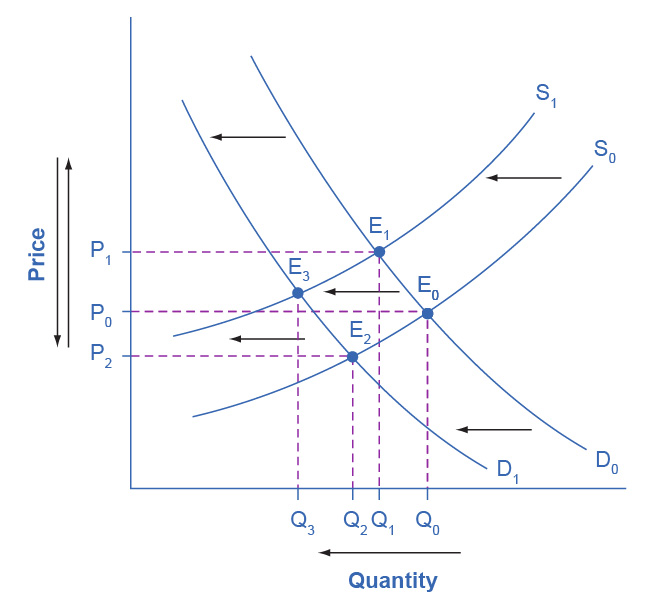


Figure 3.19図 3.19
Supply and demand shifts cause changes in equilibrium price and quantity.
英語のヒント
需要と供給のシフトが、均衡価格と均衡数量を変える。
Following are the results:
英語のヒント
結果は次のとおりである。
Effect on Quantity: The effect of higher labor compensation on Postal Services because it raises the cost of production is to decrease the equilibrium quantity. The effect of a change in tastes away from snail mail is to decrease the equilibrium quantity. Since both shifts are to the left, the overall impact is a decrease in the equilibrium quantity of Postal Services (Q3). This is easy to see graphically, since Q3 is to the left of Q0.
英語のヒント
数量への効果:郵便職員の報酬増加は、生産費用を高めるため、均衡数量を減らす。従来の郵便から離れる嗜好の変化も、均衡数量を減らす。両方のシフトが左向きなので、全体として郵便サービスの均衡数量Q3は減る。グラフでも、Q3がQ0の左にあるので、容易に確認できる。
Effect on Price: The overall effect on price is more complicated. The effect of higher labor compensation on Postal Services, because it raises the cost of production, is to increase the equilibrium price. The effect of a change in tastes away from snail mail is to decrease the equilibrium price. Since the two effects are in opposite directions, unless we know the magnitudes of the two effects, the overall effect is unclear. This is not unusual. When both curves shift, typically we can determine the overall effect on price or on quantity, but not on both. In this case, we determined the overall effect on the equilibrium quantity, but not on the equilibrium price. In other cases, it might be the opposite.
英語のヒント
価格への効果:価格への全体的な影響は、より複雑である。郵便職員の報酬増加は、生産費用を高めるため、均衡価格を上げる。従来の郵便から離れる嗜好の変化は、均衡価格を下げる。二つの効果が逆向きなので、それぞれの大きさがわからなければ、全体的な効果は不明である。これは珍しいことではない。両方の曲線がシフトすると、通常、価格か数量のどちらかについては全体的な効果を判断できるが、両方は判断できない。この例では均衡数量への全体的な効果は求められたが、均衡価格への効果は求められなかった。別の例では、逆になることもある。
The next Clear It Up feature focuses on the difference between shifts of supply or demand and movements along a curve.
英語のヒント
次の「疑問を解消」では、需要・供給のシフトと、曲線に沿った移動の違いに注目する。