第3章需要と供給
Price Floors価格下限
A price floor is the lowest price that one can legally pay for some good or service. Perhaps the best-known example of a price floor is the minimum wage, which is based on the view that someone working full time should be able to afford a basic standard of living. The federal minimum wage in 2022 was $7.25 per hour, although some states and localities have a higher minimum wage. The federal minimum wage yields an annual income for a single person of $15,080, which is slightly higher than the Federal poverty line of $11,880. Congress periodically raises the federal minimum wage as the cost of living rises. As of March 2022, the most recent adjustment occurred in 2009, when the federal minimum wage was raised from $6.55 to $7.25.
英語のヒント
価格下限は、財・サービスに対して法律上支払える最低価格である。最もよく知られた例は、おそらく最低賃金だろう。フルタイムで働く人は、基本的な生活水準を賄えるべきだという考えに基づく。2022年の連邦最低賃金は時給7.25ドルだったが、一部の州や地方では、より高い水準を定めている。連邦最低賃金で働く単身者の年収は15,080ドルとなり、連邦の貧困線11,880ドルをやや上回る。議会は生活費の上昇に応じて定期的に最低賃金を引き上げる。2022年3月時点での直近の改定は2009年で、時給6.55ドルから7.25ドルへ引き上げられた。
Price floors are sometimes called “price supports,” because they support a price by preventing it from falling below a certain level. Around the world, many countries have passed laws to create agricultural price supports. Farm prices and thus farm incomes fluctuate, sometimes widely. Even if, on average, farm incomes are adequate, some years they can be quite low. The purpose of price supports is to prevent these swings.
英語のヒント
価格下限は、一定水準以下への下落を防いで価格を支えるため、「価格支持」とも呼ばれる。世界の多くの国が、農産物の価格支持制度を設ける法律を制定してきた。農産物価格と、それによって決まる農家の所得は、時に大きく変動する。平均では十分な所得でも、年によって非常に低くなることがある。価格支持の目的は、この変動を防ぐことにある。
The most common way price supports work is that the government enters the market and buys up the product, adding to demand to keep prices higher than they otherwise would be. According to the Common Agricultural Policy reform effective in 2019, the European Union (EU) will spend about 58 billion euros per year, or 65.5 billion dollars per year (with the December 2021 exchange rate), or roughly 36% of the EU budget, on price supports for Europe’s farmers.
英語のヒント
価格支持の最も一般的な仕組みは、政府が市場に参加して製品を買い上げ、需要を増やして、介入しない場合より価格を高く保つことである。2019年に発効した共通農業政策改革によれば、欧州連合(EU)は、欧州の農家への価格支持に年約580億ユーロを使う。2021年12月の為替レートでは年655億ドル、EU予算のおよそ36%に当たる。
Figure 3.22 illustrates the effects of a government program that assures a price above the equilibrium by focusing on the market for wheat in Europe. In the absence of government intervention, the price would adjust so that the quantity supplied would equal the quantity demanded at the equilibrium point E0, with price P0 and quantity Q0. However, policies to keep prices high for farmers keep the price above what would have been the market equilibrium level—the price Pf shown by the dashed horizontal line in the diagram. The result is a quantity supplied in excess of the quantity demanded (Qd). When quantity supplied exceeds quantity demanded, a surplus exists.
英語のヒント
図3.22は、欧州の小麦市場を例に、均衡より高い価格を保証する政府事業の効果を示す。政府の介入がなければ、価格は調整され、均衡点E0で供給量と需要量が等しくなる。その価格はP0、数量はQ0である。しかし、農家のために価格を高く保つ政策は、市場均衡となるはずの水準を上回る価格を維持する。図の水平な破線のPfがそれである。その結果、供給量は需要量Qdを上回る。供給量が需要量を超えると、余剰が生じる。
Economists estimate that the high-income areas of the world, including the United States, Europe, and Japan, spend roughly $1 billion per day in supporting their farmers. If the government is willing to purchase the excess supply (or to provide payments for others to purchase it), then farmers will benefit from the price floor, but taxpayers and consumers of food will pay the costs. Agricultural economists and policy makers have offered numerous proposals for reducing farm subsidies. In many countries, however, political support for subsidies for farmers remains strong. This is either because the population views this as supporting the traditional rural way of life or because of industry's lobbying power of the agro-business.
英語のヒント
経済学者の推計では、米国、欧州、日本など世界の高所得地域は、農家支援に1日約10億ドルを使っている。政府が超過供給を買い上げるか、ほかの人が買うための資金を提供するなら、農家は価格下限から利益を得る。しかし、その費用は納税者と食料の消費者が負担する。農業経済学者や政策担当者は、農業補助金を減らす多くの提案をしてきた。それでも多くの国で、農家への補助金に対する政治的支持は根強い。人々が伝統的な農村の暮らしを支える政策と捉えるため、あるいは農業関連産業のロビー活動の力によるものである。
European Wheat Prices: A Price Floor Example欧州の小麦価格――価格下限の例
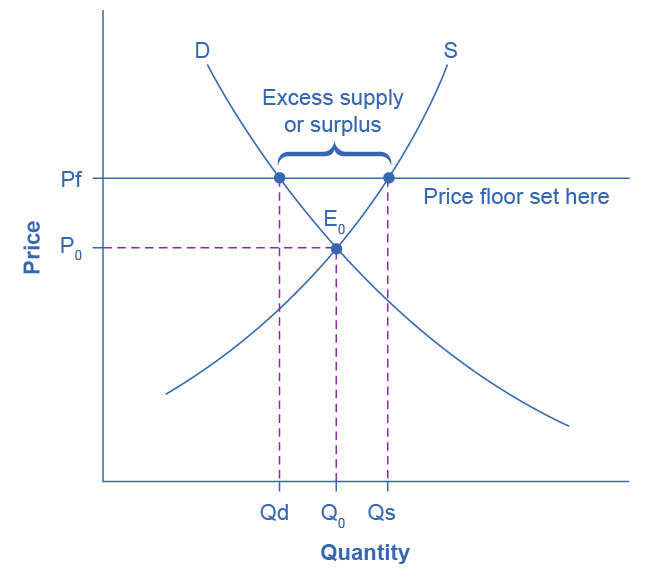

Figure 3.22図 3.22
The intersection of demand (D) and supply (S) would be at the equilibrium point E0. However, a price floor set at Pf holds the price above E0 and prevents it from falling. The result of the price floor is that the quantity supplied Qs exceeds the quantity demanded Qd. There is excess supply, also called a surplus.
英語のヒント
需要Dと供給Sの交点は、均衡点E0となるはずである。しかし、Pfに設定された価格下限が、価格をE0より高く保ち、下落を防ぐ。その結果、供給量Qsが需要量Qdを上回り、超過供給、すなわち余剰が生じる。
Key Concepts and Summary重要概念とまとめ
Price ceilings prevent a price from rising above a certain level. When a price ceiling is set below the equilibrium price, quantity demanded will exceed quantity supplied, and excess demand or shortages will result. Price floors prevent a price from falling below a certain level. When a price floor is set above the equilibrium price, quantity supplied will exceed quantity demanded, and excess supply or surpluses will result. Price floors and price ceilings often lead to unintended consequences.
英語のヒント
価格上限は、価格が一定水準より上がるのを防ぐ。均衡価格より低い上限を設定すると、需要量が供給量を上回り、超過需要、すなわち不足が生じる。価格下限は、価格が一定水準より下がるのを防ぐ。均衡価格より高い下限を設定すると、供給量が需要量を上回り、超過供給、すなわち余剰が生じる。価格上限と価格下限は、しばしば意図しない結果をもたらす。
Self-Check Questions理解度確認問題
Exercises 37–39練習問題 37–39
Exercise 37問題 37
What is the effect of a price ceiling on the quantity demanded of the product? What is the effect of a price ceiling on the quantity supplied? Why exactly does a price ceiling cause a shortage?
英語のヒント
価格上限は製品の需要量にどう影響するか。供給量にはどう影響するか。具体的に、なぜ不足を生むのか。
Solution解き方
A price ceiling (which is below the equilibrium price) will cause the quantity demanded to rise and the quantity supplied to fall. This is why a price ceiling creates a shortage.
英語のヒント
均衡価格より低い価格上限は、需要量を増やし、供給量を減らす。そのため不足を生む。
Exercise 38問題 38
Does a price ceiling change the equilibrium price?
英語のヒント
価格上限は均衡価格を変えるか。
Solution解き方
A price ceiling is just a legal restriction. Equilibrium is an economic condition. People may or may not obey the price ceiling, so the actual price may be at or above the price ceiling, but the price ceiling does not change the equilibrium price.
英語のヒント
価格上限は法的な制限にすぎず、均衡は経済的な状態である。人々が上限を守る場合も守らない場合もあるので、実際の価格は上限と同じか、それより高いかもしれない。しかし、価格上限は均衡価格を変えない。
Exercise 39問題 39
What would be the impact of imposing a price floor below the equilibrium price?
英語のヒント
均衡価格より低い価格下限を設けると、どのような影響があるか。
Solution解き方
A price ceiling is a legal maximum price, but a price floor is a legal minimum price and, consequently, it would leave room for the price to rise to its equilibrium level. In other words, a price floor below equilibrium will not be binding and will have no effect.
英語のヒント
価格上限は法定の最高価格だが、価格下限は法定の最低価格である。そのため、価格が均衡水準まで上がる余地がある。つまり、均衡を下回る価格下限は拘束力を持たず、影響を与えない。