第41章浸透圧調節と排泄
41.5 Hormonal Control of Osmoregulatory Functions41.5 浸透圧調節機能のホルモン制御
Learning Objectives学習目標
By the end of this section, you will be able to do the following:
この節を学ぶと、次のことができるようになる。
- Explain how hormonal cues help the kidneys synchronize the osmotic needs of the bodyホルモンの合図により、腎臓が体の浸透圧に関する必要をどのように整合させるかを説明する。
- Describe how hormones like epinephrine, norepinephrine, renin-angiotensin, aldosterone, anti-diuretic hormone, and atrial natriuretic peptide help regulate waste elimination, maintain correct osmolarity, and perform other osmoregulatory functionsエピネフリン、ノルエピネフリン、レニン・アンジオテンシン、アルドステロン、抗利尿ホルモン、心房性ナトリウム利尿ペプチドなどが、老廃物の除去の調節、適切な浸透圧濃度の維持、その他の浸透圧調節機能にどう役立つかを説明する。
While the kidneys operate to maintain osmotic balance and blood pressure in the body, they also act in concert with hormones. Hormones are small molecules that act as messengers within the body. Hormones are typically secreted from one cell and travel in the bloodstream to affect a target cell in another portion of the body. Different regions of the nephron bear specialized cells that have receptors to respond to chemical messengers and hormones. Table 41.1 summarizes the hormones that control the osmoregulatory functions.
英語のヒント
腎臓は体内の浸透圧平衡と血圧を保つ働きをするとともに、ホルモンとも連携する。ホルモンは、体内で伝令として働く小さな分子である。通常、ある細胞から分泌され、血流に乗って移動し、体の別の場所にある標的細胞に作用する。ネフロンのさまざまな領域には、化学的な伝達物質やホルモンに応答する受容体を備えた特殊な細胞がある。浸透圧調節機能を制御するホルモンを、表41.1にまとめる。
Hormones That Affect Osmoregulation 浸透圧調節に影響するホルモン |
||
|---|---|---|
Hormone ホルモン |
Where produced 産生される場所 |
Function 機能 |
Epinephrine and Norepinephrine エピネフリンとノルエピネフリン |
Adrenal medulla 副腎髄質 |
Can decrease kidney function temporarily by vasoconstriction 血管収縮により、腎機能を一時的に低下させることがある |
Renin レニン |
Kidney nephrons 腎臓のネフロン |
Increases blood pressure by acting on angiotensinogen アンジオテンシノーゲンに作用して血圧を上げる |
Angiotensin アンジオテンシン |
Liver 肝臓 |
Angiotensin II affects multiple processes and increases blood pressure アンジオテンシンIIは複数の過程に作用し、血圧を上げる |
Aldosterone アルドステロン |
Adrenal cortex 副腎皮質 |
Prevents loss of sodium and water ナトリウムと水の喪失を防ぐ |
Anti-diuretic hormone (vasopressin) 抗利尿ホルモン(バソプレシン) |
Hypothalamus (stored in the posterior pituitary) 視床下部(下垂体後葉に貯蔵される) |
Prevents water loss 水の喪失を防ぐ |
Atrial natriuretic peptide 心房性ナトリウム利尿ペプチド |
Heart atrium 心房 |
Decreases blood pressure by acting as a vasodilator and increasing glomerular filtration rate; decreases sodium reabsorption in kidneys 血管拡張作用と糸球体濾過量の増加によって血圧を下げる。腎臓でのナトリウム再吸収を減らす |
Epinephrine and Norepinephrineエピネフリンとノルエピネフリン
Epinephrine and norepinephrine are synthesized by the adrenal medulla. They are the flight/fight hormones that are released when the body is under extreme stress. During stress, much of the body’s energy is used to combat imminent danger. Kidney function is halted temporarily by epinephrine and norepinephrine. These hormones function by acting directly on the smooth muscles of blood vessels to constrict them. Once the afferent arterioles are constricted, blood flow into the nephrons stops. These hormones go one step further and trigger the renin-angiotensin-aldosterone system.
英語のヒント
エピネフリンとノルエピネフリンは、副腎髄質で合成される。体が極度のストレスを受けたときに放出される、逃走・闘争のホルモンである。ストレス下では、体のエネルギーの多くが差し迫った危険への対処に使われる。エピネフリンとノルエピネフリンにより、腎機能は一時的に停止する。これらのホルモンは血管の平滑筋に直接作用し、血管を収縮させる。輸入細動脈が収縮すると、ネフロンへの血流が止まる。さらに一歩進んで、レニン・アンジオテンシン・アルドステロン系も作動させる。
Renin-Angiotensin-Aldosteroneレニン・アンジオテンシン・アルドステロン系
The renin-angiotensin-aldosterone system, illustrated in Figure 41.15 proceeds through several steps to produce angiotensin II, which acts to stabilize blood pressure and volume. Renin (secreted by a part of the juxtaglomerular complex) is produced by the granular cells of the afferent and efferent arterioles. Thus, the kidneys control blood pressure and volume directly. Renin acts on angiotensinogen, which is made in the liver and converts it to angiotensin I. Angiotensin converting enzyme (ACE) converts angiotensin I to angiotensin II. Angiotensin II raises blood pressure by constricting blood vessels. It also triggers the release of the mineralocorticoid aldosterone from the adrenal cortex, which in turn stimulates the renal tubules to reabsorb more sodium. Angiotensin II also triggers the release of anti-diuretic hormone (ADH) from the hypothalamus, leading to water retention in the kidneys. It acts directly on the nephrons and decreases glomerular filtration rate. Medically, blood pressure can be controlled by drugs that inhibit ACE (called ACE inhibitors).
英語のヒント
図41.15に示すレニン・アンジオテンシン・アルドステロン系は、いくつかの段階を経てアンジオテンシンIIを作る。アンジオテンシンIIは、血圧と血液量を安定させる。レニン(傍糸球体装置の一部から分泌される)は、輸入細動脈と輸出細動脈の顆粒細胞によって作られる。このように、腎臓は血圧と血液量を直接制御する。レニンは肝臓で作られるアンジオテンシノーゲンに作用し、それをアンジオテンシンIへ変換する。アンジオテンシン変換酵素(ACE)は、アンジオテンシンIをアンジオテンシンIIへ変換する。アンジオテンシンIIは血管を収縮させて血圧を上げる。また、副腎皮質から鉱質コルチコイドのアルドステロンを放出させ、今度はアルドステロンが尿細管を刺激して、ナトリウムをより多く再吸収させる。アンジオテンシンIIは、視床下部からの抗利尿ホルモン(ADH)の放出も引き起こし、腎臓で水が保持されるようにする。ネフロンにも直接作用し、糸球体濾過量を下げる。医療では、ACEを阻害する薬(ACE阻害薬)によって血圧を制御できる。
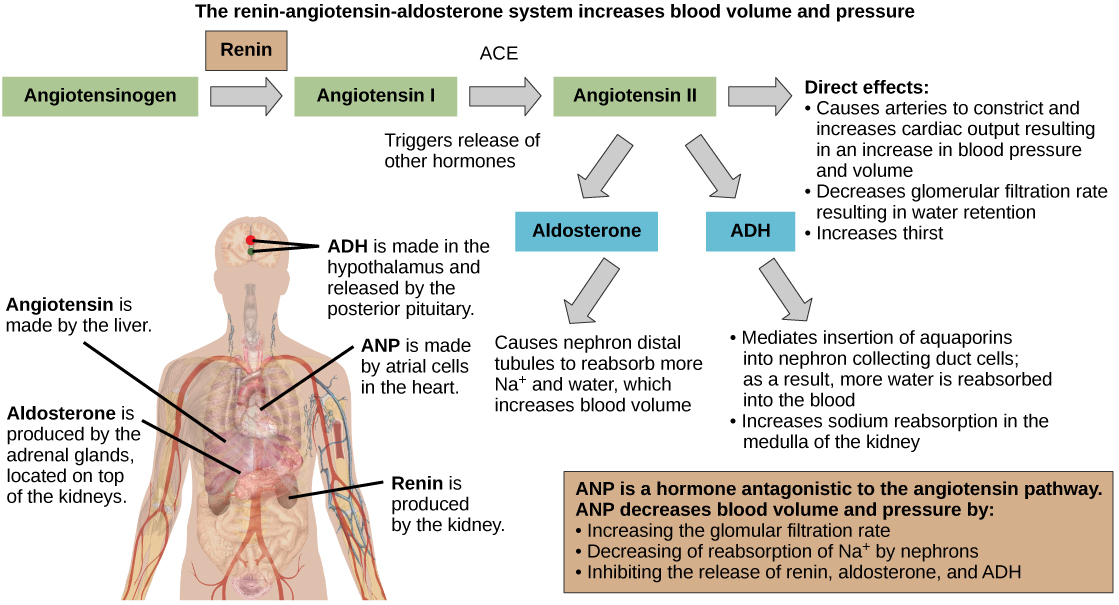
OpenStax, Rice University; Biology 2e. (credit: modification of work by Mikael Häggström) · CC BY 4.0 · Source出典

Figure 41.15図 41.15
The renin-angiotensin-aldosterone system increases blood pressure and volume. The hormone ANP has antagonistic effects. (credit: modification of work by Mikael Häggström)
レニン・アンジオテンシン・アルドステロン系は、血圧と血液量を増加させる。ANPというホルモンは、それと拮抗する作用をもつ。(出典:Mikael Häggströmの作品を改変)
Mineralocorticoids鉱質コルチコイド
Mineralocorticoids are hormones synthesized by the adrenal cortex that affect osmotic balance. Aldosterone is a mineralocorticoid that regulates sodium levels in the blood. Almost all of the sodium in the blood is reclaimed by the renal tubules under the influence of aldosterone. Because sodium is always reabsorbed by active transport and water follows sodium to maintain osmotic balance, aldosterone manages not only sodium levels but also the water levels in body fluids. In contrast, the aldosterone also stimulates potassium secretion concurrently with sodium reabsorption. In contrast, absence of aldosterone means that no sodium gets reabsorbed in the renal tubules and all of it gets excreted in the urine. In addition, the daily dietary potassium load is not secreted and the retention of K+ can cause a dangerous increase in plasma K+ concentration. Patients who have Addison's disease have a failing adrenal cortex and cannot produce aldosterone. They lose sodium in their urine constantly, and if the supply is not replenished, the consequences can be fatal.
英語のヒント
鉱質コルチコイドは副腎皮質で合成されるホルモンで、浸透圧平衡に影響する。アルドステロンは、血液中のナトリウム濃度を調節する鉱質コルチコイドである。血液中のナトリウムのほとんどすべてが、アルドステロンの作用のもとで尿細管によって回収される。ナトリウムは常に能動輸送で再吸収され、浸透圧平衡を保つために水が後に続くので、アルドステロンはナトリウム濃度だけでなく体液中の水分量も調節する。一方、ナトリウムの再吸収と同時に、カリウムの分泌も促す。これに対し、アルドステロンがないと、尿細管でナトリウムがまったく再吸収されず、すべて尿中に排泄される。さらに、毎日の食事から摂取したカリウムが分泌されず、K+の貯留によって血漿中のK+濃度が危険なほど上がることがある。アジソン病の患者では副腎皮質の機能が低下しており、アルドステロンを作れない。尿から絶えずナトリウムを失うため、補給されなければ致命的な結果になり得る。