第41章浸透圧調節と排泄
Concept of Osmolality and Milliequivalent質量浸透圧濃度とミリ当量の概念
In order to calculate osmotic pressure, it is necessary to understand how solute concentrations are measured. The unit for measuring solutes is the mole. One mole is defined as the gram molecular weight of the solute. For example, the molecular weight of sodium chloride is 58.44. Thus, one mole of sodium chloride weighs 58.44 grams. The molarity of a solution is the number of moles of solute per liter of solution. The molality of a solution is the number of moles of solute per kilogram of solvent. If the solvent is water, one kilogram of water is equal to one liter of water. While molarity and molality are used to express the concentration of solutions, electrolyte concentrations are usually expressed in terms of milliequivalents per liter (mEq/L): the mEq/L is equal to the ion concentration (in millimoles) multiplied by the number of electrical charges on the ion. The unit of milliequivalent takes into consideration the ions present in the solution (since electrolytes form ions in aqueous solutions) and the charge on the ions.
英語のヒント
浸透圧を計算するには、溶質の濃度がどのように測られるかを理解する必要がある。溶質の量を測る単位はモルである。1モルは、溶質のグラム分子量として定義される。例えば塩化ナトリウムの分子量は58.44なので、塩化ナトリウム1モルは58.44グラムである。溶液のモル濃度は、溶液1リットルあたりの溶質のモル数である。溶液の質量モル濃度は、溶媒1キログラムあたりの溶質のモル数である。溶媒が水なら、水1キログラムは水1リットルに相当する。溶液の濃度を表すにはモル濃度や質量モル濃度が用いられるが、電解質の濃度は通常、1リットルあたりのミリ当量(mEq/L)で表す。mEq/Lは、イオン濃度(ミリモル単位)に、そのイオンの電荷の数を掛けた値に等しい。ミリ当量という単位では、溶液中に存在するイオン(電解質は水溶液中でイオンになるため)と、イオンの電荷が考慮される。
Thus, for ions that have a charge of one, one milliequivalent is equal to one millimole. For ions that have a charge of two (like calcium), one milliequivalent is equal to 0.5 millimoles. Another unit for the expression of electrolyte concentration is the milliosmole (mOsm), which is the number of milliequivalents of solute per kilogram of solvent. Body fluids are usually maintained within the range of 280 to 300 mOsm.
英語のヒント
したがって、電荷の数が1のイオンでは、1ミリ当量は1ミリモルに等しい。電荷の数が2のイオン(カルシウムなど)では、1ミリ当量は0.5ミリモルに等しい。電解質濃度を表す別の単位としてミリオスモル(mOsm)があり、これは溶媒1キログラムあたりの溶質のミリ当量数である。体液は通常、280〜300 mOsmの範囲に保たれている。
Osmoregulators and Osmoconformers浸透圧調節型生物と浸透圧順応型生物
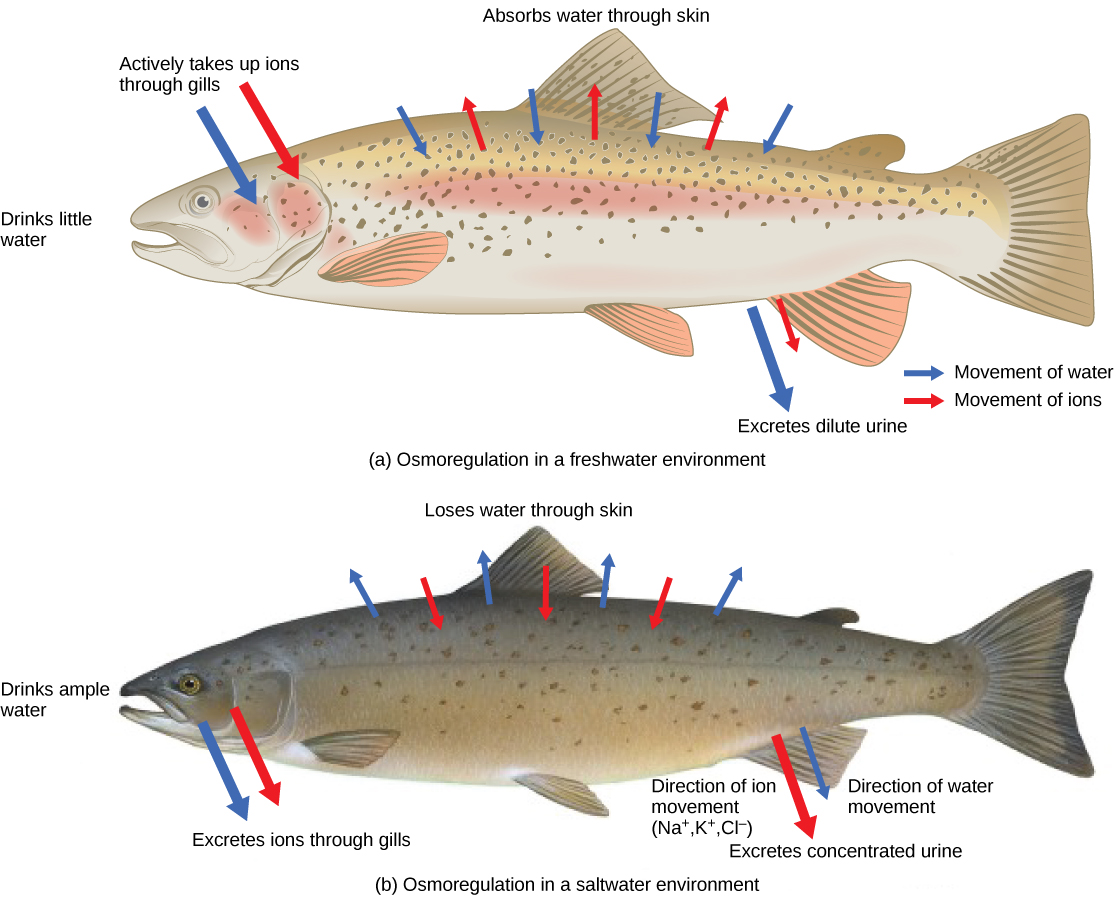
Persons lost at sea without any freshwater to drink are at risk of severe dehydration because the human body cannot adapt to drinking seawater, which is hypertonic in comparison to body fluids. Organisms such as goldfish that can tolerate only a relatively narrow range of salinity are referred to as stenohaline. About 90 percent of all bony fish are restricted to either freshwater or seawater. They are incapable of osmotic regulation in the opposite environment. It is possible, however, for a few fishes like salmon to spend part of their life in freshwater and part in seawater. Organisms like the salmon and molly that can tolerate a relatively wide range of salinity are referred to as euryhaline organisms. This is possible because some fish have evolved osmoregulatory mechanisms to survive in all kinds of aquatic environments. When they live in freshwater, their bodies tend to take up water because the environment is relatively hypotonic, as illustrated in Figure 41.3a. In such hypotonic environments, these fish do not drink much water. Instead, they pass a lot of very dilute urine, and they achieve electrolyte balance by active transport of salts through the gills. When they move to a hypertonic marine environment, these fish start drinking seawater; they excrete the excess salts through their gills and their urine, as illustrated in Figure 41.3b. Most marine invertebrates, on the other hand, may be isotonic with seawater (osmoconformers). Their body fluid concentrations conform to changes in seawater concentration. Cartilaginous fishes’ salt composition of the blood is similar to bony fishes; however, the blood of sharks contains the organic compounds urea and trimethylamine oxide (TMAO). This does not mean that their electrolyte composition is similar to that of seawater. They achieve isotonicity with the sea by storing large concentrations of urea. These animals that secrete urea are called ureotelic animals. TMAO stabilizes proteins in the presence of high urea levels, preventing the disruption of peptide bonds that would occur in other animals exposed to similar levels of urea. Sharks are cartilaginous fish with a rectal gland to secrete salt and assist in osmoregulation.
英語のヒント
飲める淡水を持たずに海上で遭難した人は、重い脱水症状を起こす危険がある。海水は体液に比べて高張であり、人間の体は海水を飲むことに適応できないためである。キンギョのように、比較的狭い範囲の塩分濃度にしか耐えられない生物を狭塩性という。硬骨魚類全体の約90%は、淡水か海水のどちらかでしか生きられず、反対の環境では浸透圧を調節できない。しかし、サケのような一部の魚は、一生の一部を淡水で、別の一部を海水で過ごせる。サケやモーリーのように、比較的広い範囲の塩分濃度に耐えられる生物を広塩性生物という。これは、さまざまな水生環境で生き残れる浸透圧調節の仕組みを進化させた魚がいるためである。淡水にいるときは、図41.3aのように環境が比較的低張なので、体に水が入りやすい。このような低張環境では、魚は水をあまり飲まない。代わりに非常に薄い尿を大量に排出し、えらを通して塩類を能動輸送することで、電解質のつり合いを保つ。高張の海水環境に移ると、海水を飲み始める。そして図41.3bのように、過剰な塩類をえらや尿から排泄する。これに対し、海生無脊椎動物の多くは海水と等張である場合がある(浸透圧順応型生物)。体液の濃度は、海水の濃度の変化に合わせて変わる。軟骨魚類の血液の塩類組成は硬骨魚類と似ているが、サメの血液には有機化合物である尿素とトリメチルアミンオキシド(TMAO)が含まれる。これは電解質の組成が海水と似ているという意味ではない。サメは尿素を高濃度に蓄えることで、海水と等張になる。尿素を排出するこのような動物を尿素排泄型動物という。TMAOは高濃度の尿素が存在してもタンパク質を安定させ、他の動物を同程度の尿素にさらすと起こるペプチド結合の破壊を防ぐ。サメは軟骨魚類であり、塩類を分泌して浸透圧調節を助ける直腸腺をもつ。
OpenStax, Rice University; Biology 2e. (credit: modification of work by Duane Raver, NOAA) · CC BY 4.0 · Source出典

Figure 41.3図 41.3
Fish are osmoregulators, but must use different mechanisms to survive in (a) freshwater or (b) saltwater environments. (credit: modification of work by Duane Raver, NOAA)
魚は浸透圧調節型生物だが、(a)淡水と(b)海水の環境で生きるには、それぞれ異なる仕組みを用いる必要がある。(出典:Duane Raver、NOAAの作品を改変)