第41章浸透圧調節と排泄
41.1 Osmoregulation and Osmotic Balance41.1 浸透圧調節と浸透圧平衡
Learning Objectives学習目標
By the end of this section, you will be able to do the following:
この節を学ぶと、次のことができるようになる。
- Define osmosis and explain its role within the body浸透を定義し、体内での役割を説明する。
- Explain why osmoregulation and osmotic balance are important body functions浸透圧調節と浸透圧平衡が重要な身体機能である理由を説明する。
- Describe active transport mechanisms能動輸送の仕組みを説明する。
- Explain osmolarity and the way in which it is measured浸透圧濃度と、その測定方法を説明する。
- Describe osmoregulators or osmoconformers and how these tools allow animals to adapt to different environments浸透圧調節型生物と浸透圧順応型生物について、また、これらの仕組みによって動物が異なる環境にどう適応するかを説明する。
Osmosis is the diffusion of water across a membrane in response to osmotic pressure caused by an imbalance of molecules on either side of the membrane. Osmoregulation is the process of maintenance of salt and water balance (osmotic balance) across membranes within the body’s fluids, which are composed of water, plus electrolytes and non-electrolytes. An electrolyte is a solute that dissociates into ions when dissolved in water. A non-electrolyte, in contrast, doesn’t dissociate into ions during water dissolution. Both electrolytes and non-electrolytes contribute to the osmotic balance. The body’s fluids include blood plasma, the cytosol within cells, and interstitial fluid, the fluid that exists in the spaces between cells and tissues of the body. The membranes of the body (such as the pleural, serous, and cell membranes) are semi-permeable membranes. Semi-permeable membranes are permeable (or permissive) to certain types of solutes and water. Solutions on two sides of a semi-permeable membrane tend to equalize in solute concentration by movement of solutes and/or water across the membrane. As seen in Figure 41.2, a cell placed in water tends to swell due to gain of water from the hypotonic or “low salt” environment. A cell placed in a solution with higher salt concentration, on the other hand, tends to make the membrane shrivel up due to loss of water into the hypertonic or “high salt” environment. Isotonic cells have an equal concentration of solutes inside and outside the cell; this equalizes the osmotic pressure on either side of the cell membrane which is a semi-permeable membrane.
英語のヒント
浸透とは、膜の両側の分子の不均衡によって生じる浸透圧に応じて、水が膜を通って拡散することである。浸透圧調節とは、水に電解質と非電解質が加わってできている体液において、膜を隔てた塩類と水のつり合い(浸透圧平衡)を維持する過程である。電解質とは、水に溶けるとイオンに解離する溶質である。これに対し、非電解質は水に溶けてもイオンに解離しない。電解質も非電解質も、浸透圧平衡に寄与する。体液には、血漿、細胞内の細胞質基質、そして細胞と組織の間の空間にある間質液が含まれる。体の膜(胸膜、漿膜、細胞膜など)は半透膜である。半透膜は、ある種類の溶質と水を通す。半透膜の両側にある溶液は、溶質や水が膜を通って移動することにより、溶質濃度が等しくなる傾向がある。図41.2に示すように、水中に置かれた細胞は、低張、すなわち「塩分の少ない」環境から水を取り込むため、膨らむ傾向がある。一方、塩分濃度の高い溶液に置かれた細胞は、高張、すなわち「塩分の多い」環境へ水を失うため、膜がしぼむ傾向がある。等張の細胞では、内外の溶質濃度が等しい。そのため、半透膜である細胞膜の両側の浸透圧が等しくなる。
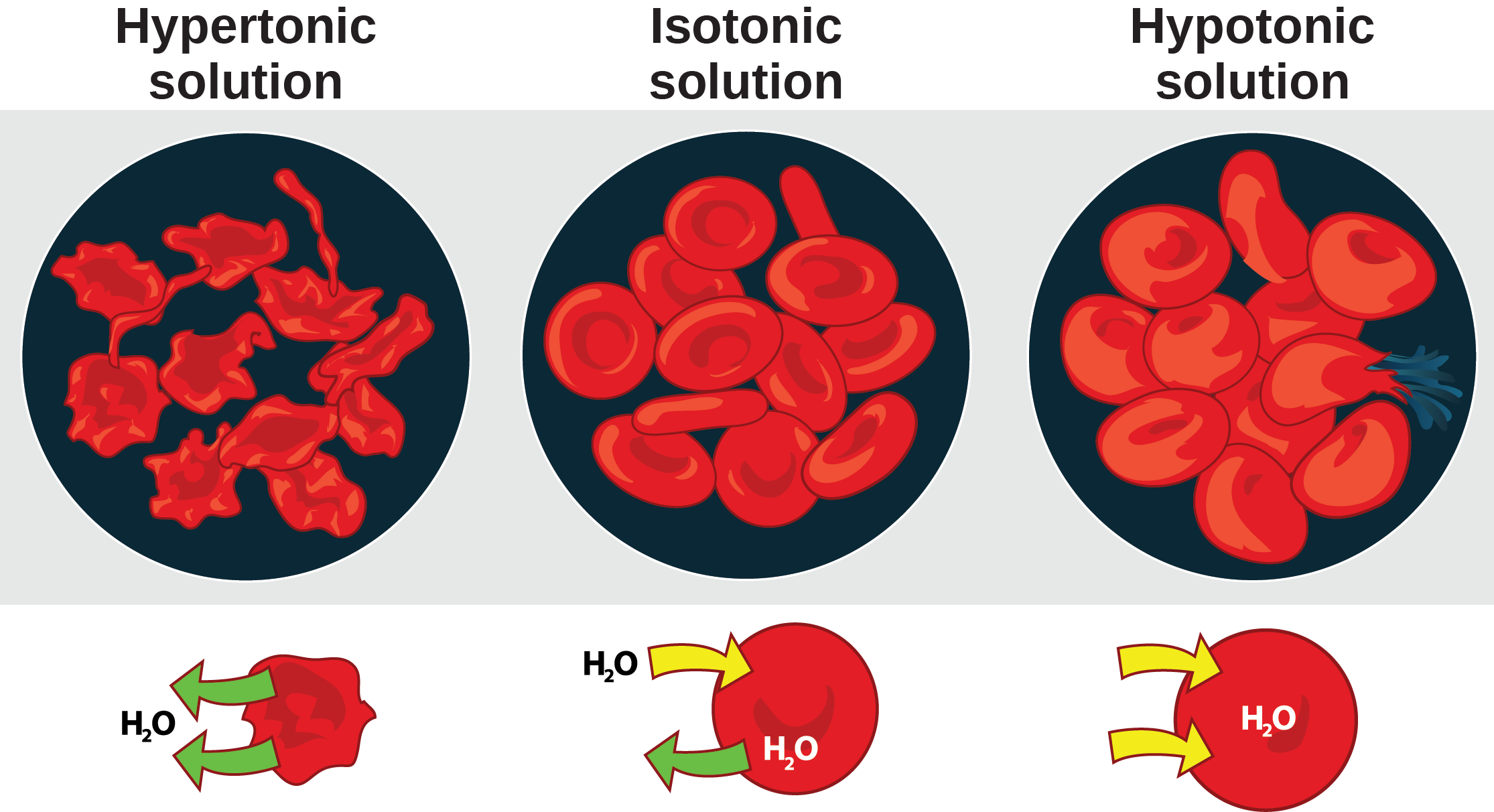

Figure 41.2図 41.2
Cells placed in a hypertonic environment tend to shrink due to loss of water. In a hypotonic environment, cells tend to swell due to intake of water. The blood maintains an isotonic environment so that cells neither shrink nor swell. (credit: Mariana Ruiz Villareal)
高張環境に置かれた細胞は、水を失って縮む傾向がある。低張環境では、水を取り込んで膨らむ傾向がある。血液は等張環境を維持し、細胞が縮んだり膨らんだりしないようにしている。(出典:Mariana Ruiz Villareal)
The body does not exist in isolation. There is a constant input of water and electrolytes into the system. While osmoregulation is achieved across membranes within the body, excess electrolytes and wastes are transported to the kidneys and excreted, helping to maintain osmotic balance.
英語のヒント
体は外界から切り離されて存在しているわけではない。水と電解質は絶えず体内に入ってくる。体内の膜を隔てて浸透圧が調節される一方、過剰な電解質と老廃物は腎臓に運ばれて排泄され、浸透圧平衡の維持に役立っている。
Need for Osmoregulation浸透圧調節の必要性
Biological systems constantly interact and exchange water and nutrients with the environment by way of consumption of food and water and through excretion in the form of sweat, urine, and feces. Without a mechanism to regulate osmotic pressure, or when a disease damages this mechanism, there is a tendency to accumulate toxic waste and water, which can have dire consequences.
英語のヒント
生物の体は、食物や水の摂取、および汗・尿・便としての排泄を通して、絶えず環境と相互作用し、水や栄養素を交換している。浸透圧を調節する仕組みがない場合や、病気でこの仕組みが損なわれた場合には、有毒な老廃物や水がたまりやすくなり、深刻な結果を招くことがある。
Mammalian systems have evolved to regulate not only the overall osmotic pressure across membranes, but also specific concentrations of important electrolytes in the three major fluid compartments: blood plasma, extracellular fluid, and intracellular fluid. Since osmotic pressure is regulated by the movement of water across membranes, the volume of the fluid compartments can also change temporarily. Because blood plasma is one of the fluid components, osmotic pressures have a direct bearing on blood pressure.
英語のヒント
哺乳類の体は、膜を隔てた全体的な浸透圧だけでなく、血漿・細胞外液・細胞内液という3つの主要な体液区画における重要な電解質の濃度も調節するように進化してきた。浸透圧は水が膜を通って移動することで調節されるため、体液区画の容積も一時的に変わることがある。血漿は体液の構成要素の1つなので、浸透圧は血圧に直接関わる。
Transport of Electrolytes across Cell Membranes細胞膜を隔てた電解質の輸送
Electrolytes, such as sodium chloride, ionize in water, meaning that they dissociate into their component ions. In water, sodium chloride (NaCl), dissociates into the sodium ion (Na+) and the chloride ion (Cl–). The most important ions, whose concentrations are very closely regulated in body fluids, are the cations sodium (Na+), potassium (K+), calcium (Ca+2), magnesium (Mg+2), and the anions chloride (Cl-), carbonate (CO3-2), bicarbonate (HCO3-), and phosphate (PO3-). Electrolytes are lost from the body during urination and perspiration. For this reason, athletes are encouraged to replace electrolytes and fluids during periods of increased activity and perspiration.
英語のヒント
塩化ナトリウムなどの電解質は水中で電離する。つまり、構成成分であるイオンに解離する。塩化ナトリウム(NaCl)は水中で、ナトリウムイオン(Na+)と塩化物イオン(Cl–)に解離する。体液中の濃度が厳密に調節されている特に重要なイオンは、陽イオンであるナトリウム(Na+)、カリウム(K+)、カルシウム(Ca+2)、マグネシウム(Mg+2)と、陰イオンである塩化物(Cl-)、炭酸(CO3-2)、炭酸水素(HCO3-)、リン酸(PO3-)である。電解質は排尿と発汗によって体から失われる。このため、運動選手は活動と発汗が増えるときに、電解質と水分を補給するよう勧められる。
Osmotic pressure is influenced by the concentration of solutes in a solution. It is directly proportional to the number of solute atoms or molecules and not dependent on the size of the solute molecules. Because electrolytes dissociate into their component ions, they, in essence, add more solute particles into the solution and have a greater effect on osmotic pressure, per mass than compounds that do not dissociate in water, such as glucose.
英語のヒント
浸透圧は溶液中の溶質濃度の影響を受ける。浸透圧は溶質の原子や分子の数に正比例し、溶質分子の大きさには依存しない。電解質は構成成分であるイオンに解離するので、実質的に、溶液中により多くの溶質粒子を加えることになる。そのため、グルコースのように水中で解離しない化合物よりも、質量あたりで浸透圧に大きく影響する。
Water can pass through membranes by passive diffusion. If electrolyte ions could passively diffuse across membranes, it would be impossible to maintain specific concentrations of ions in each fluid compartment; therefore they require special mechanisms to cross the semi-permeable membranes in the body. This movement can be accomplished by facilitated diffusion and active transport. Facilitated diffusion requires protein-based channels for moving the solute. Active transport requires energy in the form of ATP conversion, carrier proteins, or pumps in order to move ions against the concentration gradient.
英語のヒント
水は受動拡散によって膜を通過できる。電解質イオンが膜を通って受動的に拡散できたとしたら、各体液区画でイオンの濃度を一定に保つことはできない。したがって、電解質イオンが体内の半透膜を通るには、特別な仕組みが必要である。この移動は促進拡散と能動輸送によって行われる。促進拡散には、溶質を移動させるタンパク質からなるチャネルが必要である。能動輸送には、濃度勾配に逆らってイオンを移動させるために、ATPの変換によるエネルギー、担体タンパク質、またはポンプが必要である。