第41章浸透圧調節と排泄
Renal Corpuscle腎小体
The renal corpuscle, located in the renal cortex, is made up of a network of capillaries known as the glomerulus and the capsule, a cup-shaped chamber that surrounds it, called the glomerular or Bowman's capsule.
英語のヒント
腎皮質にある腎小体は、糸球体と呼ばれる毛細血管の網と、それを囲む杯状の空間である糸球体嚢、別名ボーマン嚢からなる。
Renal Tubule尿細管
The renal tubule is a long and convoluted structure that emerges from the glomerulus and can be divided into three parts based on function. The first part is called the proximal convoluted tubule (PCT) due to its proximity to the glomerulus; it stays in the renal cortex. The second part is called the loop of Henle, or nephritic loop, because it forms a loop (with descending and ascending limbs) that goes through the renal medulla. The third part of the renal tubule is called the distal convoluted tubule (DCT) and this part is also restricted to the renal cortex. The DCT, which is the last part of the nephron, connects and empties its contents into collecting ducts that line the medullary pyramids. The collecting ducts amass contents from multiple nephrons and fuse together as they enter the papillae of the renal medulla.
英語のヒント
尿細管は糸球体から出る長く曲がりくねった構造で、機能に基づいて3つに分けられる。第1部は糸球体に近いため、近位曲尿細管(PCT)と呼ばれ、腎皮質内にある。第2部はヘンレ係蹄、またはネフロンループと呼ばれる。腎髄質を通るループ(下行脚と上行脚をもつ)を形成するためである。尿細管の第3部は遠位曲尿細管(DCT)と呼ばれ、これも腎皮質内に限られる。ネフロンの最後の部分であるDCTは、髄質の錐体に沿って走る集合管につながり、内容物を流し込む。集合管は複数のネフロンから内容物を集め、腎髄質の乳頭に入るにつれて合流する。
Capillary Network within the Nephronネフロン内の毛細血管網
The capillary network that originates from the renal arteries supplies the nephron with blood that needs to be filtered. The branch that enters the glomerulus is called the afferent arteriole. The branch that exits the glomerulus is called the efferent arteriole. Within the glomerulus, the network of capillaries is called the glomerular capillary bed. Once the efferent arteriole exits the glomerulus, it forms the peritubular capillary network, which surrounds and interacts with parts of the renal tubule. In cortical nephrons, the peritubular capillary network surrounds the PCT and DCT. In juxtamedullary nephrons, the peritubular capillary network forms a network around the loop of Henle and is called the vasa recta.
英語のヒント
腎動脈から生じる毛細血管網は、濾過が必要な血液をネフロンに供給する。糸球体へ入る枝を輸入細動脈、糸球体から出る枝を輸出細動脈という。糸球体内の毛細血管の網は、糸球体毛細血管床と呼ばれる。輸出細動脈は糸球体を出ると、尿細管周囲毛細血管網を形成し、尿細管の各部を取り囲んで物質をやり取りする。皮質ネフロンでは、この毛細血管網はPCTとDCTを取り囲む。傍髄質ネフロンではヘンレ係蹄の周りに網を形成し、直血管と呼ばれる。
Kidney Function and Physiology腎臓の機能と生理
Kidneys filter blood in a three-step process. First, the nephrons filter blood that runs through the capillary network in the glomerulus. Almost all solutes, except for proteins, are filtered out into the glomerulus by a process called glomerular filtration. Second, the filtrate is collected in the renal tubules. Most of the solutes get reabsorbed in the PCT by a process called tubular reabsorption. In the loop of Henle, the filtrate continues to exchange solutes and water with the renal medulla and the peritubular capillary network. Water is also reabsorbed during this step. Then, additional solutes and wastes are secreted into the kidney tubules during tubular secretion, which is, in essence, the opposite process to tubular reabsorption. The collecting ducts collect filtrate coming from the nephrons and fuse in the medullary papillae. From here, the papillae deliver the filtrate, now called urine, into the minor calyces that eventually connect to the ureters through the renal pelvis. This entire process is illustrated in Figure 41.7.
英語のヒント
腎臓は3段階の過程で血液を濾過する。まず、ネフロンが糸球体の毛細血管網を流れる血液を濾過する。タンパク質を除くほとんどすべての溶質が、糸球体濾過という過程で糸球体へ濾し出される。次に、濾液が尿細管に集められる。大部分の溶質は、尿細管再吸収という過程によってPCTで再吸収される。ヘンレ係蹄では、濾液が引き続き腎髄質や尿細管周囲毛細血管網と溶質や水を交換する。この段階では水も再吸収される。続いて、尿細管分泌によって、さらに溶質や老廃物が尿細管内へ分泌される。これは実質的に、尿細管再吸収とは逆の過程である。集合管はネフロンからの濾液を集め、髄質の乳頭で合流する。そこから乳頭が、もはや尿と呼ばれる濾液を小腎杯へ送り出す。小腎杯は最終的に、腎盂を通じて尿管につながる。この過程全体を図41.7に示す。
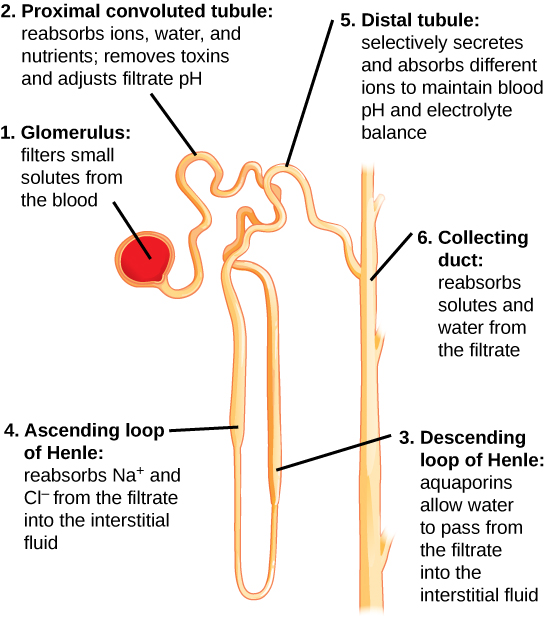
OpenStax, Rice University; Biology 2e. (credit: modification of work by NIDDK) · CC BY 4.0 · Source出典

Figure 41.7図 41.7
Each part of the nephron performs a different function in filtering waste and maintaining homeostatic balance. (1) The glomerulus forces small solutes out of the blood by pressure. (2) The proximal convoluted tubule reabsorbs ions, water, and nutrients from the filtrate into the interstitial fluid, and actively transports toxins and drugs from the interstitial fluid into the filtrate. The proximal convoluted tubule also adjusts blood pH by selectively secreting ammonia (NH3) into the filtrate, where it reacts with H+ to form NH4+. The more acidic the filtrate, the more ammonia is secreted. (3) The descending loop of Henle is lined with cells containing aquaporins that allow water to pass from the filtrate into the interstitial fluid. (4) In the thin part of the ascending loop of Henle, Na+ and Cl- ions diffuse into the interstitial fluid. In the thick part, these same ions are actively transported into the interstitial fluid. Because salt but not water is lost, the filtrate becomes more dilute as it travels up the limb. (5) In the distal convoluted tubule, K+ and H+ ions are selectively secreted into the filtrate, while Na+, Cl-, and HCO3- ions are reabsorbed to maintain pH and electrolyte balance in the blood. (6) The collecting duct reabsorbs solutes and water from the filtrate, forming dilute urine. (credit: modification of work by NIDDK)
ネフロンの各部は、老廃物の濾過と恒常性の維持において、それぞれ異なる役割を担う。(1)糸球体は、圧力によって小さな溶質を血液から押し出す。(2)近位曲尿細管は濾液から間質液へイオン、水、栄養素を再吸収し、間質液から濾液へ毒素や薬物を能動輸送する。また、アンモニア(NH3)を選択的に濾液へ分泌して血液のpHを調節する。アンモニアはそこでH+と反応してNH4+を生じる。濾液が酸性であるほど、分泌されるアンモニアは多くなる。(3)ヘンレ係蹄の下行脚の内面はアクアポリンを含む細胞で覆われ、水が濾液から間質液へ通過できる。(4)上行脚の細い部分では、Na+とCl-が間質液へ拡散する。太い部分では、同じイオンが間質液へ能動輸送される。水は失われずに塩類が失われるため、濾液は上行脚を進むほど薄くなる。(5)遠位曲尿細管では、K+とH+が選択的に濾液へ分泌される一方、Na+、Cl-、HCO3- が再吸収され、血液のpHと電解質のつり合いが維持される。(6)集合管は濾液から溶質と水を再吸収し、薄い尿を作る。(出典:NIDDKの作品を改変)