第14章DNAの構造と機能
14.6 DNA Repair14.6 DNA修復
Learning Objectives学習目標
By the end of this section, you will be able to do the following:
この節を学ぶと、次のことができるようになる。
- Discuss the different types of mutations in DNADNAのさまざまな種類の変異について論じる。
- Explain DNA repair mechanismsDNA修復の仕組みを説明する。
DNA replication is a highly accurate process, but mistakes can occasionally occur, such as a DNA polymerase inserting a wrong base. Uncorrected mistakes may sometimes lead to serious consequences, such as cancer. Repair mechanisms correct the mistakes. In rare cases, mistakes are not corrected, leading to mutations; in other cases, repair enzymes are themselves mutated or defective.
英語のヒント
DNA複製は非常に正確な過程だが、DNAポリメラーゼが誤った塩基を挿入するなど、時には誤りが起こる。修正されない誤りは、がんのような深刻な結果につながることもある。修復機構は、こうした誤りを修正する。まれには、誤りが修正されずに変異へつながることもある。また、修復酵素そのものに変異や欠陥がある場合もある。
Most of the mistakes during DNA replication are promptly corrected by the proofreading ability of DNA polymerase itself. (Figure 14.17). In proofreading, the DNA pol reads the newly added base before adding the next one, so a correction can be made. The polymerase checks whether the newly added base has paired correctly with the base in the template strand. If it is the right base, the next nucleotide is added. If an incorrect base has been added, the enzyme makes a cut at the phosphodiester bond and releases the wrong nucleotide. This is performed by the 3' exonuclease action of DNA pol. Once the incorrect nucleotide has been removed, it can be replaced by the correct one.
英語のヒント
DNA複製中の誤りのほとんどは、DNAポリメラーゼ自身の校正能力によって速やかに修正される(図14.17)。校正では、DNAポリメラーゼが次の塩基を付加する前に、新しく付加した塩基を読み取り、必要なら修正する。ポリメラーゼは、新しく付加した塩基が鋳型鎖の塩基と正しく対を作っているかを確かめる。正しい塩基なら、次のヌクレオチドを付加する。誤った塩基が付加されていれば、酵素がホスホジエステル結合を切り、誤ったヌクレオチドを取り除く。これは、DNAポリメラーゼの3′エキソヌクレアーゼ作用によって行われる。誤ったヌクレオチドを除去すれば、正しいものに置き換えられる。
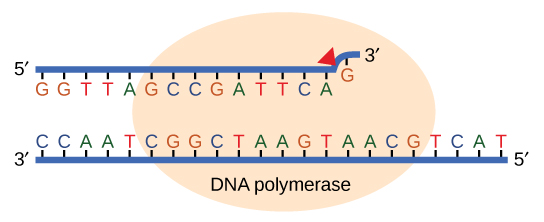
Figure 14.17図 14.17
Proofreading by DNA polymerase corrects errors during replication.
DNAポリメラーゼの校正は、複製中の誤りを修正する。
Some errors are not corrected during replication, but are instead corrected after replication is completed; this type of repair is known as mismatch repair (Figure 14.18). Specific repair enzymes recognize the mispaired nucleotide and excise part of the strand that contains it; the excised region is then resynthesized. If the mismatch remains uncorrected, it may lead to more permanent damage when the mismatched DNA is replicated. How do mismatch repair enzymes recognize which of the two bases is the incorrect one? In E. coli, after replication, the nitrogenous base adenine acquires a methyl group; the parental DNA strand will have methyl groups, whereas the newly synthesized strand lacks them. Thus, DNA polymerase is able to remove the wrongly incorporated bases from the newly synthesized, non-methylated strand. In eukaryotes, the mechanism is not very well understood, but it is believed to involve recognition of unsealed nicks in the new strand, as well as a short-term continuing association of some of the replication proteins with the new daughter strand after replication has completed.
英語のヒント
一部の誤りは複製中には修正されず、複製が完了してから修正される。この修復をミスマッチ修復という(図14.18)。特定の修復酵素が誤って対になったヌクレオチドを認識し、それを含む鎖の一部を切り出す。その後、切り出した領域が再合成される。ミスマッチが修正されずに残ると、そのDNAが複製されたときに、より恒久的な損傷につながることがある。ミスマッチ修復酵素は、2つの塩基のどちらが誤っていると見分けるのだろうか。大腸菌では、複製後に含窒素塩基のアデニンにメチル基が付く。親DNA鎖にはメチル基があるが、新しく合成された鎖にはまだない。このため、DNAポリメラーゼは、新しく合成されたメチル化されていない鎖から、誤って取り込まれた塩基を除去できる。真核生物では、その仕組みはまだよくわかっていない。ただし、新しい鎖に残る未結合の切れ目の認識に加え、複製完了後もしばらくの間、一部の複製タンパク質が新しい娘鎖と結合し続けることが関わると考えられている。
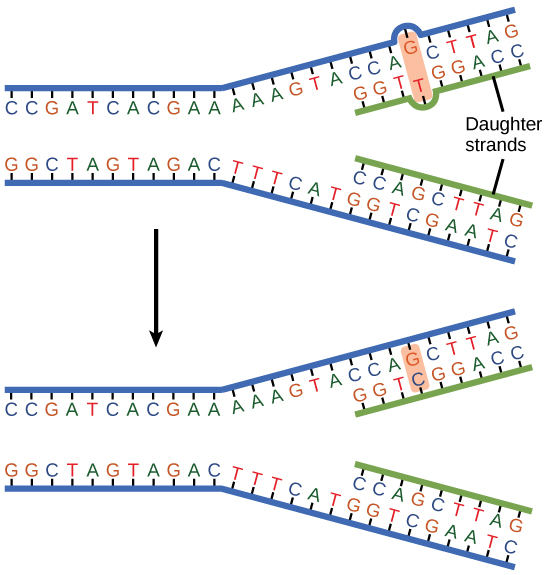
Figure 14.18図 14.18
In mismatch repair, the incorrectly added base is detected after replication. The mismatch repair proteins detect this base and remove it from the newly synthesized strand by nuclease action. The gap is now filled with the correctly paired base.
ミスマッチ修復では、複製後に、誤って付加された塩基が検出される。ミスマッチ修復タンパク質がこの塩基を検出し、ヌクレアーゼ作用によって新しく合成された鎖から除去する。その隙間は、正しく対を作る塩基で埋められる。
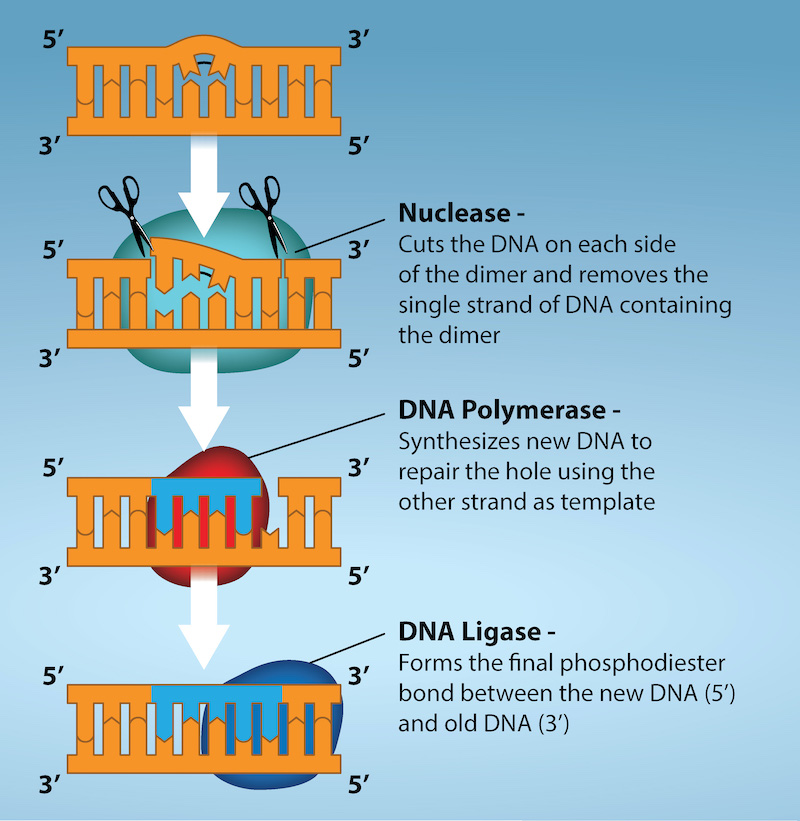
Another type of repair mechanism, nucleotide excision repair, is similar to mismatch repair, except that it is used to remove damaged bases rather than mismatched ones. The repair enzymes replace abnormal bases by making a cut on both the 3' and 5' ends of the damaged base (Figure 14.19). The segment of DNA is removed and replaced with the correctly paired nucleotides by the action of DNA pol. Once the bases are filled in, the remaining gap is sealed with a phosphodiester linkage catalyzed by DNA ligase. This repair mechanism is often employed when UV exposure causes the formation of pyrimidine dimers.
英語のヒント
別の修復機構であるヌクレオチド除去修復は、ミスマッチ修復と似ている。ただし、誤って対になった塩基ではなく、損傷した塩基を取り除く点が異なる。修復酵素は、損傷した塩基の3′側と5′側の両方に切れ目を入れて、異常な塩基を置き換える(図14.19)。DNAのその部分が除去され、DNAポリメラーゼの作用によって、正しく対を作るヌクレオチドに置き換えられる。塩基が補われると、残った隙間はDNAリガーゼが触媒するホスホジエステル結合によってつながれる。この修復機構は、紫外線への曝露によってピリミジン二量体ができたときによく用いられる。
OpenStax, Rice University; Biology 2e. Credit: Rao, A., Fletcher, S. and Tag, A. Department of Biology, Texas A&M University. · CC BY 4.0 · Source出典
Figure 14.19図 14.19
Nucleotide excision repairs thymine dimers. When exposed to UV light, thymines lying adjacent to each other can form thymine dimers. In normal cells, they are excised and replaced. Credit: Rao, A., Fletcher, S. and Tag, A. Department of Biology, Texas A&M University.
英語のヒント
ヌクレオチド除去修復はチミン二量体を修復する。紫外線にさらされると、隣り合うチミンどうしがチミン二量体を形成することがある。正常な細胞では、二量体が切り出され、置き換えられる。クレジット:Rao, A., Fletcher, S. and Tag, A.、テキサスA&M大学生物学科。
A well-studied example of mistakes not being corrected is seen in people suffering from xeroderma pigmentosa (Figure 14.20). Affected individuals have skin that is highly sensitive to UV rays from the sun. When individuals are exposed to UV light, pyrimidine dimers, especially those of thymine, are formed; people with xeroderma pigmentosa are not able to repair the damage. These are not repaired because of a defect in the nucleotide excision repair enzymes, whereas in normal individuals, the thymine dimers are excised and the defect is corrected. The thymine dimers distort the structure of the DNA double helix, and this may cause problems during DNA replication. People with xeroderma pigmentosa may have a higher risk of contracting skin cancer than those who don't have the condition.
英語のヒント
誤りが修正されない例としてよく研究されているのが、色素性乾皮症の患者である(図14.20)。この病気の人は、太陽からの紫外線に対して皮膚がきわめて敏感である。紫外線にさらされると、ピリミジン二量体、特にチミンの二量体が形成されるが、色素性乾皮症の人はその損傷を修復できない。修復できないのは、ヌクレオチド除去修復酵素に欠陥があるためである。正常な人ではチミン二量体が切り出され、異常が修正される。チミン二量体はDNA二重らせんの構造をゆがめ、DNA複製時に問題を引き起こすことがある。色素性乾皮症の人は、この病気のない人より、皮膚がんになる危険性が高いことがある。
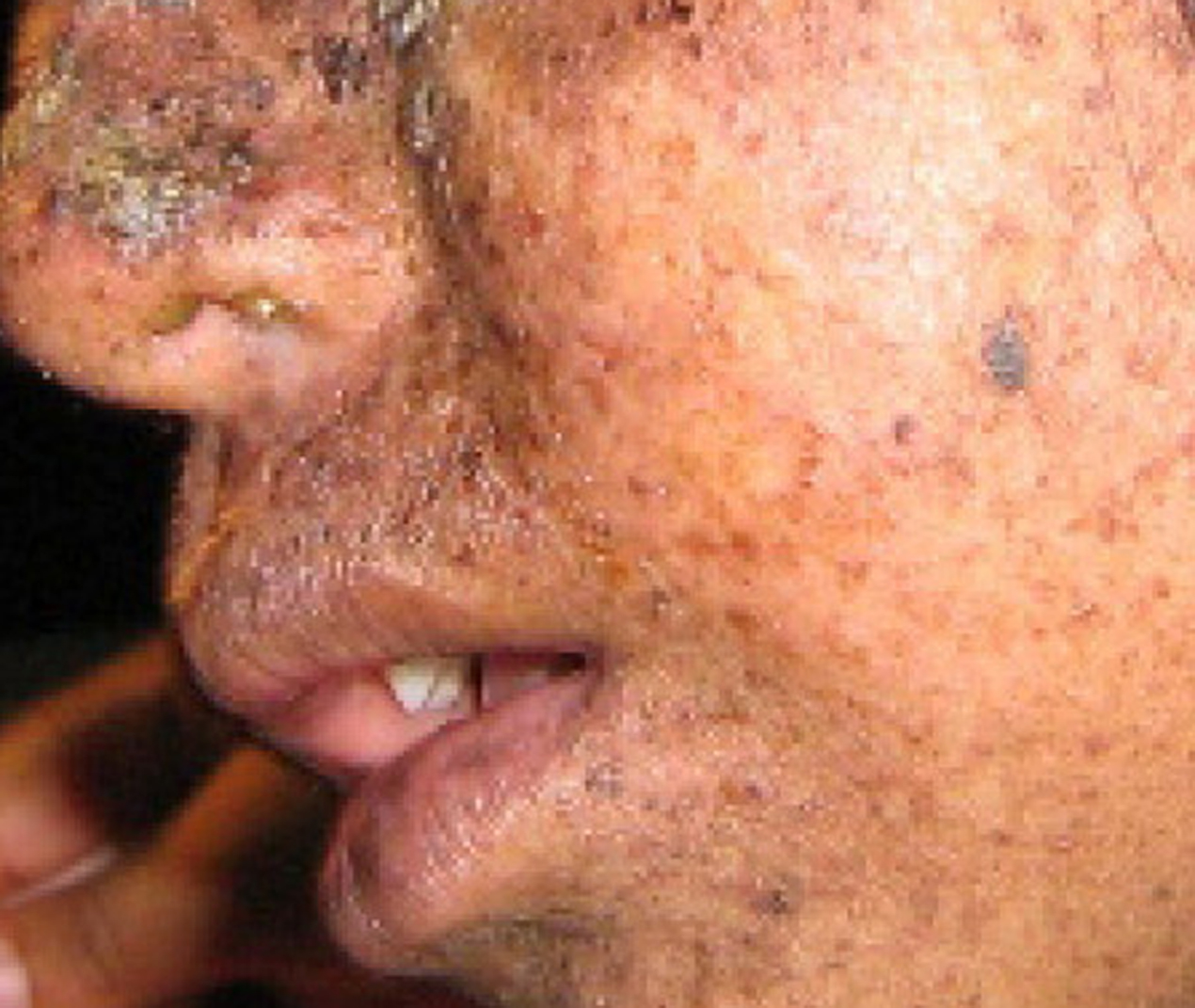


Figure 14.20図 14.20
Xeroderma pigmentosa is a condition in which thymine dimerization from exposure to UV light is not repaired. Exposure to sunlight results in skin lesions. (credit: James Halpern et al.)
英語のヒント
色素性乾皮症は、紫外線への曝露によるチミンの二量体形成が修復されない病気である。日光にさらされると、皮膚に病変が生じる。(クレジット:James Halpernら)
Errors during DNA replication are not the only reason why mutations arise in DNA. Mutations, variations in the nucleotide sequence of a genome, can also occur because of damage to DNA. Such mutations may be of two types: induced or spontaneous. Induced mutations are those that result from an exposure to chemicals, UV rays, x-rays, or some other environmental agent. For example, Charlotte Auerbach and J.M Robson discovered the mutation-inducing effects of mustard gas. Spontaneous mutations occur without any exposure to any environmental agent; they are a result of natural reactions taking place within the body.
英語のヒント
DNAに変異が生じる理由は、DNA複製中の誤りだけではない。変異、つまりゲノムのヌクレオチド配列の変化は、DNAの損傷によっても起こる。このような変異には、誘発変異と自然突然変異の2種類がある。誘発変異は、化学物質、紫外線、X線、その他の環境要因への曝露によって起こる。たとえば、シャーロット・アウアーバッハとJ・M・ロブソンは、マスタードガスに変異を誘発する作用があることを発見した。自然突然変異は、環境要因への曝露なしに起こる。体内で自然に起こる反応の結果である。
Mutations may have a wide range of effects. Point mutations are those mutations that affect a single base pair. The most common nucleotide mutations are substitutions, in which one base is replaced by another. These substitutions can be of two types, either transitions or transversions. Transition substitution refers to a purine or pyrimidine being replaced by a base of the same kind; for example, a purine such as adenine may be replaced by the purine guanine. Transversion substitution refers to a purine being replaced by a pyrimidine, or vice versa; for example, cytosine, a pyrimidine, is replaced by adenine, a purine. Some point mutations are not detectable in the final product; these are known as silent mutations. Silent mutations are usually due to a substitution in the third base of a codon, which often represents the same amino acid as the original codon. Other point mutations can result in the replacement of one amino acid by another, which may alter the function of the protein. Point mutations that generate a stop codon can terminate a protein early.
英語のヒント
変異は、さまざまな影響をもたらすことがある。1つの塩基対に影響する変異を点突然変異という。最も一般的なヌクレオチドの変異は置換であり、ある塩基が別の塩基に置き換わる。置換には、トランジションとトランスバージョンの2種類がある。トランジション置換とは、プリン塩基またはピリミジン塩基が、同じ種類の塩基に置き換わることである。たとえば、プリン塩基のアデニンが、同じプリン塩基のグアニンに置き換わる。トランスバージョン置換は、プリン塩基がピリミジン塩基に、またはその逆に置き換わることである。たとえば、ピリミジン塩基のシトシンが、プリン塩基のアデニンに置き換わる。点突然変異の中には、最終産物では検出できないものがあり、これをサイレント変異という。サイレント変異は通常、コドンの3番目の塩基の置換による。この置換後のコドンは、元のコドンと同じアミノ酸を指定することが多い。別の点突然変異では、あるアミノ酸が別のアミノ酸に置き換わり、タンパク質の機能が変わることがある。終止コドンを生じる点突然変異は、タンパク質の合成を途中で終わらせることがある。
Some mutations can result in an increased number of copies of the same codon. These are called trinucleotide repeat expansions and result in repeated regions of the same amino acid. Mutations can also be the result of the addition of a base, known as an insertion, or the removal of a base, also known as deletion. If an insertion or deletion results in the alteration of the translational reading frame (a frameshift mutation), the resultant protein is usually nonfunctional. Sometimes a piece of DNA from one chromosome may get translocated to another chromosome or to another region of the same chromosome; this is also known as translocation. These mutation types are shown in Figure 14.21.
英語のヒント
変異によって、同じコドンのコピー数が増えることがある。これをトリヌクレオチドリピート伸長といい、同じアミノ酸が繰り返される領域を生じる。変異は、挿入と呼ばれる塩基の付加や、欠失と呼ばれる塩基の除去によっても起こる。挿入や欠失によって、翻訳の読み枠が変わると(フレームシフト変異)、できるタンパク質は通常、機能をもたない。ある染色体のDNA断片が、別の染色体や同じ染色体の別の領域へ移ることもあり、これを転座という。これらの変異の種類を図14.21に示す。
Mutations in repair genes have been known to cause cancer. Many mutated repair genes have been implicated in certain forms of pancreatic cancer, colon cancer, and colorectal cancer. Mutations can affect either somatic cells or germ cells. If many mutations accumulate in a somatic cell, they may lead to problems such as the uncontrolled cell division observed in cancer. If a mutation takes place in germ cells, the mutation will be passed on to the next generation, as in the case of hemophilia and xeroderma pigmentosa.
英語のヒント
修復遺伝子の変異は、がんを引き起こすことが知られている。変異した多くの修復遺伝子が、特定の型の膵臓がん、結腸がん、結腸直腸がんに関わっている。変異は、体細胞にも生殖細胞にも影響することがある。体細胞に多くの変異が蓄積すると、がんで見られるような、制御されない細胞分裂などの問題につながることがある。生殖細胞に変異が起こると、血友病や色素性乾皮症の場合のように、その変異は次世代へ受け継がれる。